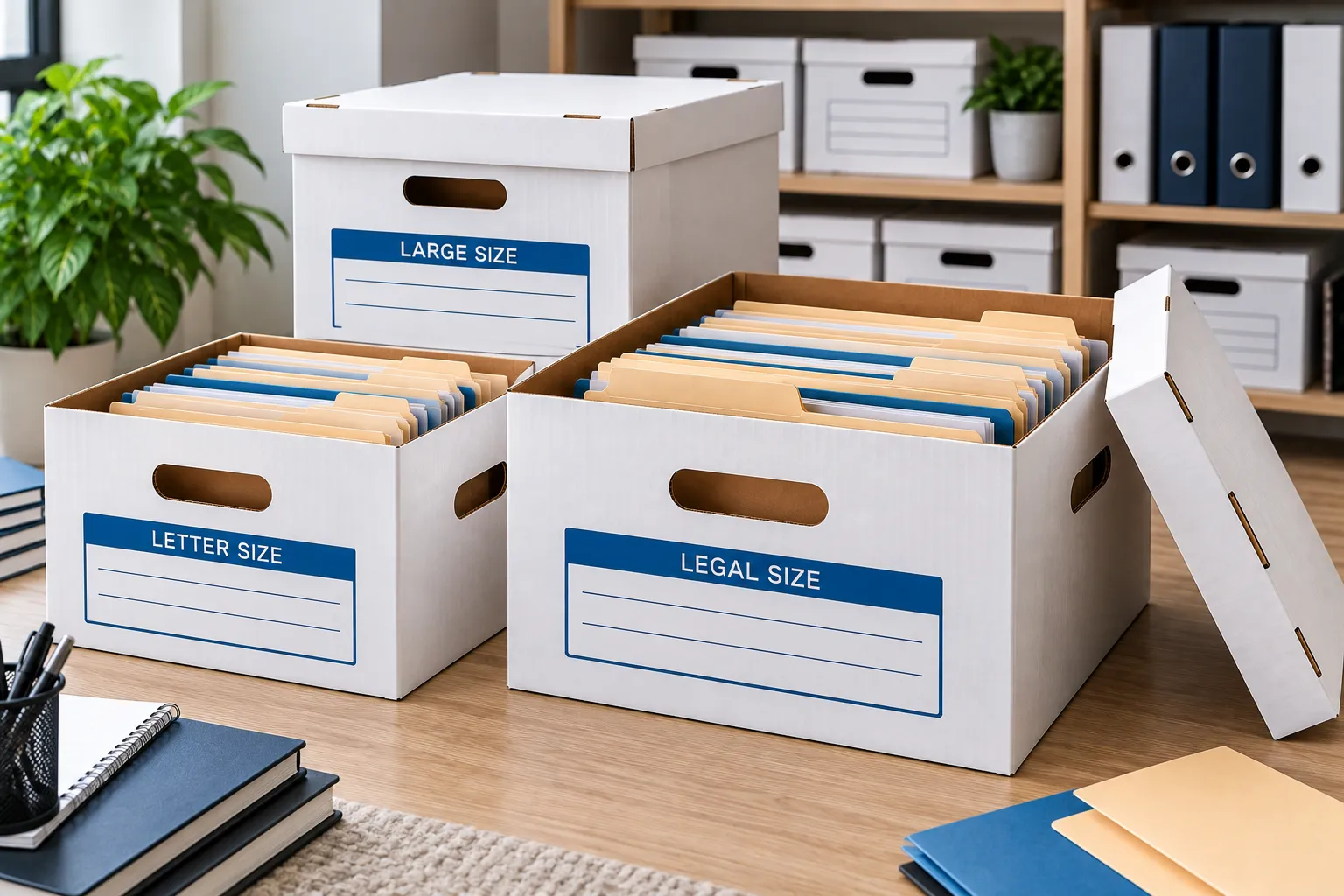
A common banker box measures about 15 × 12 × 10 inches, but that number should be treated as a reference, not a rule. Banker boxes come in different sizes depending on the files they are meant to hold and the amount of storage space available.
The important part is not simply finding a box called “standard.” You need enough room for the actual folders, including tabs or hanging rails, while the outside of the box still needs to fit your shelf, cabinet, or archive area.
Below, you’ll find the common banker box dimensions in inches, how letter and legal files affect the size you need, and what to measure before choosing a box.
What Are Standard Banker Box Dimensions?
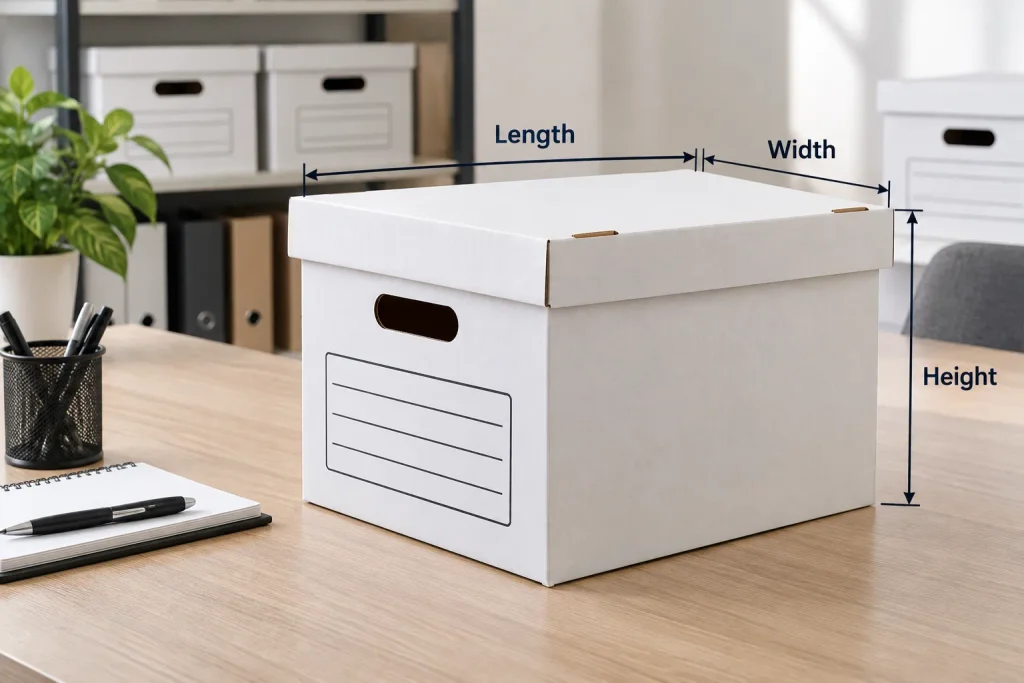
For general office filing, 15 × 12 × 10 inches (L × W × H) is one of the common banker box sizes you’ll see.
That gives you a useful starting point if you’re estimating shelf space or replacing an existing file box. It doesn’t mean every banker box will have those exact measurements.
Some are made smaller for lighter records. Others have extra length for legal folders or more capacity for archived documents. Construction can change the dimensions too, even when two boxes are intended for the same type of files.
If an exact fit matters, use the manufacturer’s listed measurements rather than assuming every “standard” box is 15 × 12 × 10 inches.
Common Banker Box Sizes in Inches
The table below gives a practical comparison of banker box sizes. Actual measurements can vary by manufacturer.
The name of the box is less useful than its actual measurements. A box described as an archive box, for example, may be close in size to a regular file box but made for a different load or filing arrangement.
For that reason, compare the dimensions and intended file orientation before buying.
Understanding Length, Width, and Height
Banker box dimensions are generally written as:
Length × Width × Height (L × W × H)
For a 15 × 12 × 10-inch box:
- 15 inches is the length
- 12 inches is the width
- 10 inches is the height
Length normally refers to the longer horizontal side. Width runs across the shorter side, while height is measured from the base upward.
This becomes important when comparing boxes online because the same three numbers may occasionally be presented in a different order. Check whether the supplier identifies each measurement as L, W, or H instead of relying only on the sequence.
File orientation matters as well. A 14-inch folder may fit along a 15-inch length but obviously won’t fit the same way along a 12-inch width.
Internal vs. External Banker Box Dimensions
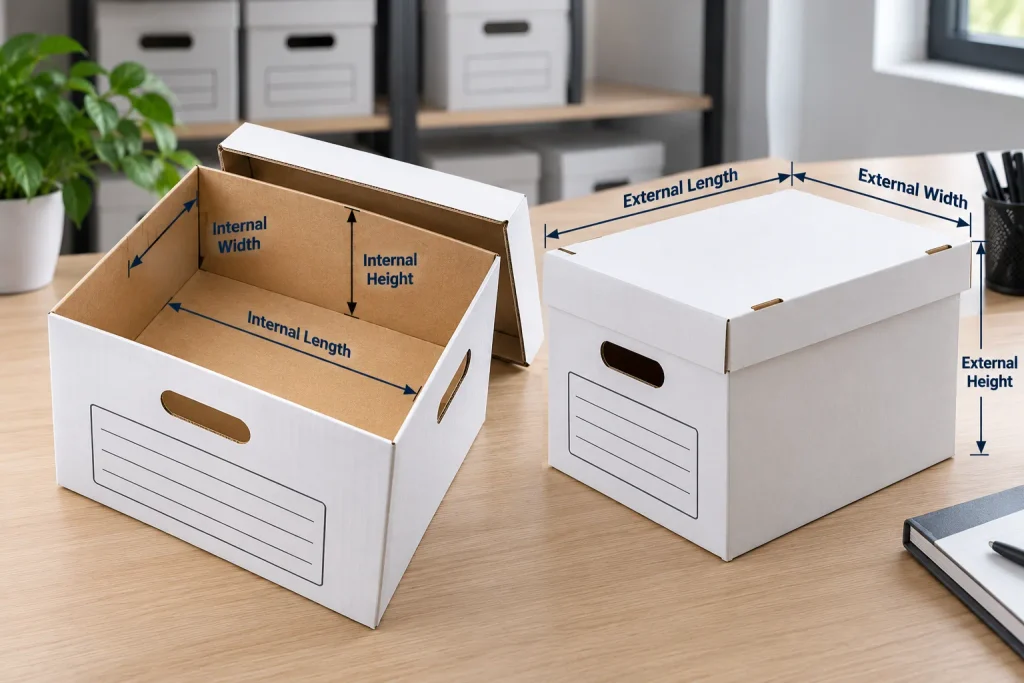
This distinction can make the difference between a box that works and one that is just slightly too small.
Internal dimensions are the usable measurements inside the box.
External dimensions measure the assembled box from the outside.
Imagine that you need to store a folder close to 15 inches long. A box listed as 15 inches long externally does not necessarily provide 15 inches of clear space inside. The corrugated board and folded panels take up some of that room.
Now look at the same box from a storage point of view. If your shelf is 16 inches deep, you need the external measurement to determine whether the whole box will sit properly on it.
So the measurement you use depends on the job:
Checking whether files fit? Use internal dimensions.
Checking whether the box fits a shelf? Use external dimensions.
Also check the lid. A lift-off lid can extend a little beyond the walls of the carton, which may matter when several boxes are placed tightly together.
Banker Box Sizes for Letter and Legal Files
Most people searching for a banker size box are trying to store paperwork, so the dimensions of the files themselves are a useful place to start.
Two paper sizes are especially common in US offices:
The paper measurement alone isn’t enough, though. Files usually sit inside folders that are larger than the sheets they contain.
Letter-Size Files
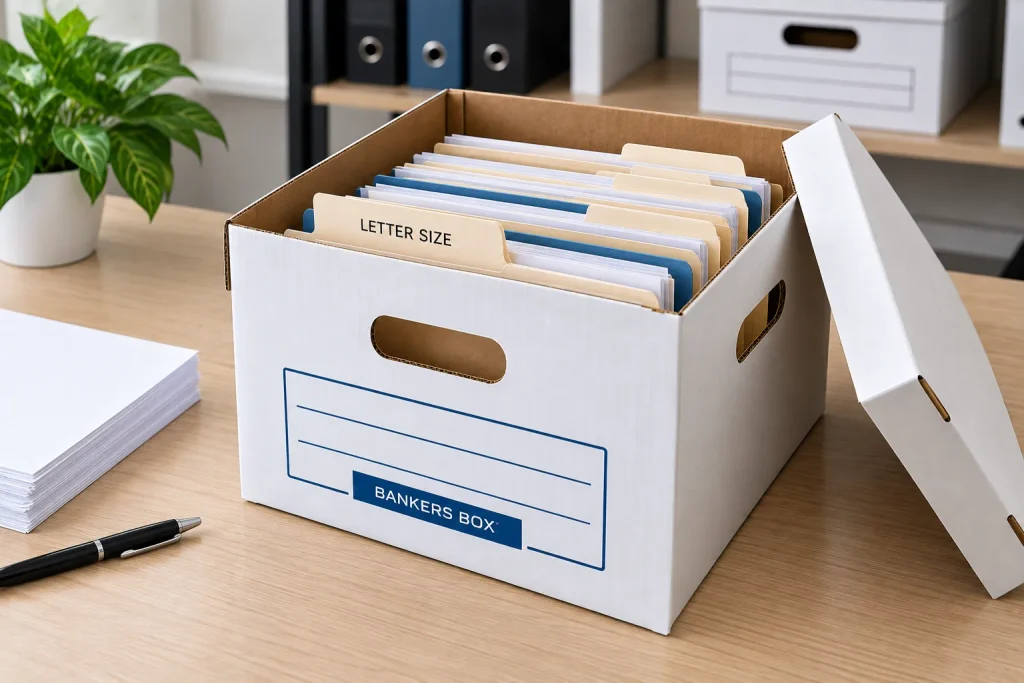
US letter paper measures 8.5 × 11 inches.
It’s widely used for invoices, reports, contracts, employee records, customer paperwork, and other everyday business documents.
A standard banker box will generally give letter folders more room than the paper dimensions suggest. That’s useful because folder edges and tabs need clearance, and files shouldn’t be jammed tightly against the box walls.
Hanging folders require another check. Their rails can make them noticeably wider than the documents inside.
Measure the complete folder if that’s what will actually go into the box.
Legal-Size Files
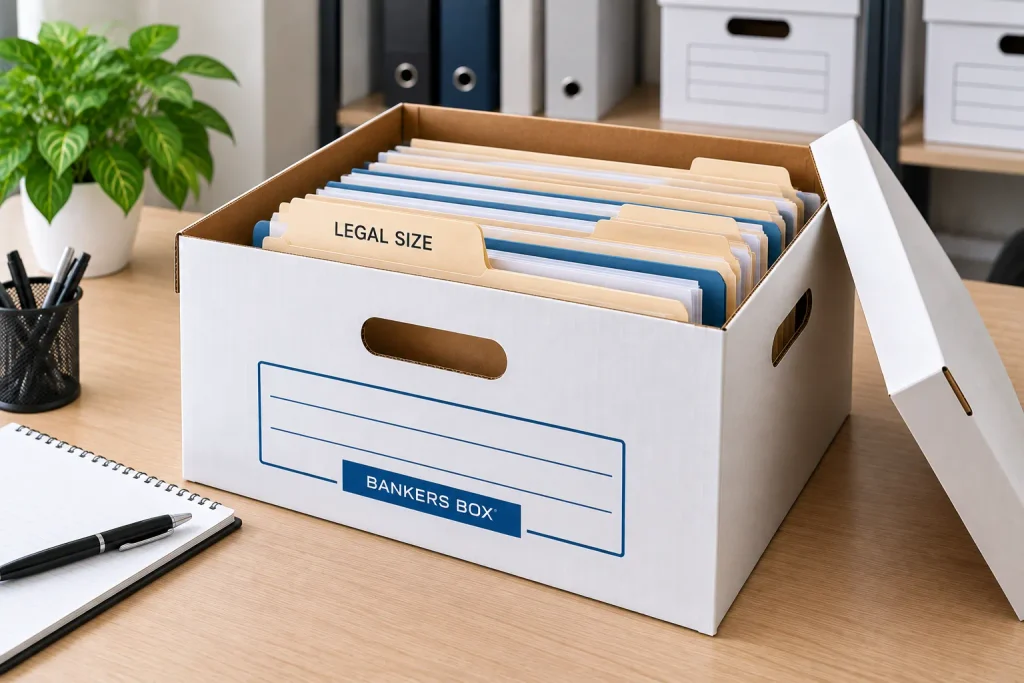
US legal paper is 8.5 × 14 inches, giving you three extra inches of length compared with letter paper.
That’s enough to change the box you need.
If a legal folder is going to sit lengthwise, make sure the internal length leaves room for the complete folder. A nominal 15-inch exterior length may be too close once the thickness of the box walls is taken into account.
Some file boxes accommodate legal folders by changing their orientation. Others are built with additional length specifically for them.
Don’t rely on the word “legal” alone. Check the usable dimensions.
How Much Can a Banker Box Hold?
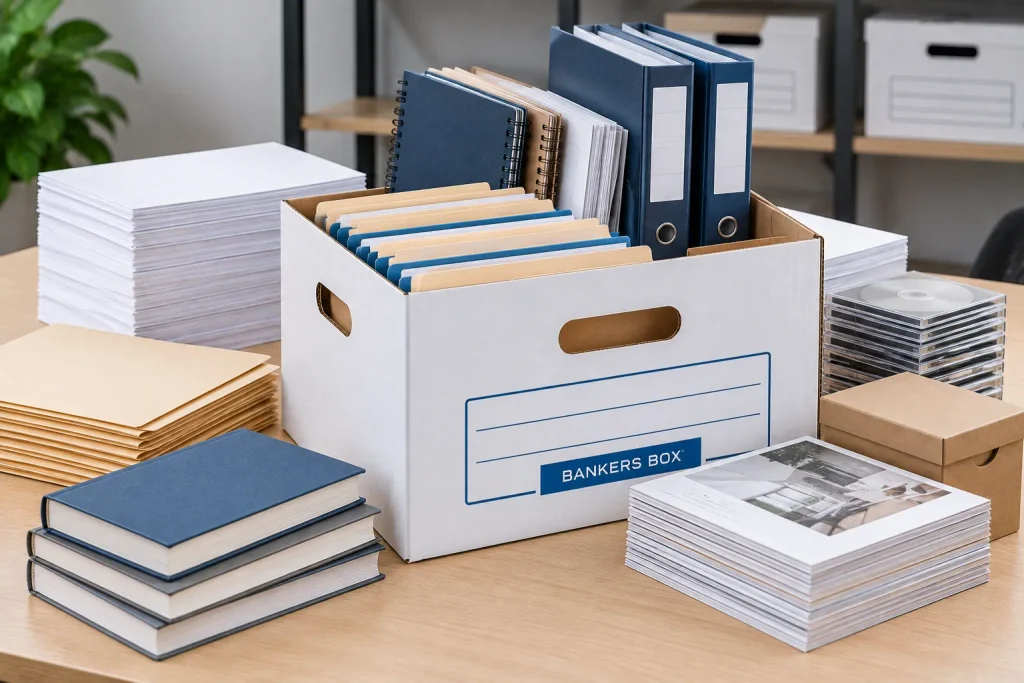
There isn’t a dependable answer such as “one banker box holds X files” because folders vary too much.
Twenty thick case files can occupy more space than a much larger number of thin folders. Hanging folders, dividers, document wallets, and file tabs change capacity again.
A better way to estimate capacity is to line up the records as they will be stored and measure the total run.
For example, if your folders occupy about 13 inches when placed together, look for an internal dimension that gives them a little extra room. Filling every last fraction of an inch makes individual files difficult to remove.
You don’t want excessive empty space either. Files can fall over, and you’re using more storage room than necessary.
Weight is another practical limit. Paper becomes heavy quickly, so a larger box isn’t automatically more convenient. If the carton will be moved regularly, keeping the loaded weight manageable can be more useful than maximizing file capacity.
Banker Box Sizes for Shelves and Storage
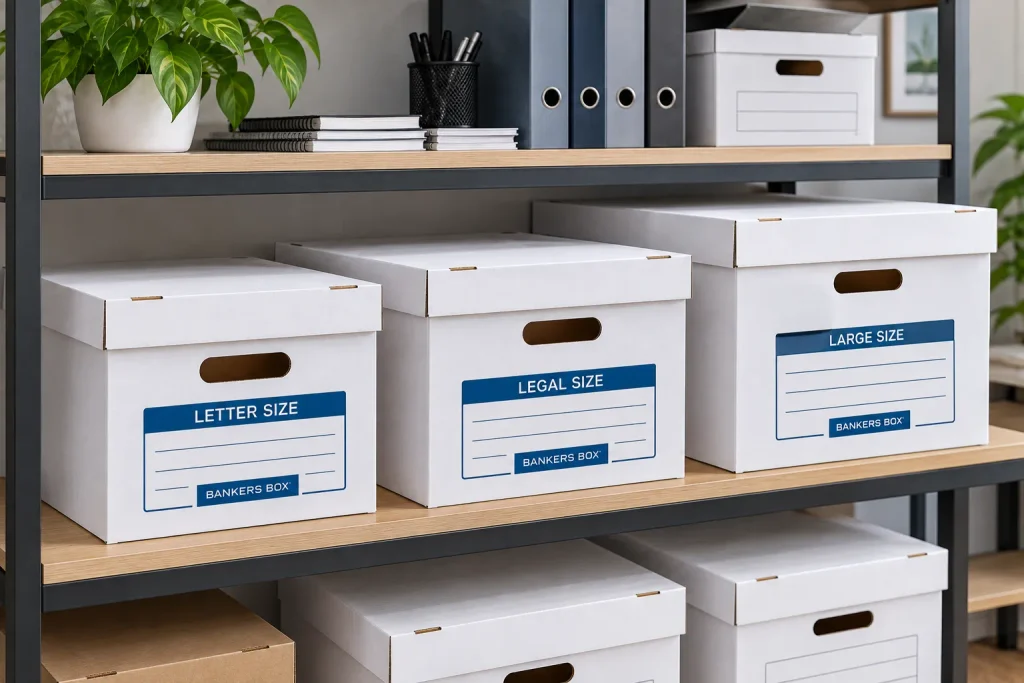
Once you’ve found a size that holds the files, check where the box will live.
For shelving, measure:
Width × Depth × Clear Height
Each measurement answers a different question.
Shelf width determines how many boxes can sit side by side.
Shelf depth tells you whether the entire box can sit on the shelf without projecting too far beyond the front.
Clear height is the actual open space between shelves.
Clear height deserves particular attention. A 10-inch-high box placed into an opening that’s almost exactly 10 inches high may technically fit, but it won’t be pleasant to use. You need enough room to slide the carton out, grip it, and deal with the lid.
If you’re planning an archive with many boxes, small differences become more noticeable.
Suppose every box is an inch wider than necessary. That doesn’t sound important when you’re storing three cartons. Across several rows and hundreds of files, it can mean losing useful shelf capacity.
Stacking also needs some thought. A stack of document-filled boxes puts considerable weight on the cartons at the bottom. Follow the box manufacturer’s stated stacking and load guidance rather than assuming any box can support a tall stack simply because its dimensions match.
How to Measure a Banker Box Correctly
If you already have a box that works well, use it as your reference.
Assemble the box fully and place it on a flat surface.
Measure the length along the longer horizontal side. Measure the width across the other side. Then measure the height from the bottom to the top.
Write the result as:
L × W × H
For example:
15 × 12 × 10 inches
Those are the outside measurements if you’ve measured from outer edge to outer edge.
To find the usable space, open the box and measure between the inside walls. Measure the interior height from the inside bottom to the point where the contents need to stop for the lid to close properly.
If your current box uses a separate lid, measure its outside footprint too. It may be slightly larger than the body of the carton.
How to Choose the Right Banker Box Size
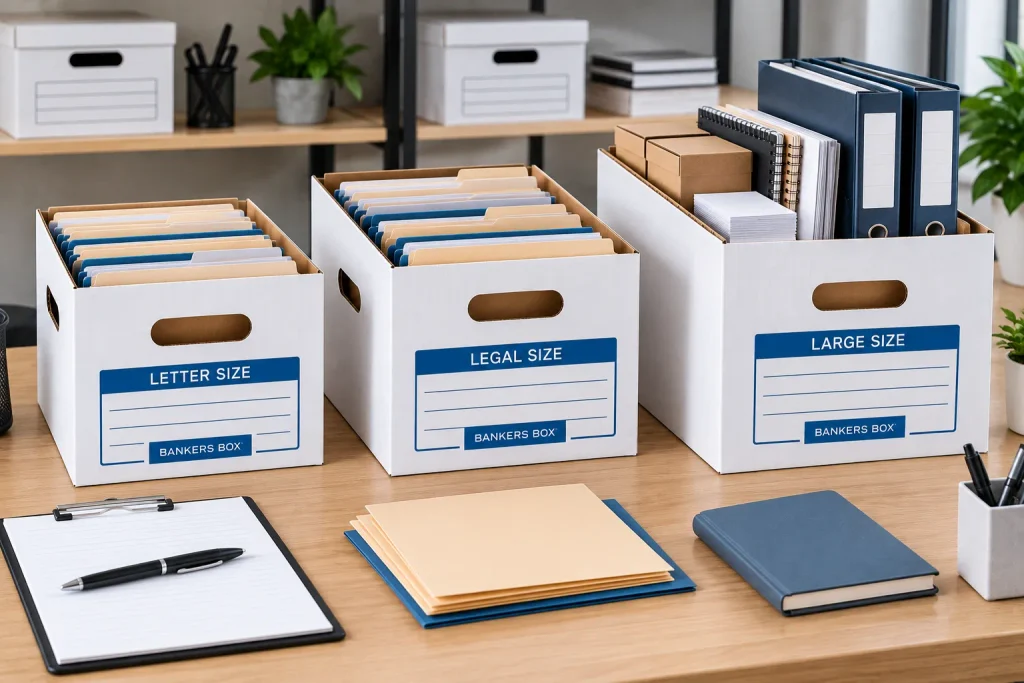
You can narrow down the right size with a few measurements rather than guessing from product names.
Start with the files in the form they’ll actually be stored. If they’ll be in folders, measure the folders. If they’ll use hanging rails, include those. For binders, measure the binders rather than the sheets inside.
Next, decide how the contents will face inside the box. This tells you which interior dimension needs to accommodate the longest part of the file.
Then compare that measurement with the box’s internal dimensions.
Leave enough clearance to get files in and out without forcing them. You don’t need several inches of empty space, but an exact edge-to-edge fit is rarely convenient for active records.
After that, check the external dimensions against the shelf or storage area.
Finally, think about the loaded box. If it will contain dense records and be carried regularly, size and capacity need to remain practical for handling.
This gives you a much better fit than simply searching for the largest box available.
When Do You Need a Custom-Size File Box?
A standard banker box works well when your records and shelves already suit common sizes. There are cases where forcing everything into a standard footprint creates wasted space or a poor fit.
Custom dimensions may be worth considering for:
- oversized documents;
- thick binders or catalogs;
- unusually sized folders;
- divided record sets;
- fixed archive shelving;
- business records requiring a particular filing arrangement.
For example, if an archive shelf is noticeably shallower than a common banker box, repeatedly buying boxes that overhang the shelf isn’t ideal. A carton designed around both the files and available depth can use the space more efficiently.
The same applies to files that are slightly too long for an off-the-shelf box. Rather than moving up to an unnecessarily large carton, the dimensions can be adjusted around the actual contents.
Hello Custom Boxes offers corrugated packaging for different storage requirements, including applications where box size and structure need to be matched more closely to the contents.
Businesses that need specific dimensions can also use custom corrugated boxes rather than being limited to a standard banker box size.