Sugar packaging has to do more than make a product shelf-ready. The package needs to suit the form of sugar being sold, hold the intended weight, deal with normal storage conditions, and remain practical through retail handling or shipping.
Those requirements can change considerably from one product to another. Granulated sugar behaves differently from cubes, while individual sachets bring their own packing and dispensing considerations. The role of the box matters too. If sugar is already sealed inside suitable primary packaging, the outer carton has a different job from packaging intended for direct food contact.
For U.S. food brands, choosing sugar packaging is therefore less about finding one “best” material and more about matching the structure to the product, sales channel, and handling conditions. This guide explains what to consider before deciding on materials, dimensions, printing, and secondary packaging.
Quick Answer: The right packaging for sugar depends on the product format, packed weight, moisture requirements, food-contact arrangement, and how the product will be sold or distributed. Paperboard, kraft board, and corrugated materials can serve different outer-packaging roles, while any component that directly contacts the sugar needs to be suitable for its intended food-contact use.
TL;DR
- Granulated sugar, cubes, and sachets have different packaging needs.
- Moisture exposure matters because sugar can absorb moisture and form clumps.
- Determine which component actually touches the food before selecting the outer box.
- Match board strength to product weight and distribution conditions.
- Size cartons around the product in its final packed form.
- Use inserts only when they improve organization or protection.
- Keep branding clear before spending on decorative finishes.
- Test the complete pack with the real product before a larger production run.
Match Sugar Packaging to the Product Format
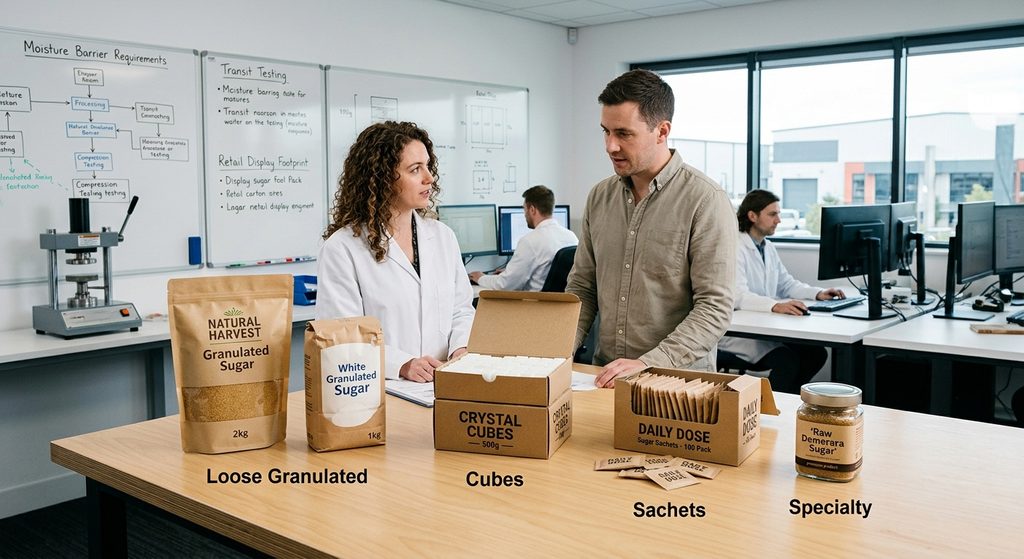
The physical form of the sugar should influence the package from the beginning. Loose granulated sugar needs dependable containment, cubes need to remain organized, and sachets are already individually portioned.
Weight changes the decision as well. A small box containing individually packed sugar portions does not place the same load on a carton as a heavier retail pack.
Before comparing box styles, establish:
- whether the product is granulated sugar, cubes, sachets, or a specialty format;
- the net weight;
- how the sugar is contained before it enters the outer carton;
- whether any part of the proposed package will touch the food;
- expected storage conditions;
- whether moisture resistance is needed;
- how the product will be displayed or dispensed;
- whether it will travel through parcel shipping;
- whether movement inside the pack needs to be controlled.
Once those points are known, it becomes much easier to rule out structures that are unnecessarily large, weak, or complicated.
Separate Food-Contact Packaging From the Outer Sugar Box
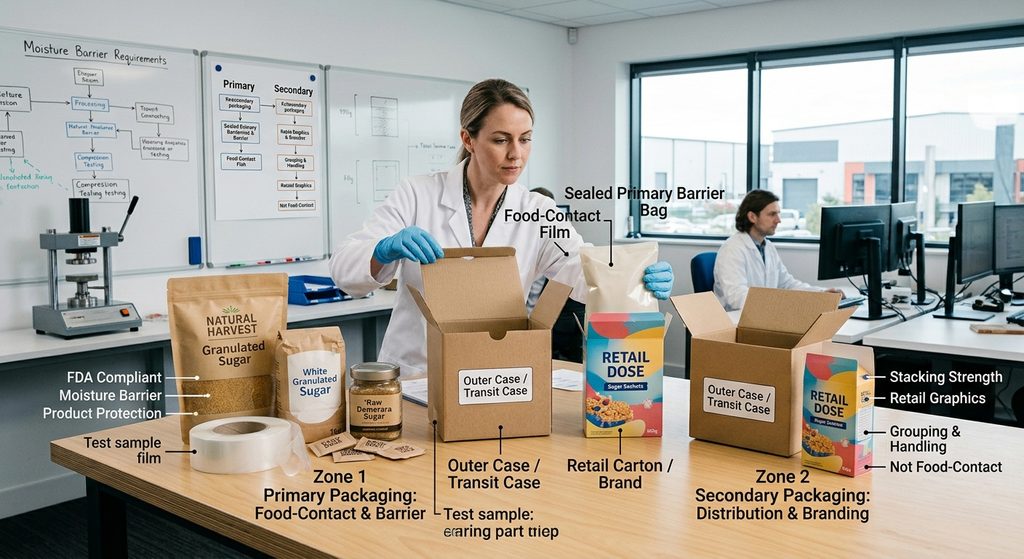
Not every part of a sugar package performs the same job.
If the sugar is sealed inside suitable primary packaging, a paperboard carton around it may mainly provide grouping, physical support, stacking, shelf presentation, and space for printed information.
Direct-contact packaging requires a different assessment. Materials and relevant components intended to touch food need to be suitable for the conditions in which they will be used.
For U.S. brands, it is useful to think of the packaging system in two parts:
Primary packaging contains or directly contacts the food.
Secondary packaging groups, protects, presents, or helps distribute the already packed product.
This distinction is particularly useful when developing sugar box packaging. It prevents the outer carton from being expected to provide barrier or food-contact performance that actually belongs elsewhere in the packaging system.
Sugar Packaging Needs a Plan for Moisture
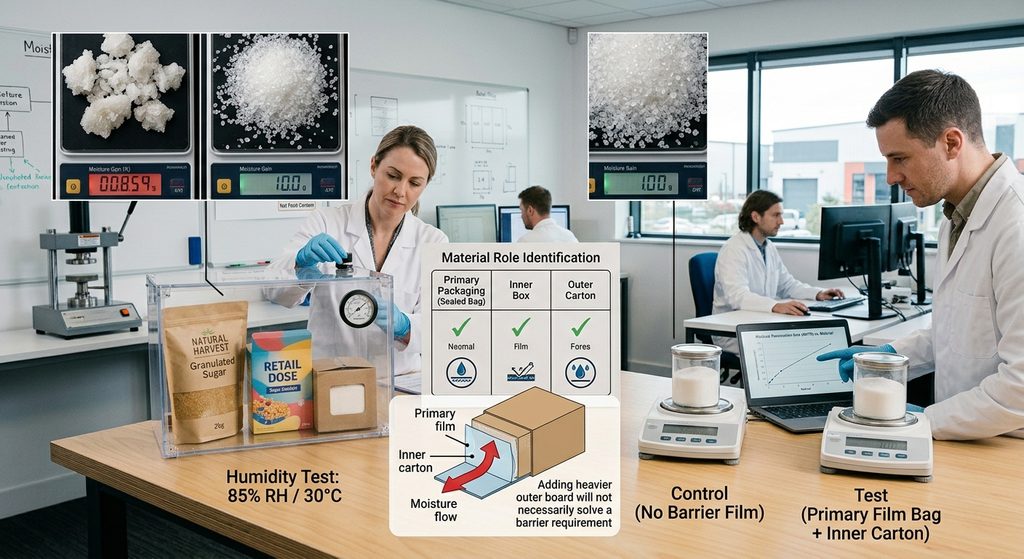
Moisture can affect sugar even when the product itself is shelf-stable. Exposure to humid conditions can cause crystals to stick together and eventually form clumps.
The level of protection needed will depend on how the product is packed and stored. A printed paperboard carton, for example, should not automatically be expected to act as the complete moisture barrier for loose sugar.
Pay closer attention to moisture when:
- storage periods are relatively long;
- the product may encounter humid conditions;
- the package will be opened repeatedly;
- the outer carton surrounds a separate inner pack;
- product quality depends on keeping the sugar free-flowing.
This is why sugar packaging materials should be selected according to their actual role. Adding a heavier outer board will not necessarily solve a barrier requirement that belongs to the primary package.
Choose the Board Around Weight, Handling, and Presentation
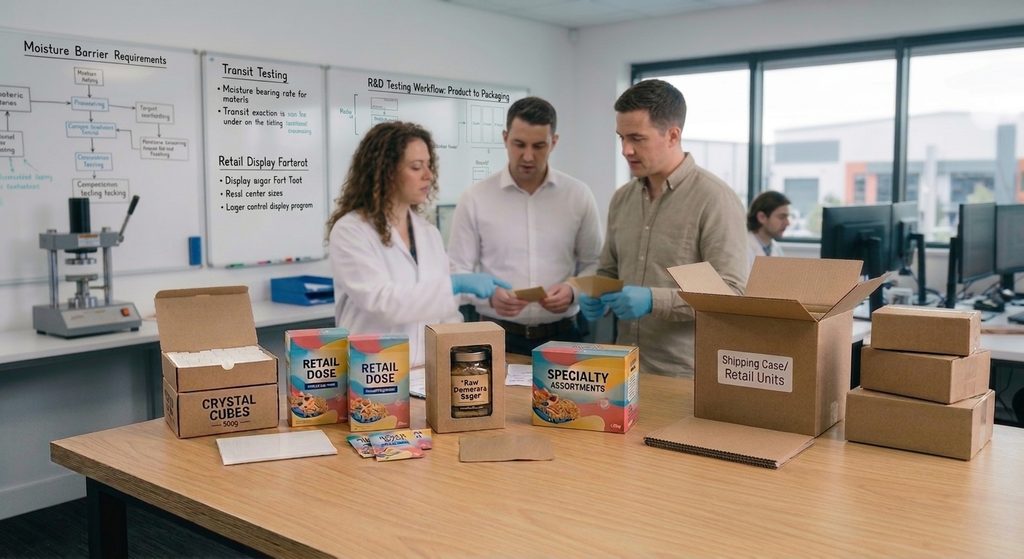
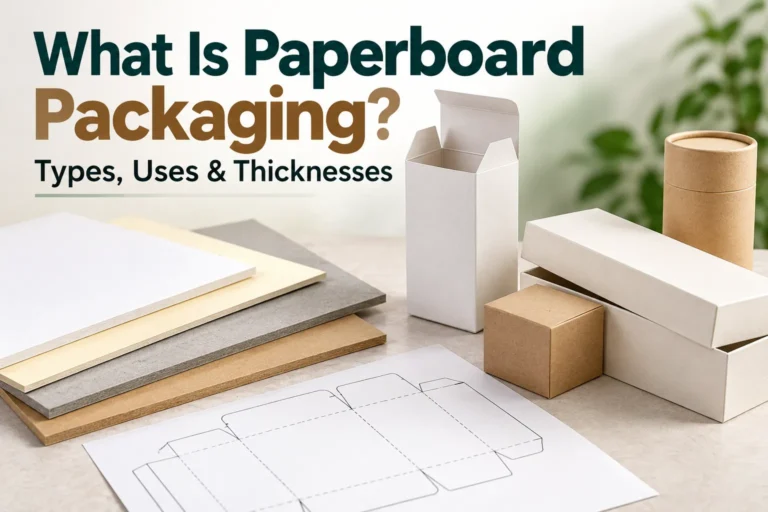
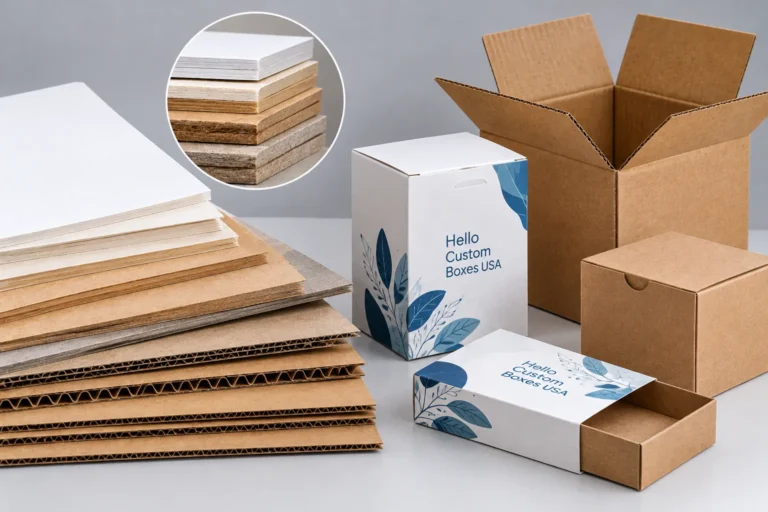
Paper-based materials can perform different jobs within a sugar packaging system. The best choice depends on how much structural support the outer package needs.
Paperboard Works Well for Many Retail Cartons
Paperboard can provide a compact structure and a smooth surface for printing. It is particularly useful when the contents are relatively lightweight and already appropriately contained.
Potential applications include outer cartons for:
- sugar cubes;
- grouped sachets;
- individually wrapped portions;
- specialty sugar products;
- gift or retail assortments.
Its relatively clean print surface also gives brands plenty of flexibility without requiring a complicated box structure.
Kraft Board Gives the Pack a Natural Paper Look
Kraft board is often chosen when a brand wants a more natural, understated appearance.
That makes it useful for certain artisan, specialty, or minimally designed products. Simple printing can work particularly well against the kraft surface.
Appearance and technical performance should still be treated separately. Choosing kraft packaging does not remove the need to consider packed weight, structure, storage, and the role of the inner package.
Corrugated Board Makes More Sense as Loads Increase
Heavier products and distribution packs can place more stress on the package than a lightweight retail carton is designed to handle.
Corrugated board can provide additional structural support for:
- heavier sugar packs;
- grouped retail units;
- shipping cases;
- e-commerce orders;
- bulk distribution.
It does not need to replace the retail carton. In many cases, the retail pack and shipping carton should simply perform separate jobs.
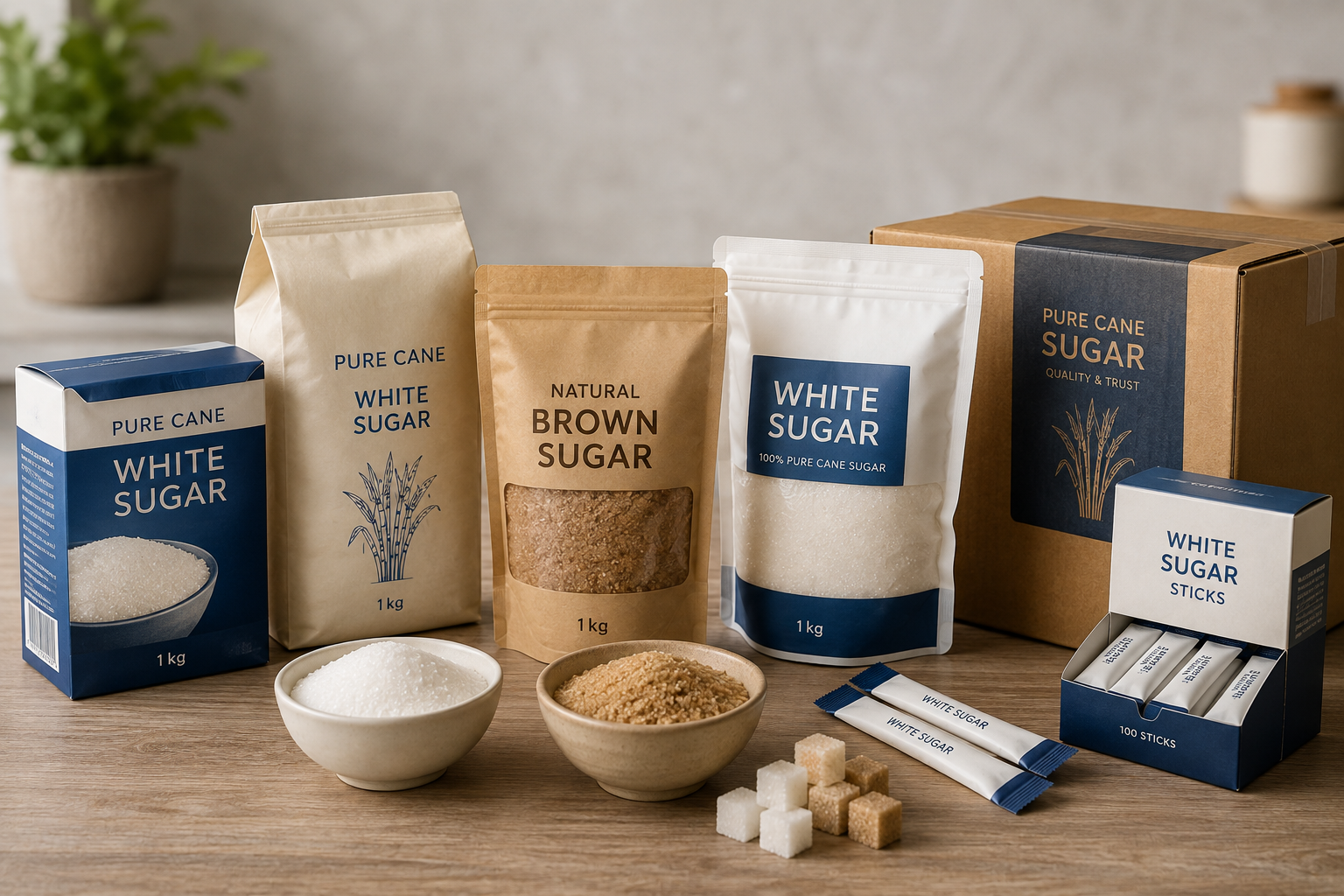
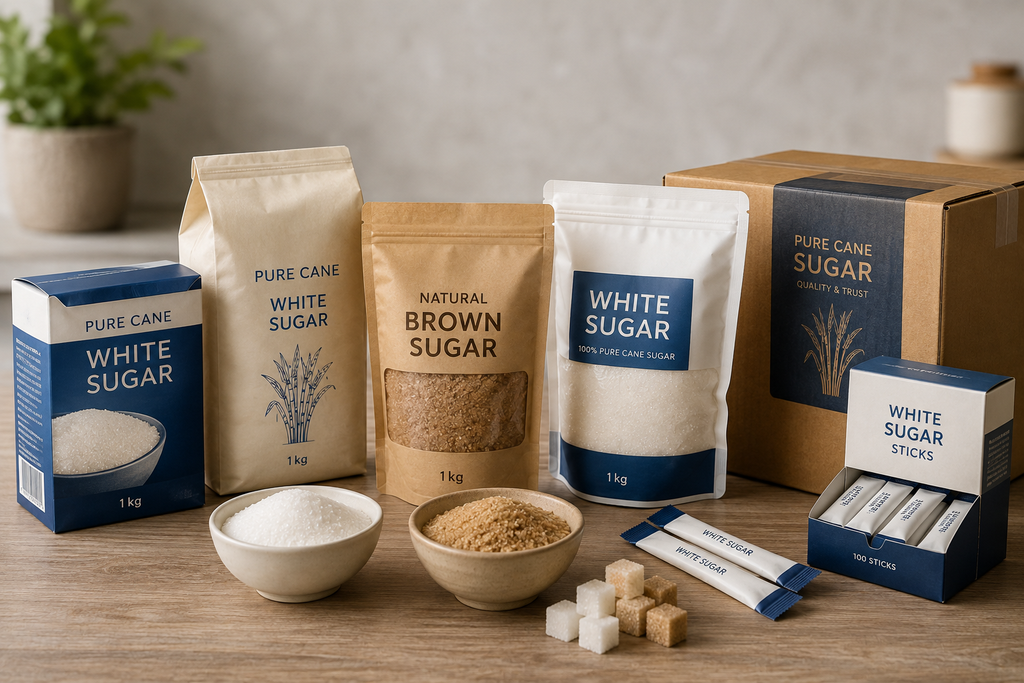
Granulated Sugar, Cubes, and Sachets Need Different Packs
Treating every sugar product as though it needs the same carton can lead to wasted space or unnecessary components.
Granulated Sugar Needs Secure Containment
For granulated products, begin with how the sugar itself is contained. If a suitable inner pack handles direct contact and moisture protection, the outer carton can be designed around its dimensions and weight.
A heavier filled pack also puts more pressure on the base and closures. That can influence both board choice and carton construction.
The important point is to design around the filled product, not just the amount of sugar written on the label.
Sugar Cubes Need Controlled Movement
Packaging for sugar cubes often needs to keep multiple pieces together without leaving excessive room for movement.
Depending on the product, that could mean a close-fitting outer carton, an inner tray, or an already grouped primary pack.
An insert is not automatically necessary. If the cubes are secure inside their primary package, another layer may add material without improving the result.
Sugar Sachets Need Grouping and Easy Access
With sugar sachet packaging, the individual portions are already contained. The outer package may therefore focus more on grouping, dispensing, presentation, and storage.
Hospitality and food-service applications may prioritize quick access. Retail packs can place more emphasis on presentation and shelf organization.
The structure should reflect how the sachets will actually be removed and used.
Size Sugar Boxes Around the Finished Pack
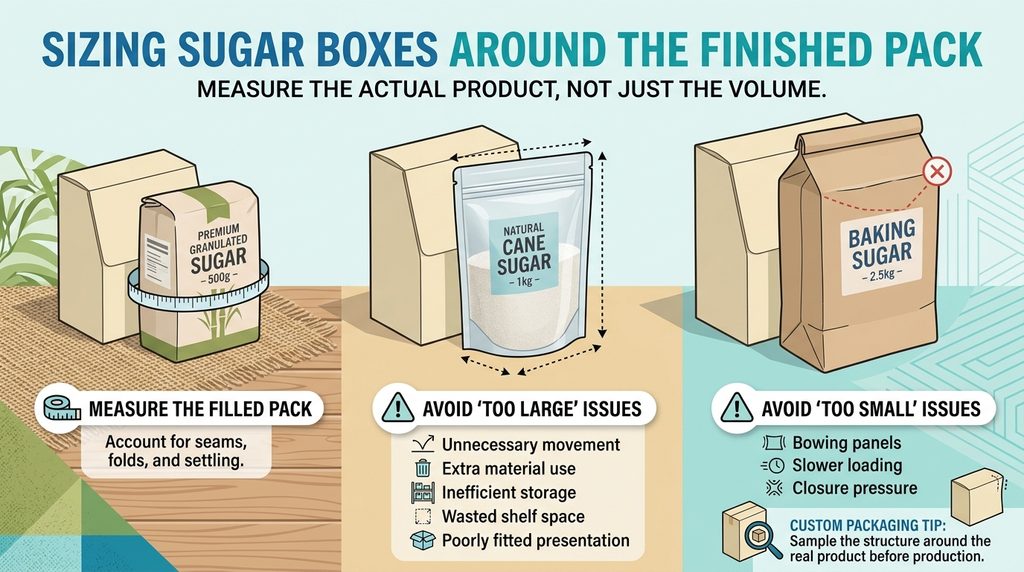
Carton dimensions should come from the product in the condition in which it will actually be packed.
For granulated sugar inside an inner package, measure that filled package rather than estimating from sugar volume. Seams, folds, and the way the contents settle can change its final shape.
A box that is too large can create:
- unnecessary movement;
- extra material use;
- inefficient storage;
- wasted shelf space;
- a poorly fitted presentation.
Going too small creates different problems. Panels may bow, loading can become slower, and closures may sit under unwanted pressure.
With custom sugar packaging, sampling the structure around the real product is one of the simplest ways to identify these problems before production.
Retail Sugar Packaging Should Work From Shelf to Home
Good retail sugar packaging has to remain practical after it reaches the store. Shelf appearance is important, but so are stacking, handling, opening, and the space the pack occupies.
Consider how the carton performs in five areas.
Shelf presence: Customers should be able to identify the brand, product type, variety, and net quantity without searching around the pack.
Stacking: The structure should remain presentable under the expected load.
Opening: Access to the product should feel straightforward.
Continued use: If consumers will keep using the carton after opening, the closure should suit that behavior.
Footprint: A compact, well-fitted pack generally makes better use of retail space than an oversized carton.
These practical details can have more impact on the customer experience than an additional decorative finish.
E-Commerce Sugar Packaging Has Different Demands
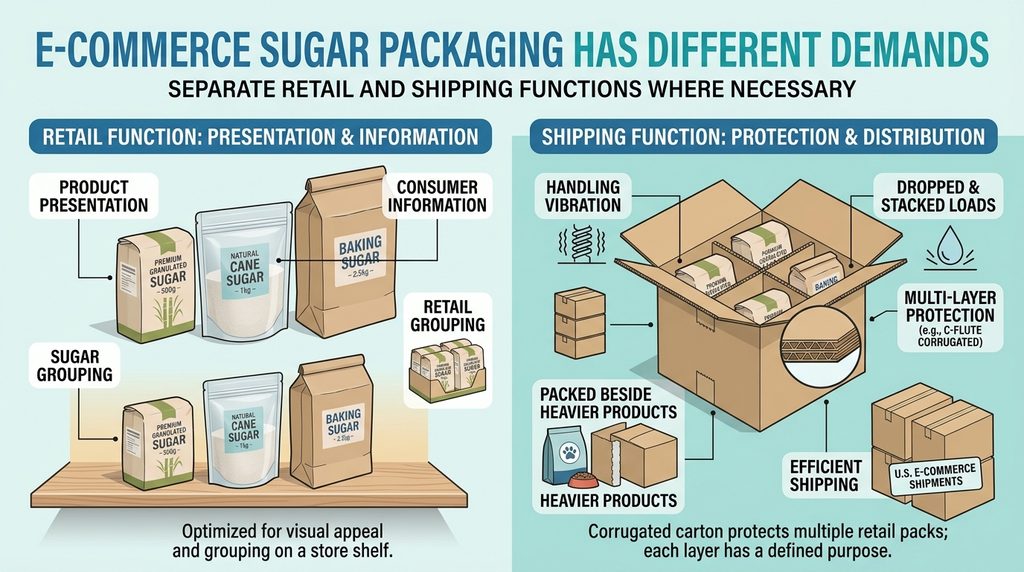
Parcel shipping introduces handling conditions that are very different from a retail shelf.
The individual carton may be dropped, vibrated, stacked, or packed beside heavier products. Several retail units may also travel together in one order.
For this reason, separate the retail and shipping functions where necessary.
Retail packaging handles presentation, product grouping, and consumer information.
Shipping packaging deals with distribution loads and protects the retail pack during transit.
A corrugated shipping carton, for example, may protect several smaller retail sugar boxes without forcing each individual carton to be overbuilt.
For U.S. e-commerce brands, this approach can also make the wider food packaging used for shipping orders more efficient because each layer has a defined purpose.
Printed Sugar Boxes Can Look Premium Without Excess Finishing
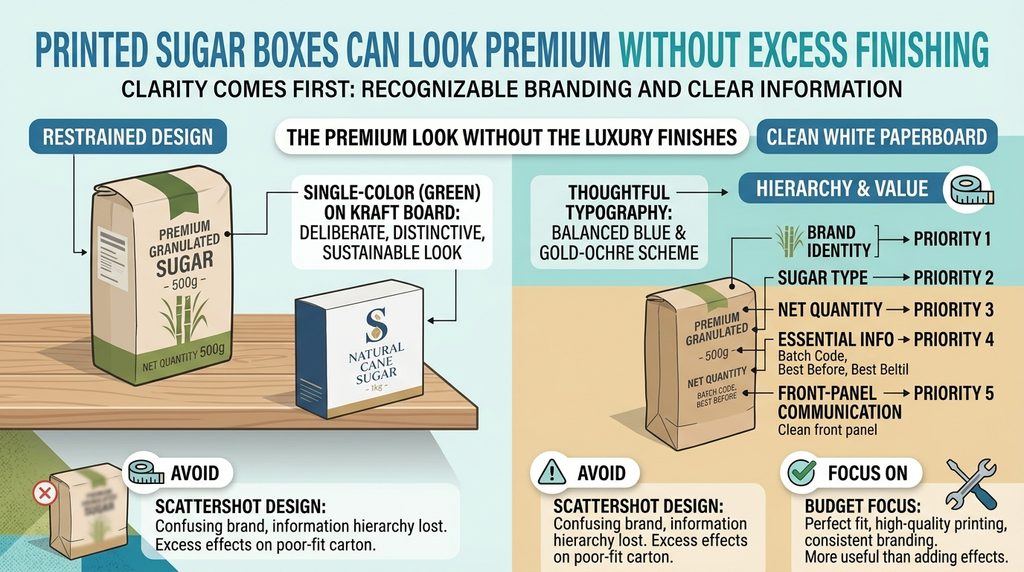
A premium-looking carton does not require every available finishing option.
For printed sugar boxes, clarity should come first. Customers need to recognize the brand and understand what is inside.
A strong hierarchy normally gives priority to:
- brand identity;
- sugar type or variety;
- net quantity;
- essential product information;
- clear front-panel communication.
After that, decorative finishes can be evaluated according to what they genuinely add.
A restrained one- or two-color design on kraft board can look deliberate and distinctive. A clean paperboard carton with thoughtful typography can achieve the same thing in a different visual direction.
For smaller food businesses, putting the budget into fit, print quality, and consistent branding can be more useful than adding several premium effects to a poorly specified carton.
Use Inserts Only When the Sugar Product Needs Them
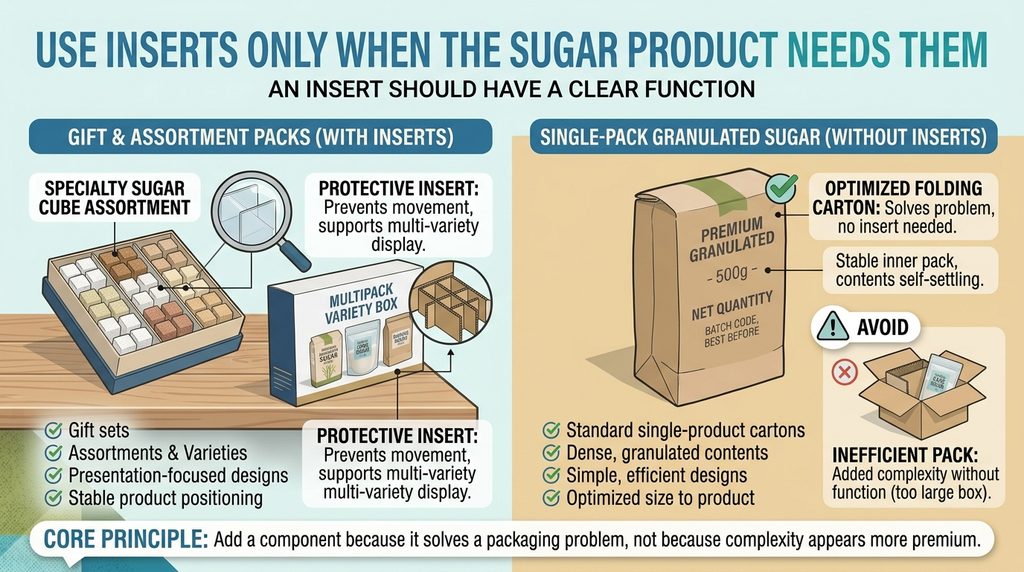
An insert should have a clear function.
It may be useful when it keeps products aligned, separates varieties, supports a presentation arrangement, or prevents movement that could otherwise affect the contents.
This can be relevant to:
- specialty sugar cube assortments;
- gift sets;
- multiple product varieties;
- presentation-focused packs.
For a stable inner package containing granulated sugar, however, another internal component may accomplish very little.
The same principle applies across custom food packaging: add a component because it solves a packaging problem, not because a more complicated pack appears more premium.
Reduce Material Before Calling Sugar Packaging Sustainable
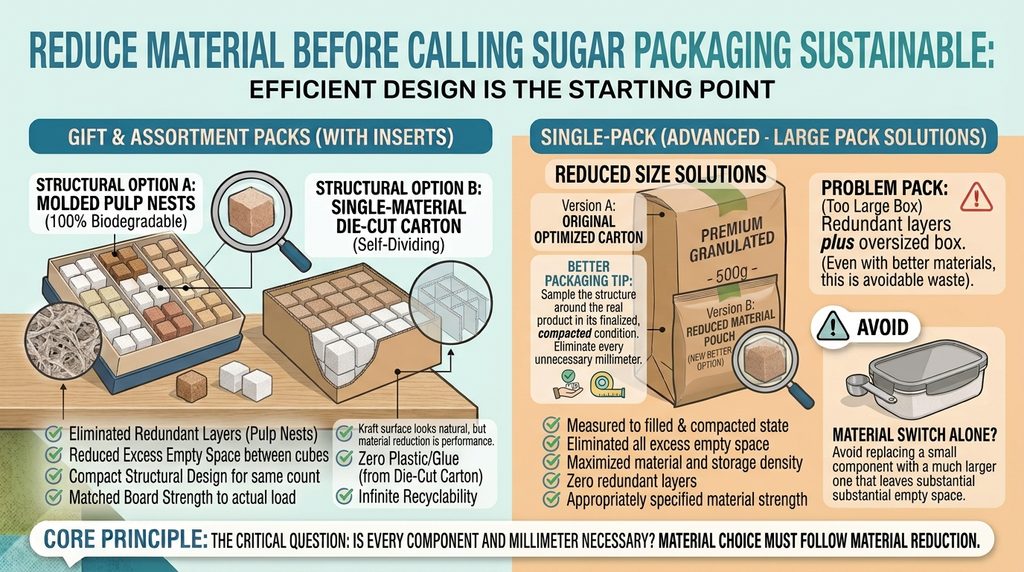
Sustainable packaging decisions begin with how efficiently the package is designed.
For sugar products, useful improvements can include:
- reducing excess empty space;
- eliminating redundant layers;
- avoiding unnecessary inserts;
- matching board strength to the actual load;
- using compact structures;
- choosing paper-based components according to their purpose.
A kraft surface may communicate a natural aesthetic, but appearance alone does not determine environmental performance.
Likewise, switching materials while leaving the box substantially oversized does not address avoidable material use.
For brands reviewing sustainable food packaging options, the better question is whether every part of the pack is necessary and appropriately specified.
Test Sugar Packaging With the Real Product Inside
A digital dieline cannot show exactly how a carton will behave once it carries the finished product.
Physical testing can reveal whether:
- the product loads easily;
- panels remain flat;
- the base supports the weight;
- closures stay secure;
- the contents move excessively;
- cubes remain organized;
- cartons stack as expected;
- printed information remains easy to read;
- opening feels natural.
For e-commerce products, evaluate the retail carton inside the intended shipping setup as well. A retail box that looks excellent on its own may still need additional distribution protection.
Testing a sample is particularly valuable when developing a new size or changing the packed weight.
Sugar Packaging Decisions at a Glance
The table below brings the main decisions together.
A specification built around these questions is more useful than selecting a material or box style in isolation.
Sugar Packaging Mistakes That Create Avoidable Problems
Some packaging problems start before the first sample is produced.
Sizing the Carton Before the Primary Pack Is Final
If the inner package changes later, the outer carton may no longer fit correctly. Finalize the packed product dimensions first.
Choosing Board on Price Alone
The lowest-cost board is not a saving if the carton bows, opens, or struggles with the packed weight.
At the other extreme, specifying far more material than the product needs adds cost without necessarily improving performance.
Adding Layers Without a Defined Purpose
Extra inserts, wraps, and secondary components should earn their place in the pack.
Treating Kraft as a Sustainability Claim
Kraft board has a natural appearance, but sustainability depends on more than color or texture.
Finishing the Artwork Too Early
Artwork prepared before the final dieline may need to be reworked when dimensions, panel proportions, or closures change.
For a smoother packaging project, settle the product, protection needs, structure, and dimensions before final artwork approval.
Build Sugar Packaging Around How the Product Is Sold
There is no single structure or material that works for every sugar product.
Granulated sugar may place more emphasis on containment, packed weight, and moisture management. Cubes can benefit from closer control of movement. Sachets need practical grouping and access. Retail products have shelf considerations, while e-commerce adds another level of handling.
For U.S. food businesses, the most reliable approach is to define those requirements first and then work through structure, material, size, and printing.
Hello Custom Boxes USA (HCB) develops custom sugar packaging for brands that need paperboard, kraft, or corrugated outer packaging tailored to their product dimensions, presentation, and distribution requirements. Where direct food contact is involved, the appropriate food-contact component should be established as part of the complete packaging system.
The result should not be the most complicated package. It should be one in which every component has a reason to be there.
Frequently Asked Questions
The best sugar packaging depends on the product format, packed weight, moisture needs, food-contact arrangement, and distribution method. Granulated sugar, cubes, and sachets can require different packaging systems.
Paperboard can work well for many lightweight retail cartons, kraft board offers a natural paper appearance, and corrugated board provides greater structural support for heavier or shipped products. Material choice should reflect the role of the outer package.
Sugar can absorb moisture and form clumps, so the complete packaging system should provide suitable moisture protection for the expected storage conditions. An ordinary paperboard outer carton should not automatically be treated as the product's moisture barrier.
Yes, paperboard can be suitable as outer packaging for sugar cubes when the product is appropriately contained and the carton provides the required fit and support.
Sugar sachets can be grouped in folding cartons, dispensing cartons, or other secondary structures. The right format depends on quantity and whether the pack is intended for retail, hospitality, or food service.
Kraft board can work for suitable secondary packaging applications. The final choice still needs to account for product weight, structure, storage, and the way direct food contact is handled.
Measure the product in its final packed form, including any primary package. The carton should provide enough clearance for efficient packing without leaving unnecessary empty space.