Quick Answer: What Are Standard Chocolate Box Sizes?
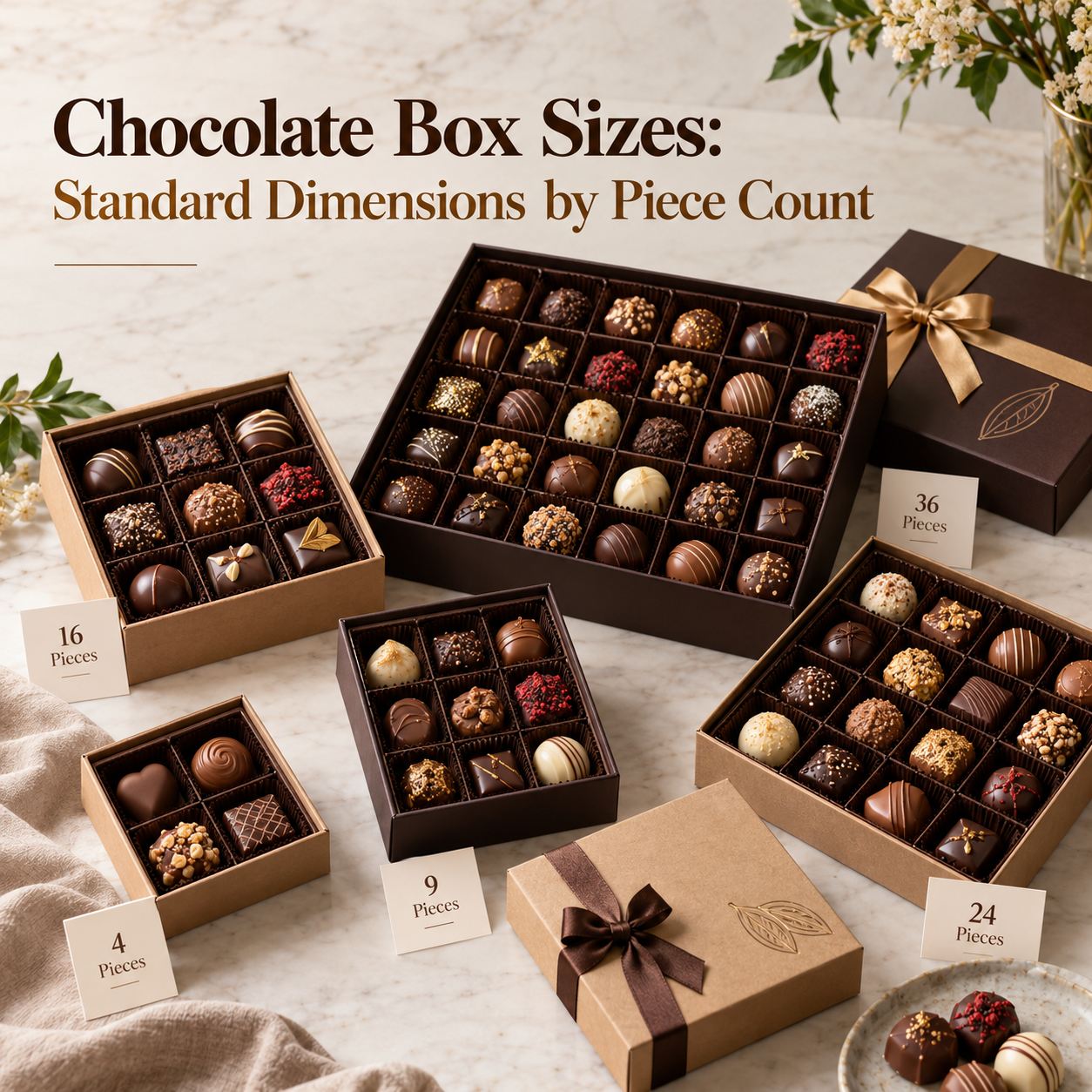
Chocolate boxes don’t come in one fixed size. Their dimensions depend on the number of pieces, the chocolates’ shape, and how they’re arranged inside. A small 4-piece box might be around 3 × 3 inches, while a box holding 12 chocolates could be closer to 8 × 6 inches. These are approximate finished-box sizes, not fixed standards. The size chart below provides calculated tray dimensions for 4, 6, 9, 12, 16, 24, and 36 chocolates using the same sample measurements. Always check the usable interior space before ordering.
TL;DR — Chocolate Box Size Guide
- 4–6 pieces: Small boxes for samples, party favors, and individual gifts.
- 9–12 pieces: Square or rectangular boxes for assorted chocolates.
- 16–24 pieces: Larger trays for gift collections and multiple flavors.
- 36 pieces: Wider trays or layered boxes for bigger assortments.
- Before ordering: Check the chocolates’ size, the tray layout, divider thickness, and available depth.
Chocolate Box Size Chart by Piece Count
The number of chocolates gives you a starting point, but it won’t tell you the exact box measurements. A collection of small square bonbons takes up less room than the same number of large round truffles.
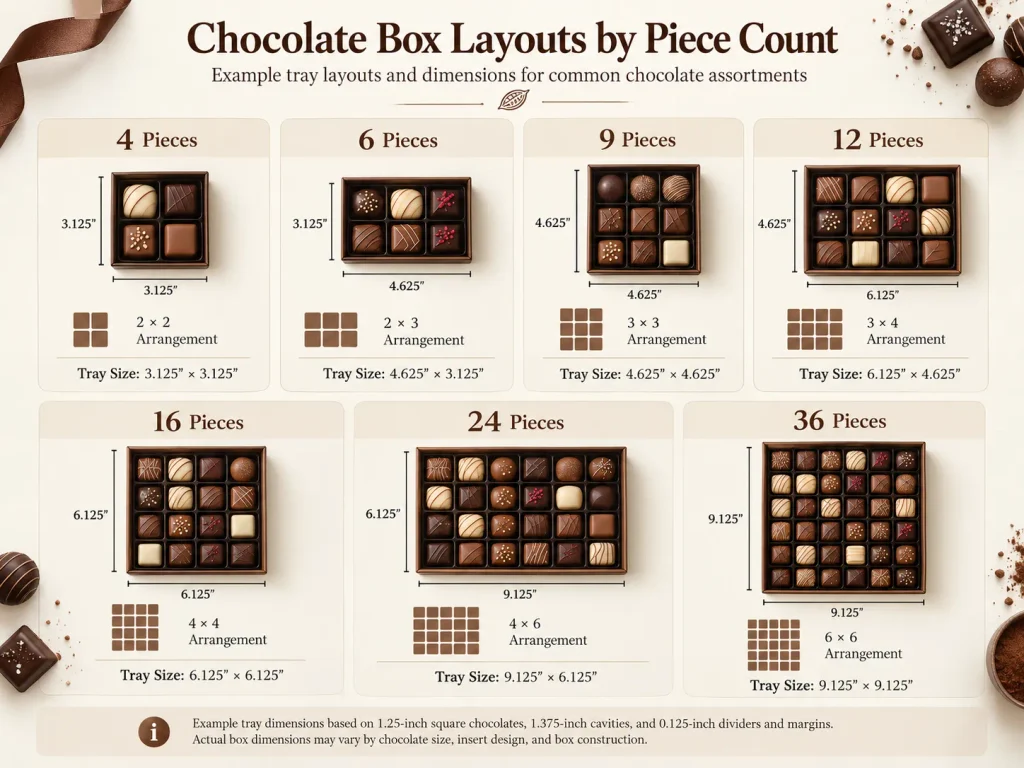
To make the comparison useful, the chocolate box size chart below uses the same measurements throughout: 1.25-inch square chocolates, 1.375-inch cavities, and 0.125-inch dividers and outer margins.
Note: These measurements show calculated tray footprints, not standard finished-box dimensions. The final box also needs space for its walls, tray construction, and sufficient height above the chocolates.
For example, if your truffles are 1.75 inches across instead of 1.25 inches, the tray will need larger cavities. That’s why it’s better to use the chart as a planning guide rather than order packaging based on piece count alone.
Chocolate Box Dimensions for Different Piece Counts
4-Piece Chocolate Box Dimensions
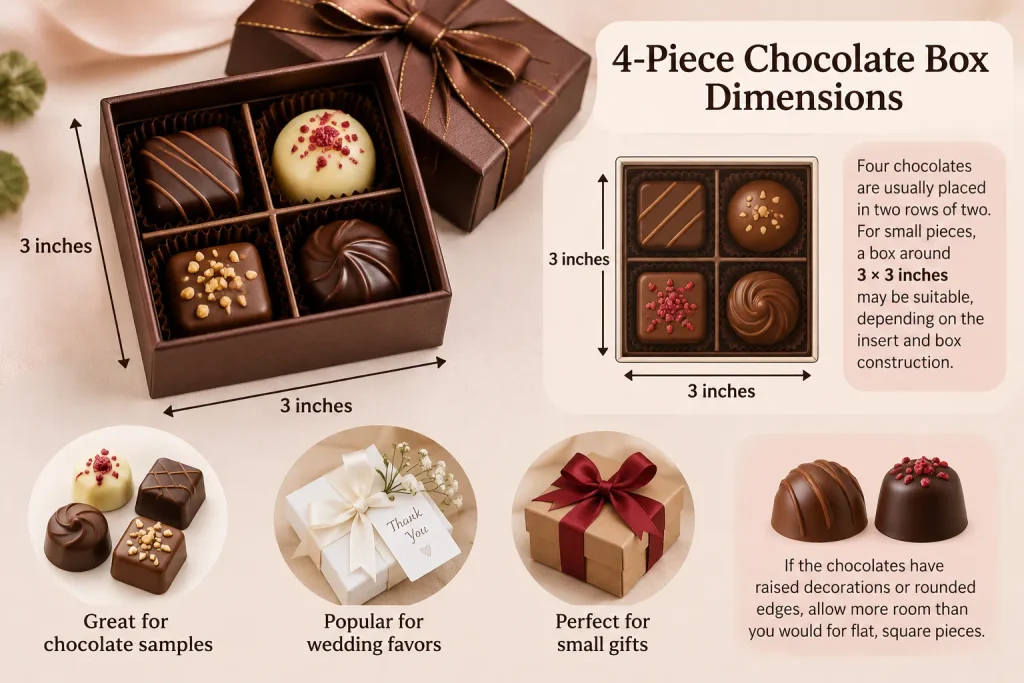
Four chocolates are usually placed in two rows of two. For small pieces, a box around 3 × 3 inches may be suitable, depending on the insert and box construction.
You’ll often see this arrangement used for chocolate samples, wedding favors, and small gifts. If the chocolates have raised decorations or rounded edges, allow more room than you would for flat, square pieces.
6-Piece Chocolate Box Dimensions
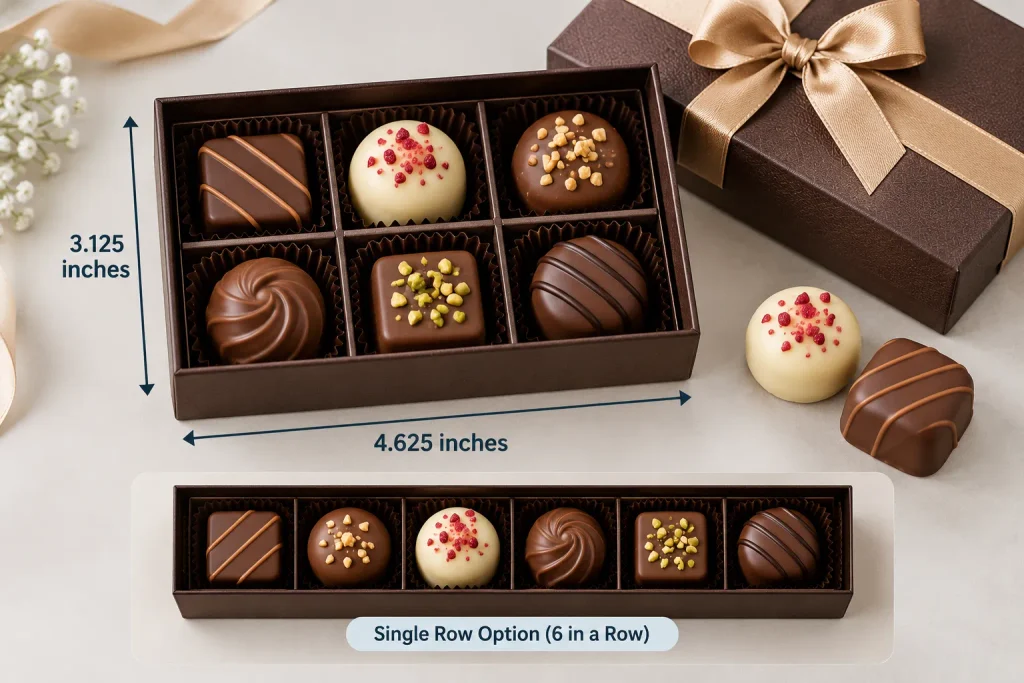
Six chocolates fit comfortably into a 2 × 3 arrangement. With the sample measurements in our chart, the tray would be roughly 4.625 × 3.125 inches.
This format works for smaller gift assortments and retail collections. You could also arrange all six chocolates in a single row if you prefer a long, narrow presentation.
9-Piece Chocolate Box Dimensions
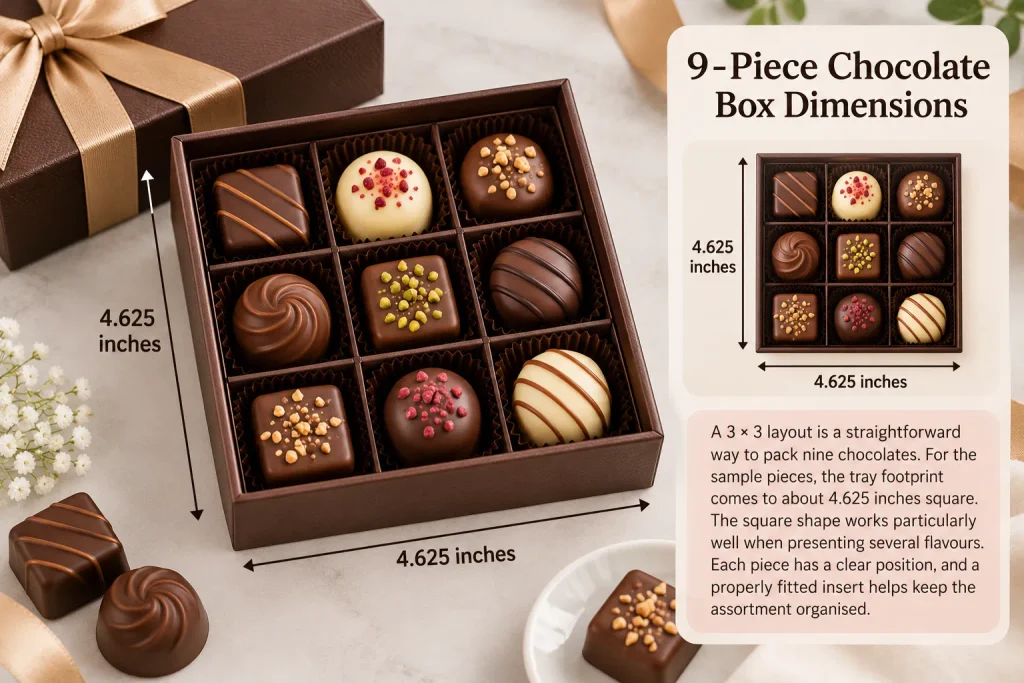
A 3 × 3 layout is a straightforward way to pack nine chocolates. For the sample pieces, the tray footprint comes to about 4.625 inches square.
The square shape works particularly well when you’re presenting several flavors. Each piece has a clear position, and a properly fitted insert helps keep the assortment organized.
12-Piece Chocolate Box Dimensions
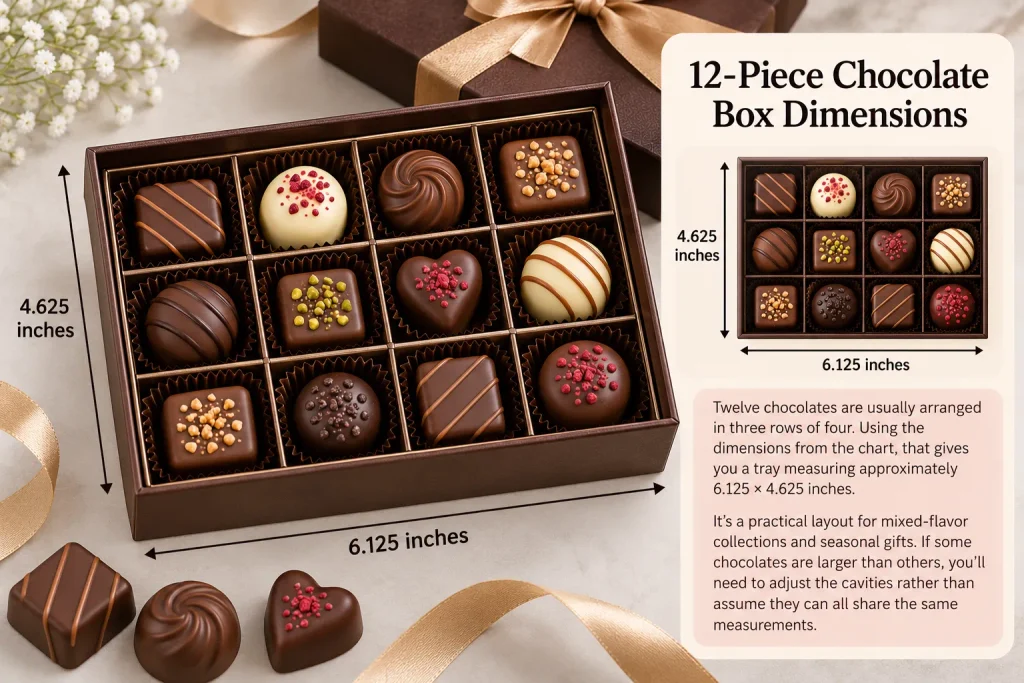
Twelve chocolates are often arranged in three rows of four. Using the dimensions from the chart, that gives you a tray measuring approximately 6.125 × 4.625 inches.
It’s a practical layout for mixed-flavor collections and seasonal gifts. If some chocolates are larger than others, you’ll need to adjust the cavities rather than assume they can all share the same measurements.
16-Piece Chocolate Box Dimensions
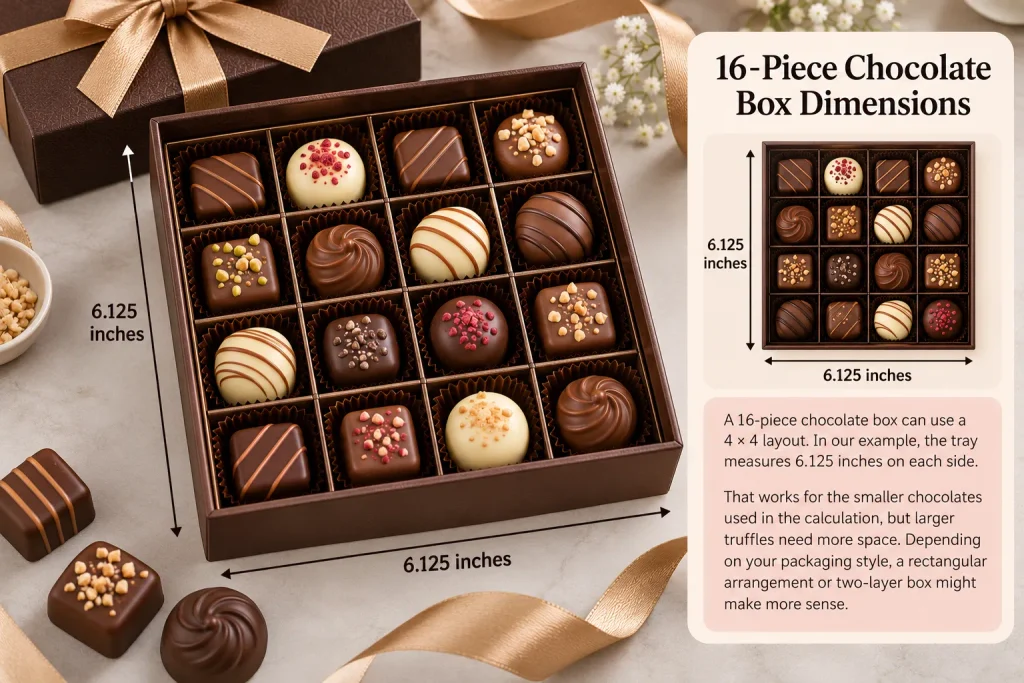
A 16-piece chocolate box can use a 4 × 4 layout. In our example, the tray measures 6.125 inches on each side.
That works for the smaller chocolates used in the calculation, but larger truffles need more space. Depending on your packaging style, a rectangular arrangement or two-layer box might make more sense.
24-Piece Chocolate Box Dimensions
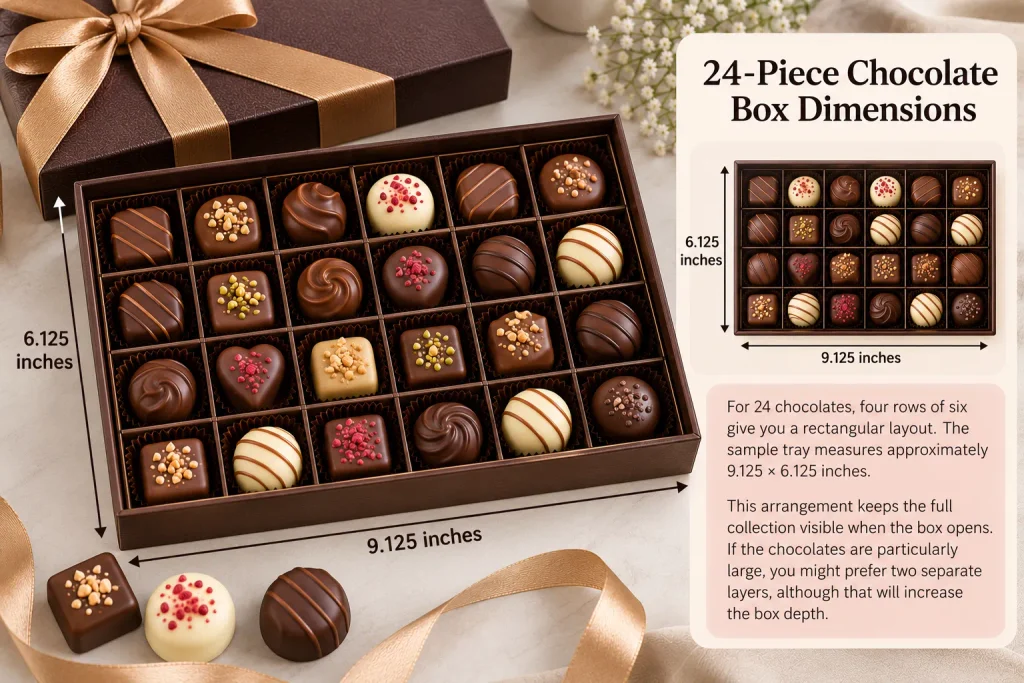
For 24 chocolates, four rows of six give you a rectangular layout. The sample tray measures approximately 9.125 × 6.125 inches.
This arrangement keeps the full collection visible when the box opens. If the chocolates are particularly large, you might prefer two separate layers, although that will increase the box depth.
36-Piece Chocolate Box Dimensions
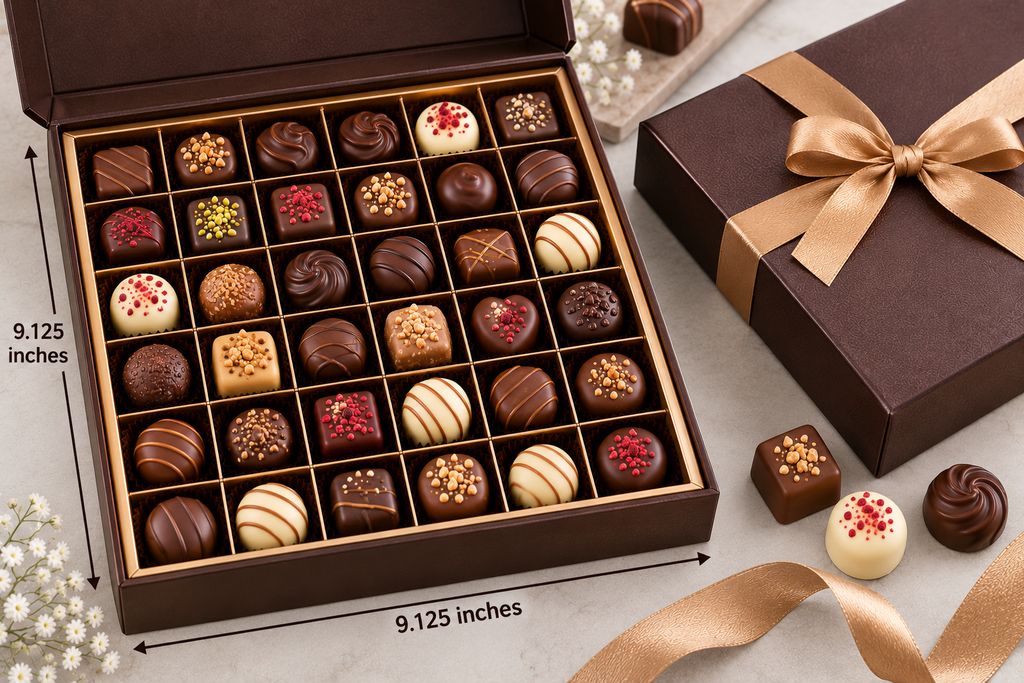
A collection of 36 chocolates can be arranged in six rows of six. Using the same sample measurements, the tray would be approximately 9.125 inches square.
That’s a sizeable assortment, so don’t overlook the tray’s strength. It needs to support the chocolates and keep them in position, especially when the box is being handled or transported.
How Chocolate Size and Shape Affect Box Dimensions
It’s easy to focus on piece count and forget that chocolates come in very different shapes.
Round truffles need cavities that stop them from rolling around. Square bonbons sit more neatly in a grid, while long or rectangular chocolates may need an entirely different arrangement.
Height can be just as important as width. A chocolate with a decorative topping needs enough clearance under the lid, or the decoration may get damaged when the box closes.
Mixed collections can be harder to size because not every piece has the same footprint. One option is to use a tray with different cavity shapes rather than making every compartment identical.
For this kind of assortment, custom bonbon boxes can be designed with inserts that suit the individual chocolates.
How to Measure a Chocolate Box Correctly
Before you settle on a box size, measure the actual chocolates. It’s more reliable than estimating from a photo or choosing a box that simply looks big enough.
Here’s what to check:
- Measure each chocolate. Record the length, width, and height at its widest points. Include any wrapping or raised decorations.
- Decide on the layout. Work out how many pieces will sit across each row and how many rows you’ll need.
- Leave room in the cavities. Chocolates should be easy to place and remove without rubbing against the sides.
- Count the divider space. The walls between compartments and the edges of the tray add to its overall size.
- Check the box depth. The insert base, chocolate height, and space beneath the lid all need to be considered.
Example: Measuring a 12-Piece Chocolate Box
Let’s say you’re packing 12 square chocolates. Each one measures 1.25 inches wide and 0.75 inches high.
You want to arrange them in a 3 × 4 grid. Each tray cavity will measure 1.375 inches across, with 0.125-inch dividers and a 0.125-inch margin around the outside.
Here’s the calculation:
Tray length
(4 × 1.375) + (3 × 0.125) + 0.25 = 6.125 inches
Tray width
(3 × 1.375) + (2 × 0.125) + 0.25 = 4.625 inches
So the tray needs a footprint of approximately 6.125 × 4.625 inches. The box must have enough usable space to hold it, along with the necessary depth for the chocolates and insert.
This is why two 12-piece chocolate boxes can have different dimensions even though they hold exactly the same number of pieces.
Internal vs. External Chocolate Box Dimensions
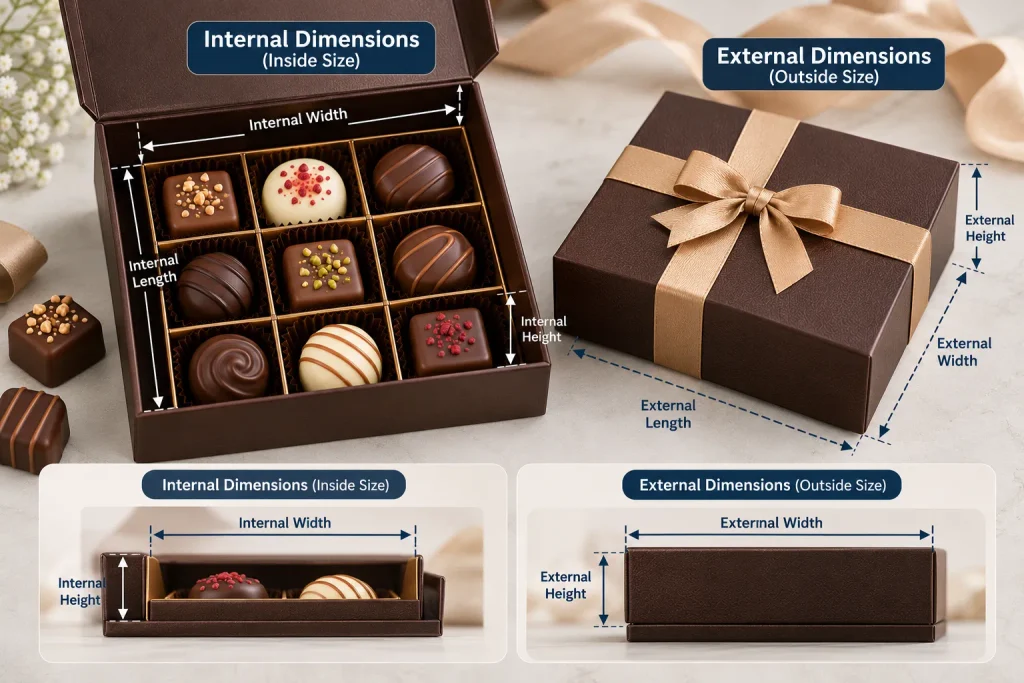
One detail worth checking before ordering is whether the supplier is giving you inside or outside measurements.
Internal dimensions tell you how much room is available for your chocolates and insert. They’re the measurements you need when checking whether everything will fit.
External dimensions describe the overall size of the finished box, including its walls. These figures matter when you’re planning shelf space, storage, or shipping cartons.
A rigid gift box typically has thicker walls than a folding carton. That means two boxes with the same outside dimensions won’t necessarily offer the same amount of space inside.
Whenever you compare chocolate box dimensions in inches, confirm which measurements are being quoted.
How Inserts and Dividers Change Chocolate Box Sizes
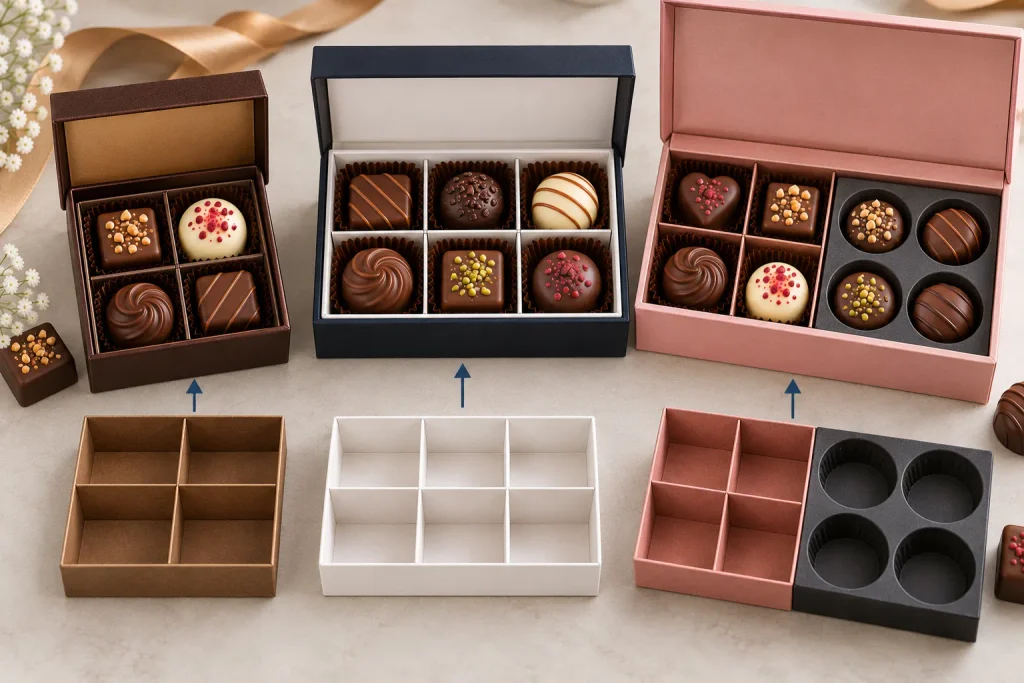
The insert might seem like a small part of the packaging, but it can make a noticeable difference to the final dimensions.
Every chocolate needs its own cavity, and the walls separating those cavities take up space. The tray also needs a margin around its outside edges.
If you’re using a single-layer insert, the entire assortment sits at one level. A two-layer design can reduce the footprint, but you’ll need a taller box and a suitable separator between layers.
Cavity depth matters too. A flat chocolate may sit too far down in a deep compartment, while a tall truffle could be squeezed by a shallow one.
Choosing Chocolate Box Sizes for Gifts, Retail, and Shipping
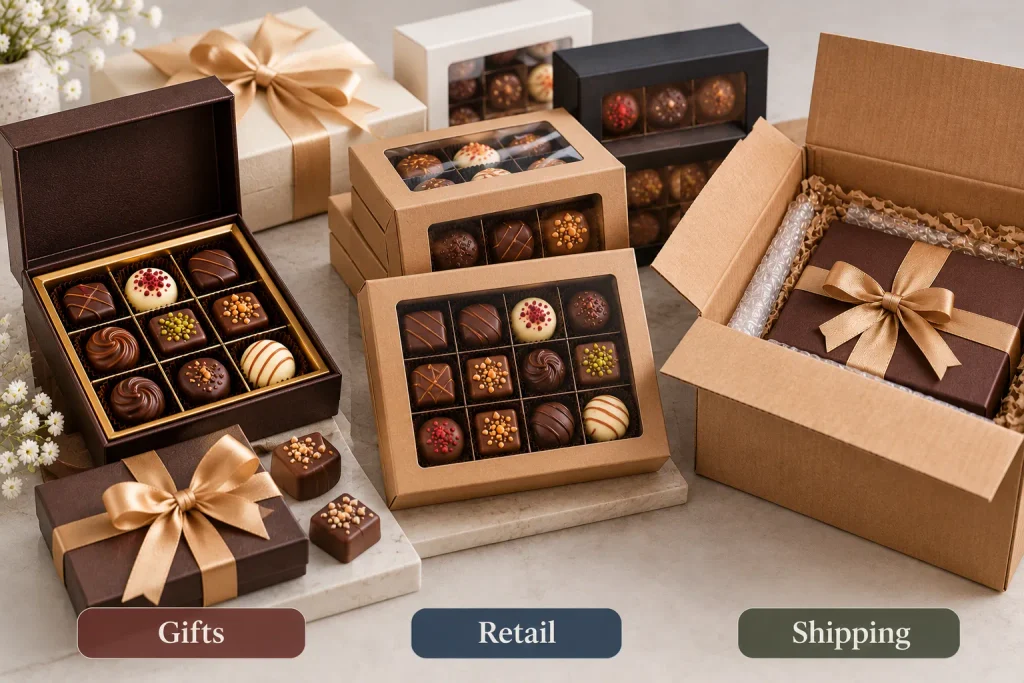
Think about where the box will be used, not just how many chocolates it needs to hold.
Gift boxes: Four- and six-piece collections work well for favors and samples. Twelve- or sixteen-piece boxes offer more variety, while a rigid box with a fitted insert can give the assortment a more premium presentation.
Retail boxes: Shelf space, branding, and visibility all matter. Folding cartons and window boxes are worth considering when their structure and dimensions suit the chocolates.
Shipping boxes: Chocolates need to stay in place during handling. A fitted insert helps limit movement, while an appropriately sized outer carton provides additional protection. Some chocolate shipments may also need insulation or temperature control.
If your brand sells other confectionery items, custom candy boxes can accommodate different assortments and retail packaging needs.
When Do You Need Custom Chocolate Box Dimensions?
Sometimes a ready-made box is almost right, but the chocolates don’t quite fit.
You may have unusually shaped pieces, a collection with different heights, or a particular arrangement in mind. Rather than changing the product layout to suit an existing box, custom dimensions allow the packaging to be planned around the assortment.
Hello Custom Boxes offers made-to-order chocolate and bonbon packaging, including options for different box structures and fitted inserts.
Before requesting a quote, gather the piece count, chocolate measurements, preferred layout, and insert requirements. Those details will help establish the right interior dimensions.
Frequently Asked Questions
Final Takeaway
There’s no one-size-fits-all measurement for chocolate packaging. The number of pieces gives you a starting point, but the chocolates’ shape, cavity spacing, dividers, and depth determine the final size. Use the chart to plan your arrangement, then check the actual measurements before placing an order.