TL;DR
For many food products, paperboard works well for lightweight retail packaging, kraft suits simple branded presentation, and corrugated board provides more strength for delivery and shipping. Match the material to food contact, grease, moisture, weight, and handling. Use only the barrier and protection the food actually needs so you can balance freshness, safety, cost, and sustainability.
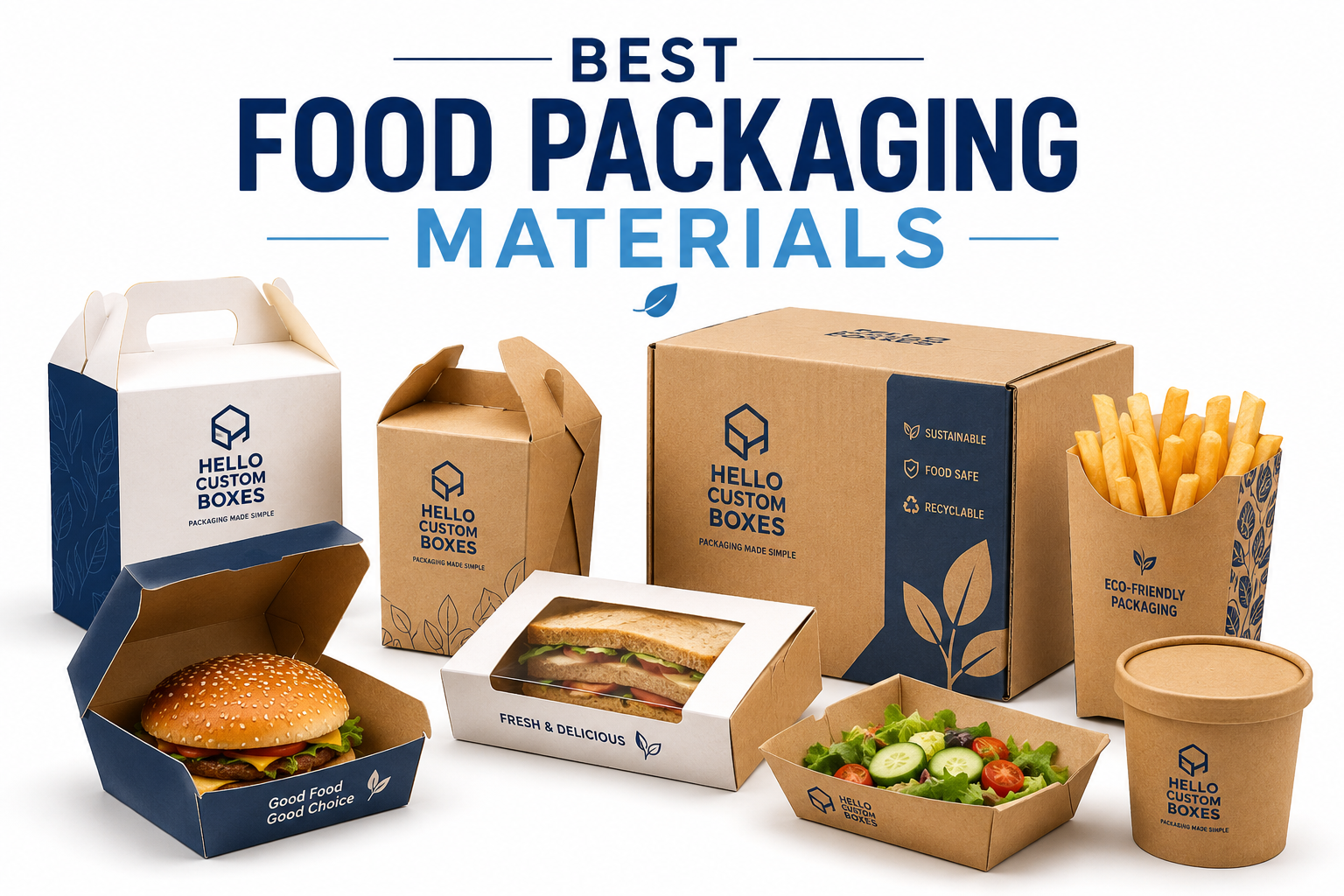
The best food packaging materials depend on the food being packed, how long it needs to stay in the package, whether it contacts the material directly, and what happens during storage, takeaway, retail display, or delivery. For many food businesses, paperboard, kraft board, and corrugated cardboard provide practical options when they are correctly matched to the product and any required food-contact or barrier needs.
A dry cookie does not need the same packaging as a buttery pastry. A cupcake needs different protection from a pizza, and a retail bakery carton has a different job from an e-commerce shipping box.
This guide compares common paper-based materials and explains where each one works best for bakeries, restaurants, takeaway businesses, e-commerce sellers, and growing food brands.
What Makes a Food Packaging Material Actually Suitable?
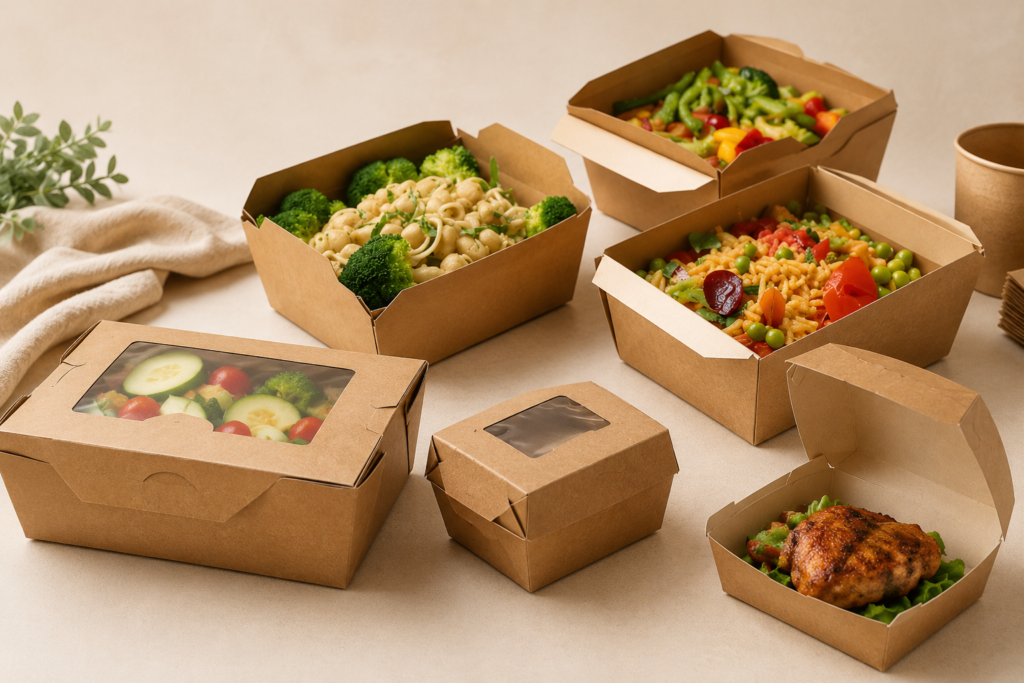
A food packaging material is suitable when the complete package works safely for its intended food, contact conditions, temperature, storage period, and handling environment.
That means “food safe” should not be judged by how a sheet of board looks.
FDA guidance treats packaging and its components—including relevant coatings, adhesives, and other substances—as part of the food-contact system when they are intended to come into contact with food.
Before comparing food grade packaging materials, answer these questions:
- Will the food touch the packaging directly?
- Is it dry, oily, moist, chilled, frozen, or packed warm?
- How long will it remain inside?
- Does it need grease or moisture resistance?
- Is ventilation important?
- How heavy is the packed product?
- Will the box be stacked?
- Is it for retail, pickup, takeaway, or parcel shipping?
- Does the food need an insert or divider?
- Will printing appear near a direct-contact surface?
These questions should determine the structure before branding and decoration are considered.
Paperboard Is a Strong Choice for Lightweight Food Products
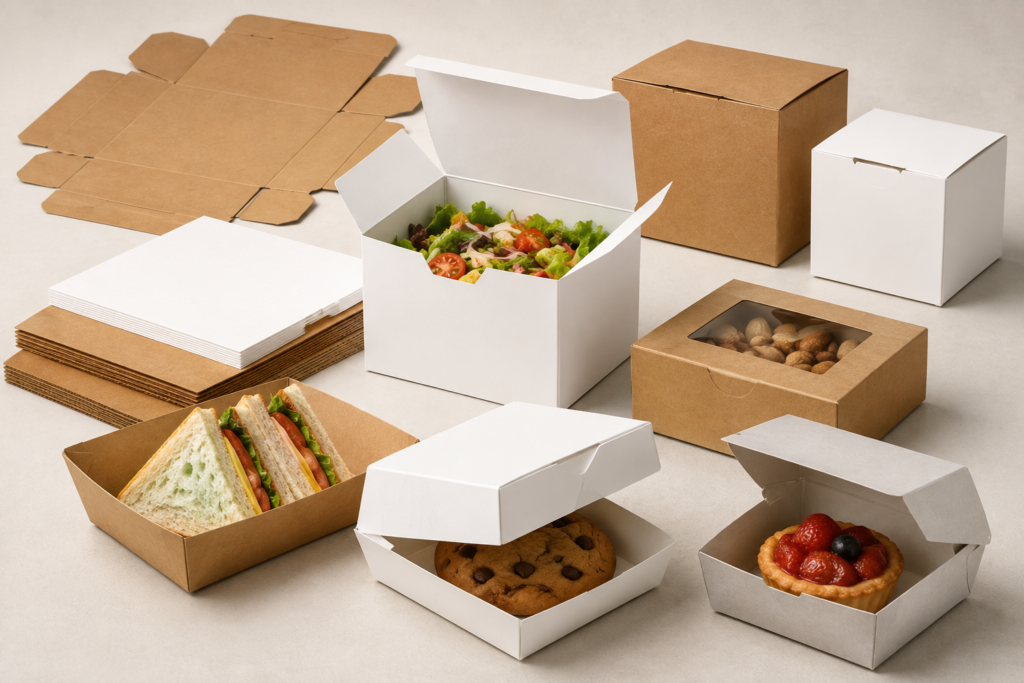
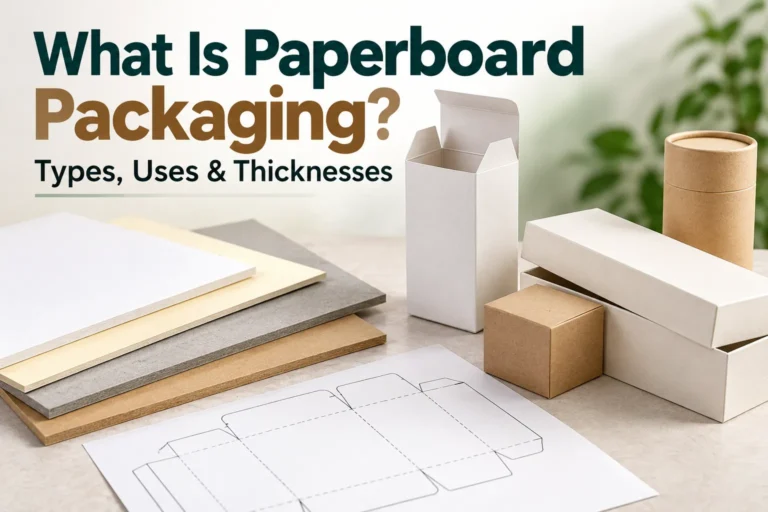
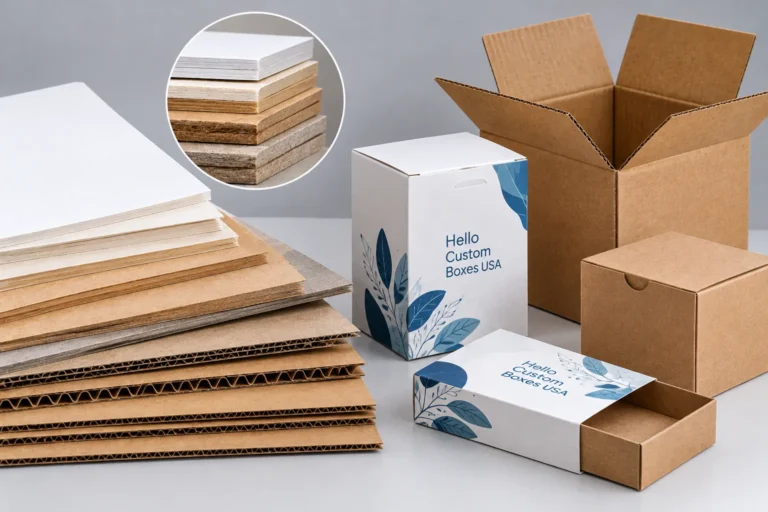
Paperboard food packaging works particularly well when the product is relatively lightweight and the box needs clean printing, folding accuracy, and good retail presentation.
It is commonly considered for:
- Cookies
- Chocolates
- Confectionery
- Cupcakes
- Pastries
- Dry bakery products
- Snack foods
- Food sleeves
- Secondary food cartons
Its smooth surface makes paperboard useful for custom printed food boxes because logos, product information, illustrations, and brand colors can be reproduced clearly.
Paperboard can also be die-cut into windows, locking tabs, handles, partitions, and fitted inserts.
For example, cupcakes benefit from a structure that provides enough headroom while controlling movement. Businesses packing multiple cupcakes can compare bakery box options with fitted inserts rather than relying on a larger empty carton.
However, paperboard alone should not automatically be assumed suitable for every type of food.
A dry cookie and a buttery pastry place very different demands on the board. Direct food contact, grease, moisture, and temperature may require a different specification or an appropriate barrier.
The advantage of paperboard is not that it works for everything. It is that it can be precisely specified for many lightweight food applications.
Kraft Food Packaging Works Best When Simplicity Fits the Brand
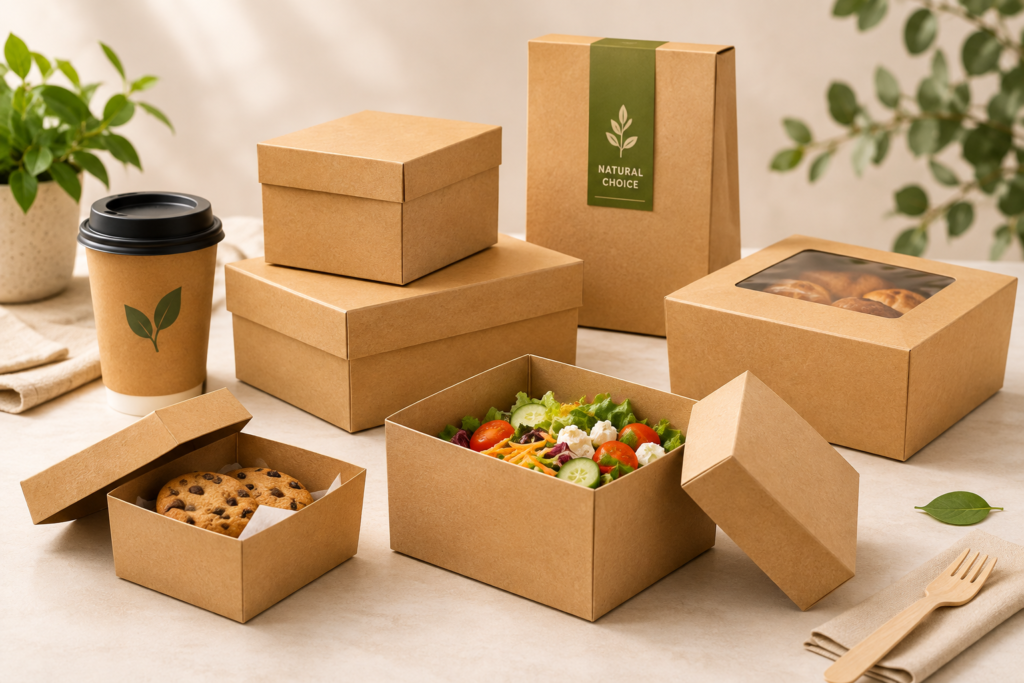
Kraft food packaging is a practical choice for businesses that want a natural paper-based appearance without making the package feel unfinished.
The brown surface works particularly well for:
- Bakeries
- Cafés
- Sandwich shops
- Dry snacks
- Cookies
- Pastries
- Food sleeves
- Takeaway products
Kraft usually does not need complicated decoration to look intentional. A correctly sized box with a one-color logo, branded seal, or simple label can provide a strong identity with relatively restrained printing.
Businesses considering this look can explore kraft packaging options for food and retail products before deciding whether the material fits their product and brand.
But a brown appearance does not automatically make a package sustainable or suitable for direct food contact.
Material sourcing, barrier treatments, coatings, inks, recyclability, and the actual food-contact application still matter.
Choose kraft because the material properties and visual style suit the food, not simply because natural-looking packaging appears environmentally friendly.
Corrugated Cardboard Food Boxes Handle More Demanding Jobs
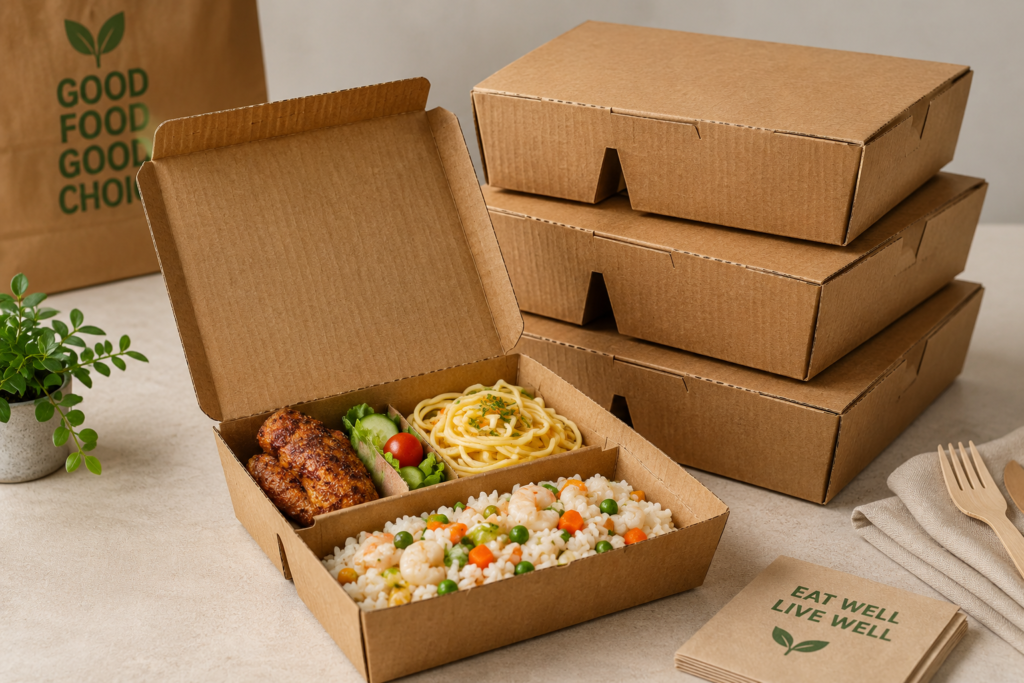
Corrugated cardboard food boxes are better suited to applications that need additional structural strength, stacking performance, or transportation protection.
Corrugated board contains a fluted layer between liners, creating more rigidity than lightweight folding board.
It can be useful for:
- Pizza packaging
- Larger bakery orders
- Multi-item food packs
- Restaurant delivery
- Subscription food boxes
- E-commerce food shipments
- Secondary shipping cartons
The correct specification depends on the actual job.
A box carrying pastries from a bakery counter to a customer’s car does not face the same handling as an order moving through a parcel network.
Board construction, flute profile, dimensions, product weight, stacking, and handling all influence performance.
This is particularly important for food packaging for e-commerce. A visually attractive retail carton may work perfectly on a shelf but still need a stronger outer corrugated shipping box when sent through parcel distribution.
The goal is not to choose the strongest board available.
It is to use enough strength for the product and distribution route without adding unnecessary material.
Freshness Comes From Controlling the Right Risk
Food packaging for freshness works best when it addresses the actual reason a food product loses quality.
Depending on the food, that may involve:
- Moisture movement
- Grease
- Air exposure
- Light
- Temperature
- Physical movement
- Storage time
- Closure performance
- Ventilation
A paperboard box can protect cookies from crushing, but the board should not automatically be expected to provide every moisture or oxygen barrier needed for longer-term shelf stability.
Likewise, takeaway packaging for hot food may need enough ventilation to manage trapped steam.
Instead of asking only:
Which material should we use?
Ask:
What must this package control between packing and consumption?
A bakery selling pastries for same-day pickup may mainly need grease resistance, shape protection, and convenient handling.
A packaged product expected to remain stable for much longer may need more carefully defined food packaging barrier properties.
Once the freshness risk is clear, the material decision becomes much easier.
Grease-Resistant Packaging Should Match the Food
Grease resistance matters when oils or fats can stain, weaken, or pass through an unsuitable paper-based package.
Common examples include:
- Buttery pastries
- Fried foods
- Pizza
- Chicken
- Certain baked goods
- Sauced takeaway foods
For these applications, appropriately specified grease-resistant packaging may be necessary.
FDA notes that food-contact substances have been used in paper or cardboard packaging specifically to prevent grease from leaking through.
The important point is to specify the barrier around the food rather than automatically adding a coating to every food box.
A dry cookie may not need the same grease protection as fried chicken.
For example, restaurant businesses handling oily products can compare food packaging designed around heat, grease, and takeaway handling with the needs of their actual menu rather than using one universal carton.
Using only the barrier that solves a real problem can help control cost and avoid unnecessary package complexity.
Food Packaging Safety Includes More Than the Outer Board
Food packaging safety should be evaluated across the complete packaging construction, particularly when food touches the material directly.
Relevant food contact materials may include:
- Paper and paperboard
- Coatings
- Adhesives
- Inks where applicable
- Liners
- Inserts
- Other components in the package
FDA regulations and food-contact notifications distinguish between components and their intended uses rather than treating every material as universally acceptable for every food application.
That is why the phrase “food grade” should lead to another question:
Food grade for what intended use?
A printed surface on the outside of a bakery carton is a different application from an interior surface that directly contacts food.
When requesting food safe packaging materials, give the supplier enough information to evaluate the intended use:
- Food type
- Direct or indirect contact
- Temperature
- Grease or moisture
- Storage period
- Required barrier
- Printing location
A more specific brief normally produces a better packaging specification.
Sustainable Food Packaging Starts With Less Waste
The most practical approach to sustainable food packaging is to use the right amount of material while still protecting the food.
An oversized box can require:
- More board
- More storage space
- More shipping volume
- Additional secondary packaging
- More cushioning in shipped orders
Right-sizing reduces several of those issues at once.
The same principle applies to unnecessary layers.
If a package includes an outer box, inner tray, divider, wrap, and insert, every part should perform a clear function.
Removing packaging that protects the food can increase product damage and food waste, so “less material” should not become the only sustainability target.
When evaluating eco-friendly food packaging, look at the complete system:
- Material quantity
- Responsible sourcing
- Necessary versus unnecessary barriers
- Ease of separating components
- Local recycling acceptance
- Package weight
- Product protection
- Food waste prevention
Businesses interested in the wider topic can also review Hello Custom Boxes’ guide to eco-friendly packaging materials for e-commerce shipments.
What About Biodegradable Food Packaging?
Biodegradable food packaging should be evaluated carefully rather than treated as an automatic sustainability upgrade.
Whether a material breaks down effectively depends on its composition and disposal conditions.
A material described as biodegradable may require particular industrial or environmental conditions, so businesses should understand what the claim actually means before using it as a purchasing criterion or marketing message.
Clear material specifications are more useful than broad environmental wording.
Bakery Packaging Has to Match the Actual Baked Product
There is no universal food packaging for bakery products because bakery items behave differently.
Compare:
- A single cookie
- Six frosted cupcakes
- A buttery croissant
- A decorated cake
- A dozen donuts
- A fresh pie
Each product creates different packaging requirements.
Cookies usually need protection from crushing and an appropriate closure.
Cupcakes need enough vertical space and may benefit from inserts that reduce movement.
Pastries may require grease resistance.
Cakes need a stable base, sufficient height, and enough structure to support carrying.
Pies need a box that accommodates the pan or product diameter without damaging the crust.
This is why bakeries should select boxes around individual product dimensions rather than treating “bakery packaging” as one specification.
The broader custom bakery packaging range shows how structures differ across cupcakes, cookies, cakes, and other baked products.
For additional planning guidance, the blog on choosing suitable bakery boxes in the U.S. explains why product size, shipping requirements, and structure matter alongside appearance.
Restaurant and Takeaway Packaging Must Work During Service
Good food packaging for restaurants should perform well when the kitchen is busy, not just when the box is inspected empty.
The packaging may need to:
- Assemble quickly
- Close securely
- Resist grease
- Manage heat and steam
- Stack without collapsing
- Remain easy to carry
- Match actual portion sizes
- Provide enough labeling space
For food packaging for takeaway, speed matters.
A complicated carton that looks impressive but takes too long to assemble can create problems during peak service.
Fit matters too.
Using one oversized package for several portion sizes may simplify purchasing, but smaller orders can shift around inside it and require extra material.
A better approach is often a limited set of sizes chosen around the menu’s most common portions.
Hello Custom Boxes’ custom food packaging options for takeaway and restaurant products provide examples of how different foods require different structures.
Food Packaging for E-Commerce Has Two Separate Jobs
Food packaging for e-commerce should be planned as both a product package and a shipping system.
Ask two separate questions:
- What does the food need?
- What does the shipment need?
The inner package may handle:
- Food contact
- Portion control
- Branding
- Product organization
- Grease resistance
- Freshness requirements
The outer corrugated package may handle:
- Parcel impacts
- Stacking
- Compression
- Movement
- Shipping labels
- Distribution handling
Trying to make one lightweight retail carton perform both jobs can lead to damage.
At the same time, adding an oversized shipping carton around a small retail package can introduce unnecessary volume.
Test the complete shipment with the food or representative packed product inside.
That gives a much more realistic picture than evaluating an empty printed carton.
Small Food Businesses Should Avoid Over-Specifying
For food packaging for small business, buying too much packaging can be just as expensive as buying packaging that is too weak.
A new food brand may be tempted to specify:
- Heavy board
- Full-color printing
- Interior printing
- Specialty coatings
- Foil
- Embossing
- Custom inserts
- Several box sizes
all on the first order.
Some products genuinely justify those features.
Many do not.
Start with four priorities:
1. Food suitability
Is the packaging construction appropriate for the food and intended contact?
2. Protection
Does the package remain functional through handling, stacking, and delivery?
3. Fit
Are the dimensions close to the actual packed product?
4. Brand recognition
What is the simplest visual system that still looks like your business?
Once those four areas work, add decorative or structural features that solve a genuine need.
This tends to produce better custom food packaging boxes than starting with finishes and trying to make the structure fit later.
Custom Printed Food Boxes Should Be Designed Structure First
Custom printed food boxes work best when the structural decisions are made before final artwork.
Confirm:
- Internal dimensions
- Product orientation
- Material
- Closure style
- Inserts or dividers
- Required barriers
- Food-contact requirements
- Shipping method
Then build the artwork around the dieline.
This avoids common problems such as important graphics landing across folds, labels hiding required information, or artwork needing to be rebuilt after the box dimensions change.
A simple visual system also makes packaging easier to scale.
One or two brand colors, consistent typography, and repeatable logo placement can connect several different food packages without requiring identical designs.
Brands exploring presentation alongside functionality can also review current food packaging design ideas and trends without letting visual trends override the material requirements of the product.
How to Choose the Best Food Packaging Material
The best food packaging material is the material that gives the food the necessary protection, freshness support, contact suitability, handling performance, and presentation without adding unnecessary complexity.
Before requesting a quote, work through this checklist:
- What food will be packed?
- Will the food directly contact the packaging?
- Is it dry, oily, moist, hot, chilled, or frozen?
- How long will it remain packaged?
- Does it need grease resistance?
- Does it need moisture or another barrier?
- How heavy is the packed product?
- Will packages be stacked?
- Is the product for retail, pickup, takeaway, or shipping?
- Does it need an insert or divider?
- What happens during transport?
- Is the proposed material appropriate for the intended food-contact use?
- Can any layer be removed without reducing protection?
There is little benefit in specifying a premium material that solves a problem the food does not have.
The opposite is equally important: a cheap material is poor value if it stains, bends, leaks, or fails during ordinary use.
Match the material to the food and the distribution method.
Choose Food Packaging Around the Product
The best food packaging materials are not defined by one board type, one environmental claim, or the most expensive specification.
They are defined by how well the package works for the food.
Start with direct or indirect food contact, freshness, grease, moisture, product weight, stacking, and delivery conditions. Then compare paperboard, kraft, corrugated structures, barriers, inserts, and printing around those requirements.
Hello Custom Boxes can help businesses compare custom food packaging solutions based on product dimensions, intended food use, structure, board choice, printing, and order quantity.
If you are planning packaging for a bakery, restaurant, takeaway service, retail food brand, or online food business, review the relevant food packaging structures for different products before deciding which material and box style fits your operation.
Good packaging for food products starts with function. Freshness, branding, cost, and sustainability become easier to balance once the package is already doing its primary job correctly.
Frequently Asked Questions
There is no single best material for every food. Paperboard is useful for many lightweight retail and bakery products, kraft works well for simple paper-based presentation, and corrugated board offers greater structural strength for heavier products, takeaway, and shipping. Food contact, grease, moisture, weight, storage, and distribution should determine the final choice
Food-safe packaging materials are materials and complete packaging components suitable for their intended food-contact use. Paperboard, coatings, adhesives, inks, and other components should be evaluated according to how the package will actually be used.
Kraft can work well for many food applications when the material and complete package are suitable for the intended product. Foods involving direct contact, grease, moisture, or elevated temperatures may need additional specification.
It depends on what threatens freshness. A food may need control of moisture, grease, air exposure, physical movement, temperature, or light. The best package addresses those specific risks rather than relying on one universal material.
Paperboard can support a sustainable packaging strategy when it is correctly sized, unnecessary layers are avoided, and the material is suitable for available recycling systems. Sustainability also depends on sourcing, coatings, material use, and how well the packaging prevents food damage or waste.
Paperboard and corrugated structures are commonly useful, but the structure should match the product. Cupcakes may need inserts and vertical clearance, pastries may need grease resistance, while cakes and pies require stronger bases and dimensions suited to the finished product.
Restaurants should consider portion size, food contact, grease, moisture, ventilation, heat, closure strength, stacking, carrying, and assembly speed. The best takeaway box should work reliably during busy service and remain functional until the food reaches the customer.