Paper Cup Sizes: Oz, ml & Dimensions Guide
Paper cup sizes are usually listed in ounces, but that number is only a starting point. It tells you the cup’s nominal capacity. It does not tell you how tall the cup is, how wide the opening will be, or which lid belongs with it.
Those details matter once the cup moves from a catalog into everyday service. A café serving lattes needs room for milk and foam. Iced drinks lose some usable space to ice. If the cups are being custom printed, their shape also determines how much room the artwork has.
This guide covers common U.S. cup capacities, useful measurements, drink applications, lid fit, and the details that help businesses compare paper cup options more confidently.
Quick Answer
Common paper cup sizes range from 2–4 oz for espresso and samples to 20–32 oz for larger drinks. Start with the amount you intend to serve, then allow for ice, foam, toppings, or headspace. For lids and fitted accessories, use the measurements of the actual cup rather than relying on its ounce label.
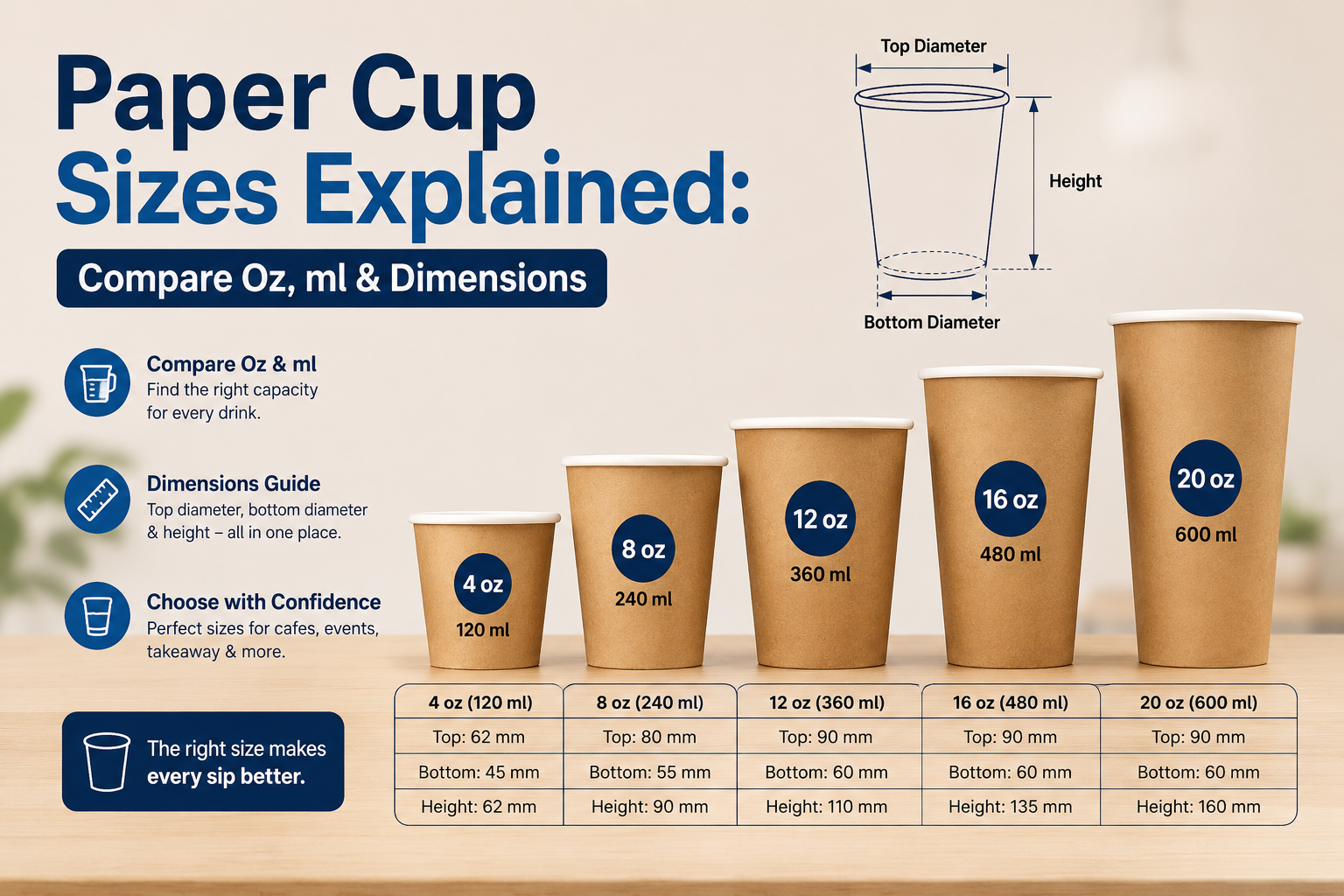
Paper Cup Size Chart: Oz, ml & Common Uses
U.S. paper cups are generally identified by fluid-ounce capacity. The metric figures below are approximate conversions.
The chart is useful for comparing serving capacities. It should not be read as a dimensional standard, since the shape of a cup can vary between product ranges.
What Does a Paper Cup Size Actually Tell You?
The ounce rating tells you how much the cup is designed to hold. To understand how it will work in practice, you also need to know its top diameter, base diameter, and height.
Capacity
For U.S. buyers, capacity is normally stated in fluid ounces.
For example:
12 US fl oz ≈ 355 ml
This gives you a useful starting point when matching a cup to a menu portion.
Top Diameter
The top diameter is the width across the opening of the cup. It is especially useful when selecting a lid because the lid has to match the finished rim.
Bottom Diameter
Paper cups generally taper toward the base. The bottom measurement becomes important when the cup needs to sit in a holder, tray, carrier, or another fitted space.
Height
Height affects storage and dispensing as well as the appearance of the cup in the customer’s hand. A taller format also gives artwork a different shape and amount of usable wall space.
These measurements describe the cup far more clearly than an ounce number on its own.
Why Can Two 12 oz Cups Look Different?
A 12 oz rating describes volume, not a fixed shape.
One 12 oz cup might be relatively tall with a narrow base. Another may be wider and slightly shorter while offering a similar nominal capacity. The wall angle and opening can change too.
This is normal rather than a sizing error.
For a café choosing between cup styles, those differences may simply affect appearance. They become more important when the cup has to work with a lid, dispenser, sleeve, carrier, or print template.
Use a general paper cup size chart to narrow down the capacity you need. Once you have chosen a cup range, work from its actual measurements for anything that has to fit around it.
Which Paper Cup Size Fits Your Drink?
Think about the finished drink rather than starting with labels such as small, medium, and large. Those names mean different things from one business to another.
These ranges provide a practical starting point:
They are not fixed industry rules. Recipes and serving styles still decide what works at the counter.
Coffee and Tea
Many cafés build their range around 8 oz, 12 oz, and 16 oz cups. That can provide a straightforward progression from smaller drinks to larger servings.
Your own recipes are a better guide than those numbers, though. If a regular coffee includes room for milk, that space needs to be allowed for. A cappuccino of similar liquid volume may need more room at the top because of the foam.
Espresso and Samples
For espresso, tastings, and promotional samples, 2–4 oz cups are often enough.
A smaller format also suits the way these portions are presented. Putting a small sample into a much larger cup can make the serving look undersized and uses more material than necessary.
Iced Drinks
With iced beverages, some of the internal space is already occupied before the drink is poured.
How much ice you normally use should therefore be part of the size decision. A 16 oz iced drink is not necessarily 16 oz of liquid.
Nominal Capacity vs the Drink You Actually Serve
A cup should not normally be filled right to the rim just because its listed capacity allows it.
Consider a latte. Espresso and milk account for much of the drink, but foam still needs somewhere to sit. Leave too little room and fitting the lid becomes awkward.
Iced coffee works differently. Ice takes up part of the available volume, so the amount of liquid added may be considerably lower than the nominal cup size.
Toppings can change the calculation again.
In practice, allow for whatever accompanies the liquid:
- Milk or foam
- Ice
- Whipped toppings
- Lid clearance
- Comfortable carrying space
This usable volume is often more helpful when planning a menu than the nominal capacity by itself.
Hot and Cold Drinks Use Cup Space Differently
The same ounce size can work for both hot and cold drinks, yet the space inside the cup may be used in a different way.
A hot latte might need headroom for foam. An iced coffee gives part of that space to ice instead. The lid format can differ as well.
There is no need to create a completely separate sizing system for hot and cold beverages. Just consider how the finished drink is prepared before settling on the capacity.
Businesses serving drinks alongside meals can also coordinate their cups with food packaging for takeaway orders, rather than choosing every item independently.
Choose the Lid by the Rim, Not by the Cup Name
Buying a 12 oz cup does not automatically mean that any lid marketed around that size will fit it.
The important part is the rim.
Some manufacturers use the same rim across several cup capacities. In such a range, an 8 oz, 12 oz, or 16 oz cup may share one lid. Another cup family may use different openings for those same capacities.
When matching the two, look at:
- Finished rim diameter
- Rim profile
- Cup reference
- Compatible lid reference
This can have a practical benefit for a busy café. If several cup sizes genuinely share one lid, fewer lid types may need to be stored behind the counter.
But treat that as a feature of a particular cup range, not a rule that applies to every paper cup.
How Cup Size Can Affect Printed Artwork
A larger cup gives you more surface area, but good cup artwork is not simply the same design enlarged or reduced.
The shape changes too.
That matters whenever artwork is being prepared for printed paper cups, because cup size and shape change the space available for branding.
Small Cups Have Less Room for Detail
An espresso cup does not leave much space for fine text, multiple messages, and complex graphics.
A clear logo and a restrained design usually read better at that scale. If the same branding will appear across several cup sizes, smaller formats may need a simplified version rather than a miniature copy of the largest design.
Paper Cup Artwork Is Not Rectangular
Look at the side of a paper cup and the reason becomes obvious: the opening is wider than the base.
A flat print template has to account for that taper. Artwork prepared as a normal rectangle can appear distorted once the cup is formed.
This is why the production template matters.
Seams Need Breathing Room
Wraparound artwork may travel across most of the cup, but important information should not be placed carelessly near the manufacturing seam or outside the safe print area.
Keep elements such as:
- Logos
- Small text
- QR codes
- Contact details
- Important graphics
inside suitable production boundaries.
Decorative patterns can usually tolerate minor shifts much better than a small QR code or a line of contact information.
Build the Artwork for the Selected Cup
Do not finish the design first and decide on the cup afterward.
Choose the format, obtain its production template, and then lay out the artwork. An 8 oz design may need different spacing and proportions when adapted to a 16 oz cup.
For printed cups, the artwork should therefore be planned around the selected cup format rather than treated as a separate design decision.
Match Each Measurement to the Decision
You do not need every measurement for every decision. Use the one that answers the question in front of you.
This is also a useful checklist when discussing a cup order with a packaging supplier.
What to Check When Comparing Paper Cup Options
You do not need a complicated specification to compare paper cups, but a few basic details make it easier to narrow down a suitable option.
Start with the beverage. Is it coffee, tea, espresso, latte, an iced drink, or a sample? Then note the serving size you actually use.
After that, collect:
Cup capacity
The nominal size you want in US fluid ounces.
Cup measurements
Top diameter, bottom diameter, and height for the selected format.
Lid requirement
Whether you need lids and which compatible style belongs with the cup.
Hot or cold use
Useful when deciding on the appropriate cup construction.
Printed artwork
If the cup will be printed, check whether artwork must follow a template supplied for that specific cup format.
Expected quantity
Expected volume can affect which cup ranges and purchasing options are practical, especially when several sizes are being considered.
Together, these details make it easier to compare cup options and avoid choosing a size based on capacity alone.
Start With the Drink, Then Choose the Cup
The easiest way to understand paper cup sizes is to stop treating the ounce number as the whole specification.
First, look at what you serve and how it is prepared. A plain coffee, foamy latte, and iced drink may use cup space differently even when their menu sizes sound similar. Once the capacity feels right, the cup’s measurements help you sort out lids, holders, dispensers, and other fitted items.
Printing comes after that decision. With the correct cup selected, artwork can be built on its actual template instead of being forced onto a shape it was never designed for.
For cafés, bakeries, restaurants, food trucks, and other U.S. beverage businesses, choosing the right cup size is only one part of planning a practical takeaway setup. The boxes, carriers, sleeves, and other packaging used alongside drinks should also suit the food, portion size, and way the order will be handled.
Hello Custom Boxes provides custom food and takeaway packaging for businesses that want their boxes, carriers, and other paper-based packaging to work consistently with the products they serve.
Frequently Asked Questions
Common paper cup sizes include 4 oz, 6 oz, 8 oz, 10 oz, 12 oz, 16 oz, and 20 oz. Smaller 2–4 oz cups are useful for espresso and samples, while 24 oz and 32 oz formats are more commonly associated with larger cold drinks.
Twelve US fluid ounces are approximately 355 ml. Supplier catalogs may show a rounded metric figure for the same nominal size.
Eight US fluid ounces are approximately 237 ml.
Sixteen US fluid ounces are approximately 473 ml.
For many coffee servings, 8–12 oz is a useful starting range. Larger menu drinks often use 16 oz or above. The recipe and the amount of headspace you need should guide the final choice.
No. Two 12 oz cups can have different heights, rim diameters, bases, and overall profiles while offering a similar nominal capacity.