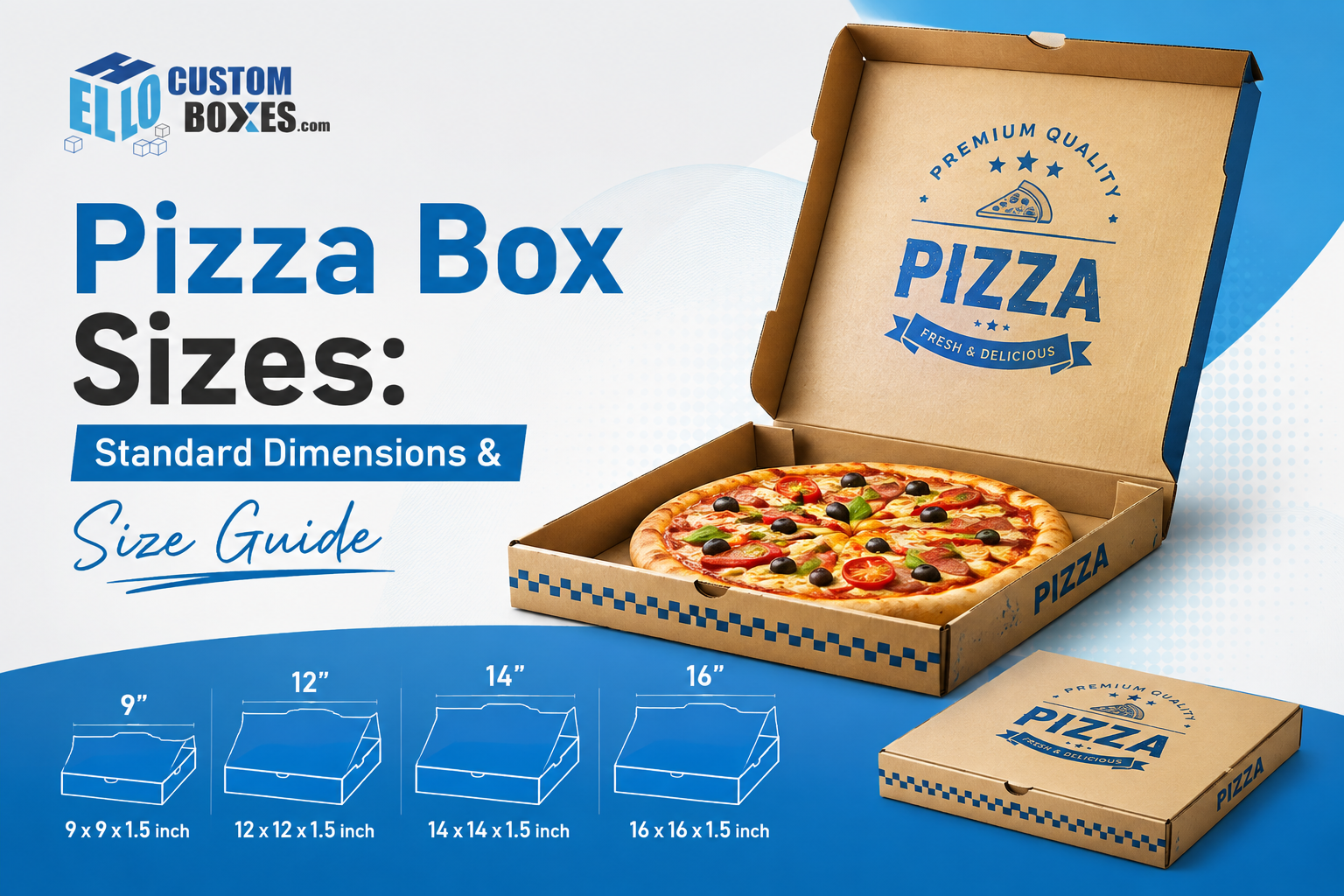
Pizza boxes are commonly available in sizes from 8 to 18 inches, with 10, 12, 14, and 16-inch formats frequently used for restaurant and delivery packaging. The right box should fit the pizza comfortably without leaving excessive space or pressing against the crust and toppings.
A pizza box is usually described by its internal length and width, but depth also matters. Board thickness, crust style, toppings, and supplier tolerances can affect the final dimensions.
Quick Answer: Common pizza box sizes include 8 × 8, 10 × 10, 12 × 12, 14 × 14, 16 × 16, and 18 × 18 inches. These are nominal sizes rather than a universal standard, so actual dimensions may vary slightly between manufacturers.
What Are the Standard Pizza Box Sizes?
There is no single mandatory standard for pizza packaging in the USA. However, several square sizes are widely used throughout the foodservice and packaging industries.
Small Pizza Box Size
A small pizza box is commonly around 8 × 8 or 10 × 10 inches.
These sizes work well for personal pizzas, small pies, lunch portions, and individual orders.
The correct size depends on the actual baked diameter rather than the menu description alone. One restaurant’s “small” pizza may be different from another’s.
Medium Pizza Box Size
A 12 × 12-inch box is a common medium format.
It provides a practical size for many standard restaurant pizzas while remaining compact enough for takeaway and delivery.
If the pizza is exactly 12 inches after baking, slightly more internal clearance may be needed depending on the crust and box construction.
Large Pizza Box Size
Large pizza boxes commonly fall around 14 × 14 or 16 × 16 inches.
A 14-inch format is widely used for standard large pizzas, while some restaurants use 16 inches as their large or extra-large size.
This is why the menu label alone should not determine the box dimensions.
Extra-Large Pizza Box Size
Extra-large pizza packaging usually starts around 16 × 16 inches and may extend to 18 inches or more.
Larger boxes need enough board strength to remain stable when carried, stacked, and delivered. Structural performance becomes increasingly important as the footprint grows.
Pizza Box Size Chart in Inches and Centimeters
The chart below shows common nominal pizza box sizes and their metric equivalents.
These measurements should be treated as a starting point. Supplier specifications can vary, and external measurements may be slightly larger than usable internal dimensions.
8-Inch Pizza Box Size
An 8-inch pizza box measures approximately 20.3 × 20.3 cm.
It is suited to mini pizzas, individual servings, kids’ portions, and smaller specialty pies.
10-Inch Pizza Box Size
A typical 10 inch pizza box size is approximately 10 × 10 inches, or 25.4 × 25.4 cm.
It is commonly considered for small or personal pizzas.
12-Inch Pizza Box Size
A standard 12 inch pizza box size is approximately 12 × 12 inches, or 30.5 × 30.5 cm.
The actual pizza diameter should still be checked before production, especially where thick crusts or irregular handmade bases are used.
14-Inch Pizza Box Size
A 14-inch box measures approximately 35.6 × 35.6 cm.
This is one of the common options for large restaurant pizzas and delivery orders.
16-Inch Pizza Box Size
A 16-inch pizza box measures approximately 40.6 × 40.6 cm.
It is suitable for larger pizzas and requires a board construction that can support the increased span without excessive flexing.
18-Inch Pizza Box Size
An 18-inch pizza box measures approximately 45.7 × 45.7 cm.
This format is generally used for extra-large, family, party, or sharing pizzas.
What Size Is a Large Pizza Box?
There is no universal answer because restaurants use different naming systems.
In many cases, a standard large pizza box size is around 14 × 14 or 16 × 16 inches. The correct box should be selected from the finished pizza diameter rather than relying only on the word “large.”
For example, a restaurant selling a 14-inch large pizza will normally require packaging around that footprint, with enough internal clearance for easy placement and removal.
What Is the Average Pizza Box Size?
If you are looking for an average pizza box size, 12 to 14 inches represents a practical middle range among common commercial formats.
However, an “average” measurement is less useful when ordering packaging.
A pizzeria should base its box dimensions on the pizzas it actually produces. Accurate sizing reduces unnecessary space while protecting crust edges and toppings.
How to Measure a Pizza Box Correctly
Pizza packaging should be measured as length × width × depth.
For custom production, clarify whether the dimensions being supplied are internal or external.
Length and Width
Measure the pizza at its widest point after baking.
Because pizzas are not always perfectly round, check several points rather than relying only on the intended dough size.
The usable internal dimensions of the box should accommodate the finished pizza comfortably.
Box Depth
Depth is the vertical space between the base and lid.
Many standard pizza boxes are roughly 1.5 to 2 inches deep, although deep-dish pizzas or heavily topped products may require more clearance.
Too little depth can allow the lid to touch cheese or toppings. Excessive depth can make the package unnecessarily bulky.
Clearance Around the Pizza
Allow enough clearance for the pizza to be inserted and removed without crushing the crust.
Clearance should be controlled rather than excessive. Large gaps allow the pizza to move around during delivery.
How Much Bigger Should a Pizza Box Be Than the Pizza?
There is no fixed clearance that works for every pizza.
Some commercial boxes use the same nominal size as the pizza, while others provide additional usable space. For example, supplier conventions can range from a nominal 12 × 12-inch box for a 12-inch pizza to a slightly larger carton designed to provide additional clearance.
The safest approach is to test the finished baked pizza inside a sample box.
The ideal fit should:
- protect the crust edges;
- prevent toppings from touching the sides;
- allow easy removal; and
- limit excessive movement during delivery.
How to Choose the Right Pizza Box Size
Match the Box to Pizza Diameter
Start with the finished pizza rather than the raw dough measurement.
Baking, crust formation, and production methods can slightly change the final diameter.
Consider Crust Thickness and Toppings
A thin-crust cheese pizza and a thick, heavily topped pizza may need different box depths even when their diameters are identical.
Check vertical clearance as carefully as width.
Avoid Too Much Empty Space
A significantly oversized box uses more board and allows the pizza to shift during transportation.
Right-sizing creates a cleaner presentation and makes the packaging more efficient without compromising protection.
Do Pizza Box Sizes Vary Between Restaurants?
Yes. Terms such as small, medium, large, and extra-large are not standardized across restaurants.
One brand may call a 14-inch pizza large, while another may use 16 inches.
HotBox Pizza provides a useful example: its menu currently lists a 10-inch small, 14-inch large, and 16-inch extra-large pizza. This demonstrates why searches for terms such as hot box pizza sizes should not be treated as a universal pizza-box sizing standard.
Packaging buyers should therefore work from actual pizza diameter rather than restaurant size labels.
Standard vs Custom Pizza Box Sizes
Standard sizes are useful when the pizza already fits an established packaging format.
Custom dimensions become valuable when a restaurant has:
- an unusual pizza diameter;
- square or rectangular pizzas;
- deep-dish products;
- specialty crusts;
- unique portion formats; or
- specific presentation requirements.
Custom sizing can also help reduce unnecessary empty space and create a more deliberate fit around the product.
Custom Printed Pizza Boxes in All Sizes
Hello Custom Boxes can produce custom printed pizza boxes in different sizes for restaurants, pizzerias, takeaway businesses, and food brands.
The specification should be built around the food, handling conditions, and desired presentation rather than selecting dimensions from a generic size label.
Custom Box Dimensions
Custom dimensions allow the box to match the actual pizza more closely.
Before finalizing a dieline, provide:
- finished pizza diameter;
- required box depth;
- crust style;
- typical topping height; and
- preferred box structure.
Testing a sample before a larger production run can help confirm the fit.
Printing and Branding Options
Pizza boxes can carry logos, brand colors, contact information, QR codes, promotional graphics, and other customer-facing details.
Artwork should remain clear and practical. Strong branding does not require filling every panel with graphics.
A simple, recognizable design often works better on delivery packaging.
Choosing the Right Board Strength
Size is only one part of pizza-box performance.
The board also needs enough rigidity for handling and stacking. Corrugated constructions are commonly used because they provide strength while remaining relatively lightweight. When comparing food packaging materials, consider board strength alongside grease resistance, moisture exposure, stacking, and delivery conditions.
Larger pizzas generally place greater demands on the base panel, so material selection should consider:
- pizza weight;
- box span;
- stacking;
- delivery conditions; and
- moisture and grease exposure.
The goal is not simply to choose the thickest board. It is to use a structure suitable for the actual application.
For the best fit, measure the finished pizza first and build the packaging specification around the product rather than relying only on labels such as small, medium, or large.
Frequently Asked Questions
A regular pizza box is often around 10 to 12 inches, but “regular” is not a standardized industry measurement. Always check the actual pizza diameter.
A 10-inch pizza commonly uses a box around 10 × 10 inches, although slightly more internal clearance may be appropriate depending on the crust and manufacturer.
A 12 × 12-inch pizza box is commonly used for a 12-inch pizza. Check the internal dimensions and finished pizza before finalizing the specification.
Large pizza boxes commonly measure around 14 × 14 or 16 × 16 inches. Restaurant definitions of “large” vary.
In the USA, pizza box sizes are usually specified in inches. Metric measurements in centimeters can be provided when required.
Yes. Custom pizza boxes can be produced around specific pizza diameters, depths, structures, printing requirements, and branding needs.