Getting the box sizes wrong is one of the fastest ways to lose money on shipping and risk damaged products. The good news? It’s pretty easy to get it right once you know what to measure and how the numbers work.
This guide walks you through everything you need: how box dimensions actually work, the difference between internal and external measurements, step-by-step measuring, ready-to-use size charts for common shipping and mailer boxes, product-specific recommendations, and how size affects your UPS, FedEx, and USPS costs. Whether you’re packing cosmetics, apparel, candles, electronics, or mixed orders, you’ll finish with clear, practical answers.
At Hello Custom Boxes, we help U.S. businesses every day choose or create the right packaging. Here’s the straightforward knowledge that keeps products safe and shipping costs under control.
How Box Dimensions Work (L × W × H Explained Simply)
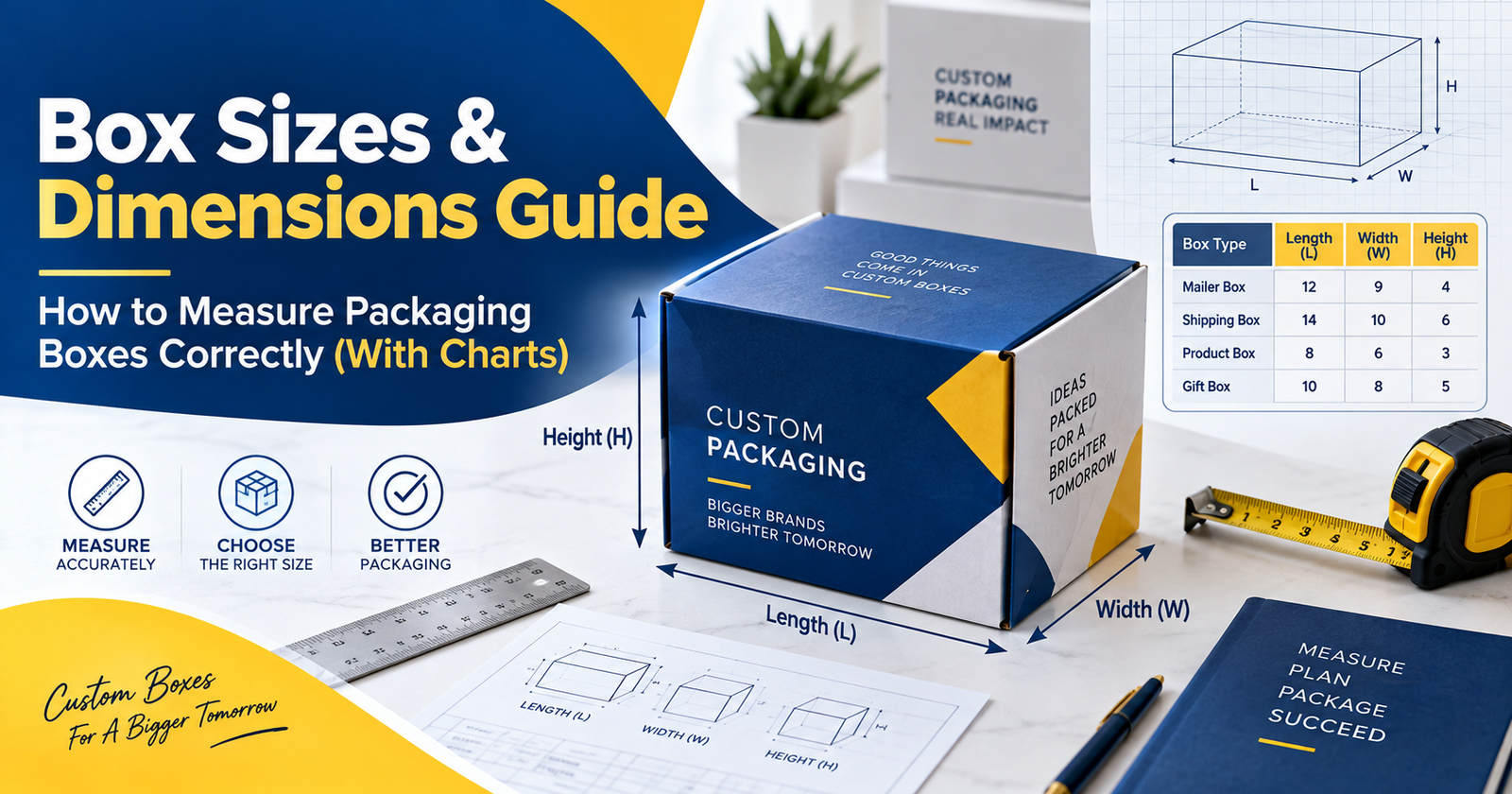
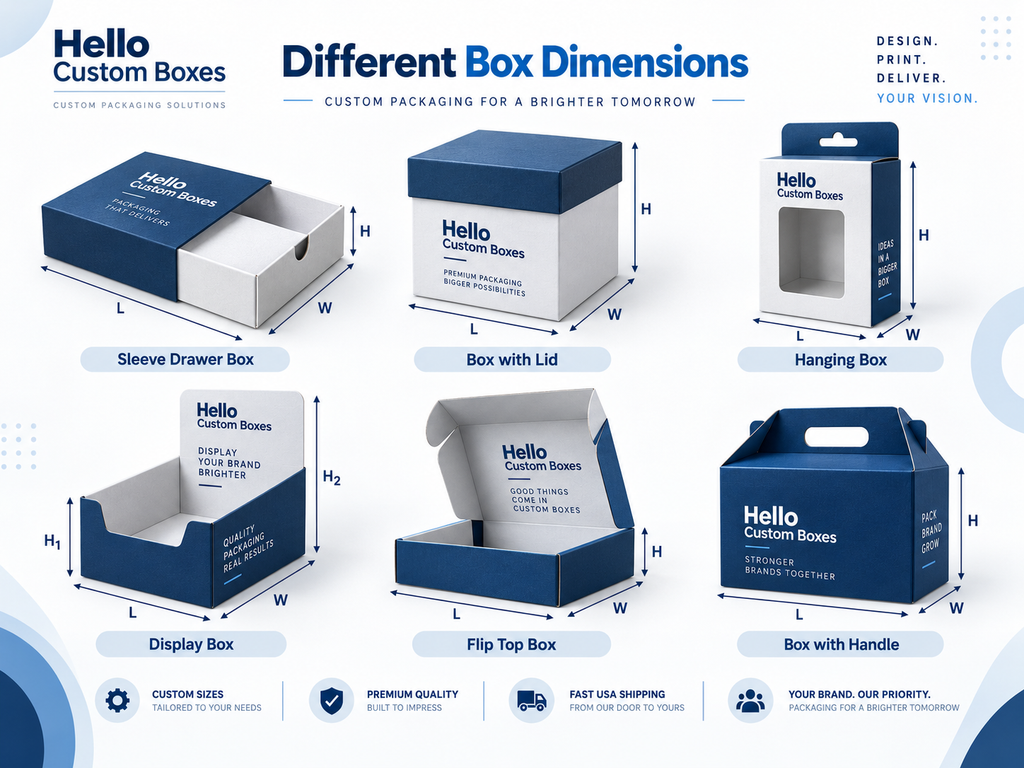
Box dimensions are always listed as Length × Width × Height (L × W × H) in inches in the United States.
- Length is the longest side of the box opening.
- Width is the shorter side of the opening.
- Height (sometimes called depth) is the distance from the bottom to the top when the box is closed or standing upright.
Think of it like describing a shoe box: the longest side of the open top is length, the shorter side is width, and how tall the box stands is height. Most packaging suppliers and carriers follow this order. When you see “12 × 9 × 4,” that means 12 inches long, 9 inches wide, and 4 inches high.
These numbers almost always refer to internal (inside) dimensions when you’re matching a product to a box. That usable space is what actually matters for fit.
Internal vs External Dimensions – The Biggest Mistake People Make
This one trips a lot of people up and quietly costs money.
Internal dimensions are the usable space inside the box—the measurements your product (plus padding) must fit into.
External dimensions include the thickness of the cardboard walls and are what carriers use for dimensional weight, pallet space, and size limits.
For a typical single-wall corrugated box, the difference is roughly ⅛ to ¼ inch per side (more for double-wall). So a box listed as 12 × 9 × 6 internal might measure closer to 12.25 × 9.25 × 6.25 external.
If you order based on external numbers and expect your product to fit snugly, you’ll end up with a box that’s too small or one that forces extra void fill.
Always confirm whether a supplier is quoting internal or external dimensions.
How to Measure Any Box Correctly (Step-by-Step)
You don’t need fancy tools—just a tape measure or ruler and a few minutes.
- Open the box fully and flatten any flaps so you can see the true inside edges.
- Measure the longest inside edge of the opening—that’s length.
- Measure the shorter inside edge of the opening—that’s width.
- Measure from the inside bottom to the top of the side wall (or to the underside of the closed lid if it’s a lid-style box)—that’s height.
- Record the numbers in inches, and note whether they are internal.
- For an existing product, measure the product itself first (longest side, next longest, and thickness), then add space for padding.
Standard Shipping Box Size Chart
Here are the most common corrugated shipping box sizes used across U.S. e-commerce, warehouses, and small businesses. Dimensions are approximate internal measurements in inches. Actual stock can vary slightly by supplier.
Standard Shipping Box Size Chart
Jewelry, small cosmetics, and samples
Candles, electronics, books
Skincare sets, shoes, kits
Apparel, electronics, multi-item packs
Bulk orders and home goods
Lightweight bulky items and bedding
These cover the majority of everyday package sizes. A medium box size around 12 × 12 × 12 is one of the true workhorses for general shipping.
Mailer Box & Retail Box Size Chart
Mailer boxes (often called shippers or e-commerce boxes) are usually shallower and designed for clean presentation and efficient shipping. Common internal sizes include:
Standard Box Size Guide
6 × 4 × 2
9 × 6 × 3
12 × 9 × 4
14 × 10 × 6
These package sizes keep dimensional weight lower while still looking professional when the customer opens them.
Recommended Box Sizes by Product Type
Match the box to the product plus a little room for protection:
- Cosmetics & skincare: Small cubes or mailers (4 × 4 × 4 to 8 × 6 × 3). Add tissue or a simple insert.
- Candles (jar): 4 × 4 × 4 to 6 × 6 × 6 depending on jar height. Cushion the glass.
- Apparel (t-shirts, hoodies): Flatter mailers such as 10 × 8 × 3 or 12 × 9 × 4. Fold neatly and use tissue.
- Electronics: Medium sizes with foam or bubble wrap (10 × 8 × 6 up to 14 × 12 × 8). Prioritize protection.
- Jewelry: Extra-small rigid or mailer boxes (2–4 inch range) with padding or cotton fill.
- Food / snacks: Food-safe mailers or cubes sized tightly to the product to minimize shifting.
- Mixed or subscription orders: Medium rectangular boxes that accommodate your most common combination without excess space.
When in doubt, measure your highest-volume SKU first and build a short “box fit map” for your top products.
How Box Size Affects Shipping Costs
Carriers don’t only charge by scale weight. They also use dimensional weight (DIM weight). The formula is simple:
As of recent carrier rules, UPS and FedEx commonly use a divisor of 139 and round each dimension up to the next whole inch before calculating. USPS typically uses 166 for packages over one cubic foot (and has been aligning rules). You pay the higher of actual weight or DIM weight.
A lightweight item in an oversized box can cost far more than the same item in a properly sized box. That’s why choosing the smallest practical box size—without crushing the product—directly protects your margins. Large box dimensions or the dimensions of a big box quickly push up billable weight.
Always measure the finished, sealed package for the most accurate quote.
How to Choose the Perfect Box Size
Use this easy formula:
Product measurements + padding/void fill + a little breathing room (usually ½–1 inch total per dimension for most items; more for fragile goods).
Example: A product that measures 9 × 6 × 3 inches with light padding often fits well in a 10 × 8 × 4 mailer. Test with real packing materials before ordering large quantities. The goal is a snug, secure fit—not a box that rattles or one that requires excessive filler.
Common Box Sizing Mistakes (And How to Avoid Them)
- Ordering by external dimensions and discovering the product doesn’t fit.
- Choosing a much larger box “just in case” and paying higher DIM charges.
- Forgetting padding space so items shift and get damaged.
- Using the same box size for every product instead of matching the most common ones.
- Ignoring carrier maximums (UPS/FedEx length + girth limits, USPS combined length + girth rules).
Measure, test, and standardize on a short list of sizes. It speeds packing and cuts costs.
When Custom Boxes Make More Sense Than Stock Sizes
Stock boxes work great when your product fits a common size with reasonable void fill. Custom boxes (or custom mailers) make more sense when:
- Your product has an unusual shape or exact fit requirement.
- You ship high volume of the same item and want to eliminate wasted space and material.
- Brand presentation and unboxing experience matter.
- You need specific strength, inserts, or printing.
Many businesses start with stock sizes and move to custom once volume justifies it. At Hello Custom Boxes we help you evaluate both options so you only pay for what you actually need.
Quick Reference Charts
Bookmark or screenshot the two main charts above (standard shipping boxes and mailer boxes). They cover the majority of everyday box sizes and package sizes used in the U.S.
Final Thoughts
Choosing the right box size isn’t complicated once you understand L × W × H, internal versus external measurements, and how carriers calculate costs. The charts and steps in this guide give you a practical starting point for almost any product.
If your items don’t fit the standard options cleanly, or if you want packaging that matches your brand and reduces long-term costs, the team at Hello Custom Boxes is ready to help. Visit hellocustomboxes.com, share your product dimensions, and we’ll walk you through stock or custom options that protect your products and your bottom line.
Get the size right the first time, your customers (and your shipping budget) will thank you.
Frequently Asked Questions
Measure your product, add padding space, and match the closest internal dimensions from the charts. Start with the smallest box that still protects the item.
Product-fit sizes are almost always internal. Shipping cost calculations use external (or the finished package measurements).
Commonly around 10 × 8 × 6 to 12 × 12 × 12 inches internal, depending on whether it’s a shipping carton or mailer.
Larger external volume raises dimensional weight, so you may pay more even if the actual weight is low.
Yes—when the product fits safely. Smaller boxes usually mean lower material cost and lower DIM weight.