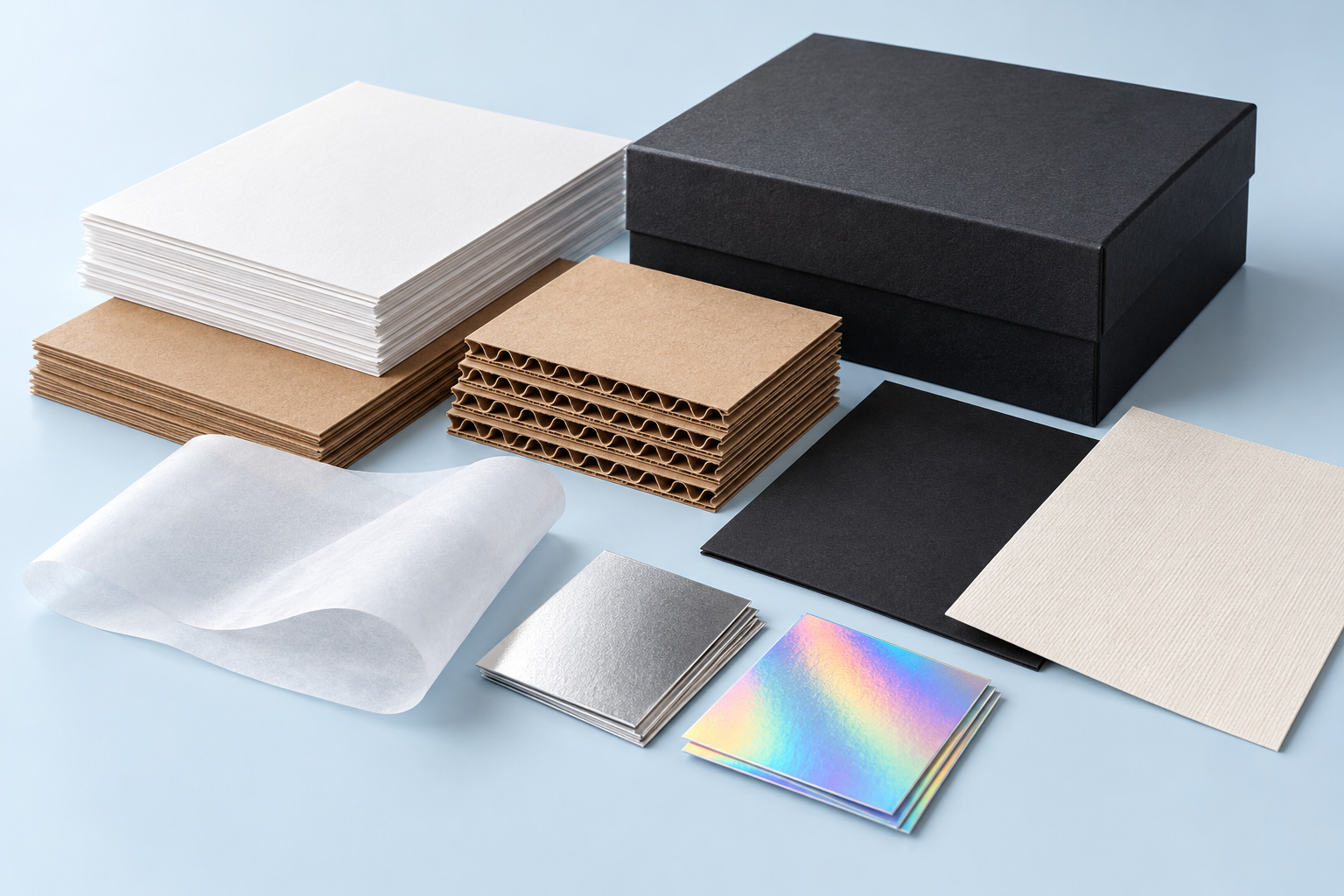
Which material should I choose for a custom box?+
Start with the product weight, box size and delivery route. SBS and kraft paperboard suit many retail cartons; corrugated is a starting point for shipping; rigid construction suits presentation. Then select the surface, print and any inserts. Validate the complete package for the intended use.
Are kraft paper and kraft paperboard the same?+
No. Kraft wrapping paper is flexible and used for wraps, liners and light void fill. Kraft paperboard is a stiffer stock used for folding cartons and sleeves. Ask for the exact grade and thickness rather than choosing from the color alone.
What is the difference between GSM, points and millimeters?+
GSM measures mass per unit area, not thickness. Points and millimeters can describe caliper: one point is 0.001 inch, so 18 pt is about 0.457 mm. Papers with the same GSM can have different thicknesses and stiffness. Compare the actual stock specifications.
Is butter paper the same as baking parchment?+
Not necessarily. Butter paper is a trade name used differently across markets. Greaseproof paper, waxed paper and baking parchment can have different treatments and heating limits. Confirm the exact grade and intended use; do not assume a liner is suitable for an oven or microwave.
Are all of these materials suitable for direct food contact?+
No material name establishes food-contact suitability by itself. The selected paper, barrier, inks, adhesives and use conditions need to suit the application. Tell us the food type, direct-contact needs, storage conditions and any heating requirements so the specification can be reviewed.
Are holographic and metallic effects the same as foil stamping?+
No. Holographic and metallic stocks can have an effect across the surface of a base material. Foil stamping typically adds selected details such as a logo. The chosen process, base stock and coverage affect printing, folding, appearance and end-of-life handling.
Can black and textured stocks be custom printed?+
They can be printed using compatible processes, but artwork needs to suit the actual surface. Black stock may need opaque white ink or foil for contrast; a textured surface may affect fine details. Review the intended print and finishing method on a physical sample.
Which packaging materials are recyclable?+
Assess the complete finished package rather than its material name. Coatings, films, metallic layers, adhesives, inserts and contamination can affect acceptance. Check the selected construction and local recycling instructions. Brown color alone does not establish recycled content, recyclability or certification.