TL;DR — Quick Answer
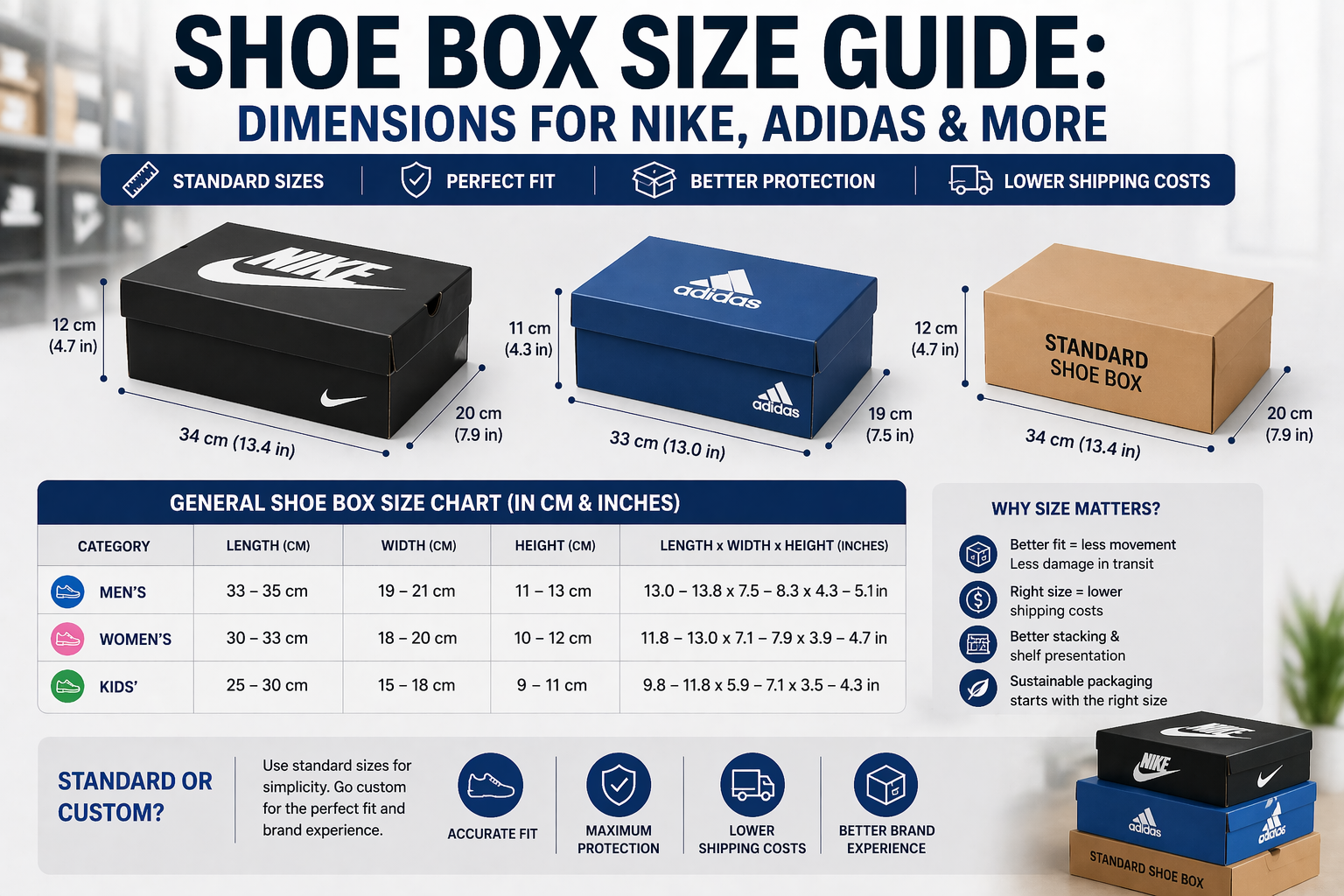
Most shoe boxes end up somewhere near 33 x 19 x 11.5 cm (13 x 7.5 x 4.5 inches). You’ll see that number a lot.
But it’s not exact.
Nike, Adidas, other brands — they all shift it a little depending on the shoe itself. Thicker soles, extra padding, different shapes… the box adjusts with it.
On paper, it looks like a small change. In real use, it shows up pretty quickly. Boxes stop stacking cleanly, extra space builds up, and sometimes the product just shifts around inside.
You’d think a shoe box is just… a box. Fixed size, predictable.
It isn’t.
Walk into a warehouse and you’ll see stacks that look uniform. Then you try packing them for shipping. Suddenly, half your cartons don’t stack right, void space appears, and some boxes collapse under pressure. That’s where most businesses realize: shoe box size isn’t standard in practice.
What “Standard Shoe Box Size” Actually Means
People often search for a single number. Something clean. Reliable.
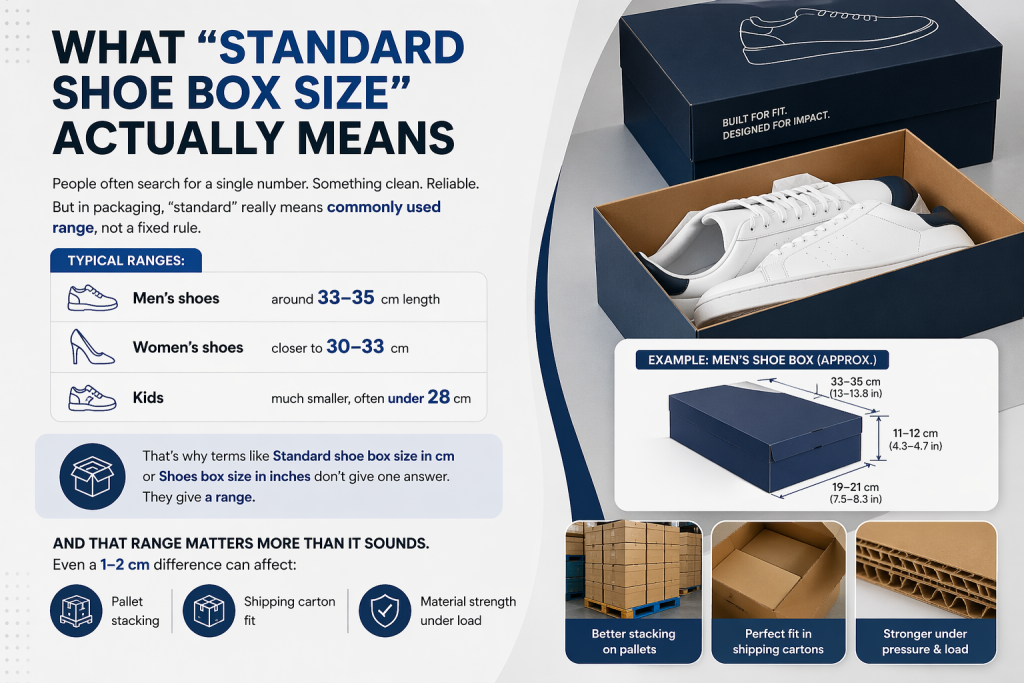
But in packaging, “standard” really means commonly used range, not a fixed rule.
Typical ranges:
- Men’s shoes: around 33–35 cm length
- Women’s shoes: closer to 30–33 cm
- Kids: much smaller, often under 28 cm
That’s why terms like Standard shoe box size in cm or Shoes box size in inches don’t give one answer. They give a range.
And that range matters more than it sounds. Even a 1–2 cm difference can affect:
- pallet stacking
- shipping carton fit
- material strength under load
Nike vs Adidas Shoe Box Dimensions (What Changes and Why)
Let’s get practical.
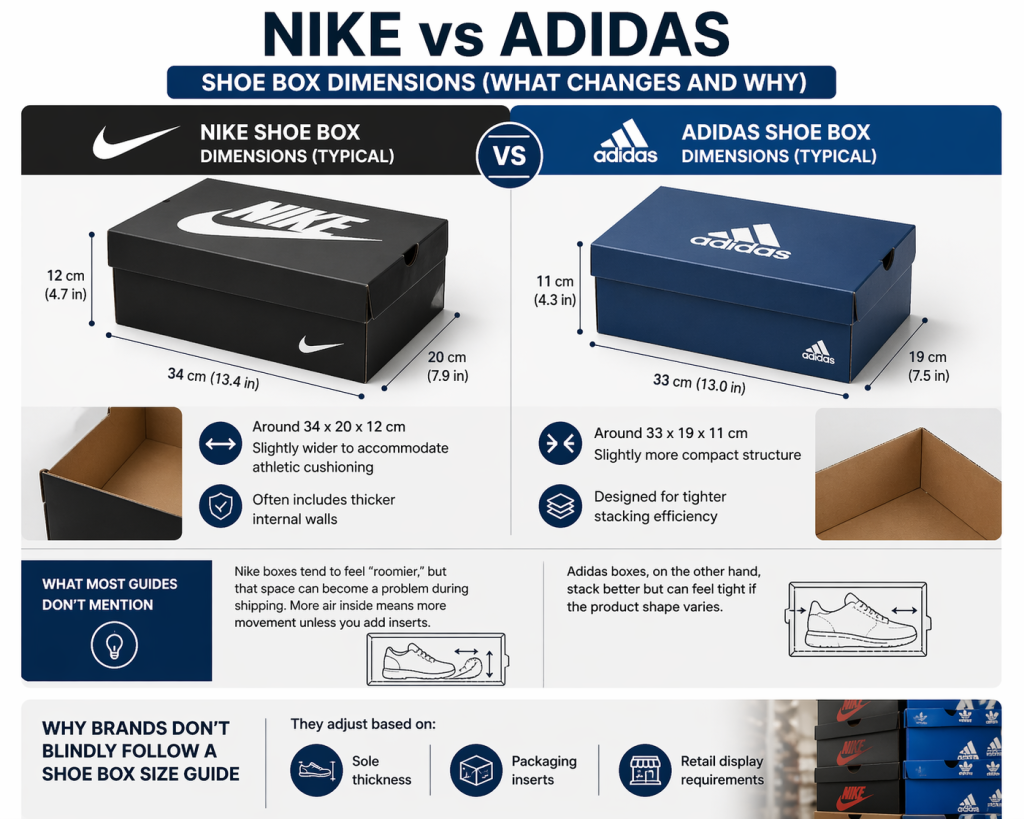
Nike shoe box dimensions (typical)
- Around 34 x 20 x 12 cm
- Slightly wider to accommodate athletic cushioning
- Often includes thicker internal walls
Adidas shoe box dimensions (typical)
- Around 33 x 19 x 11 cm
- Slightly more compact structure
- Designed for tighter stacking efficiency
Now here’s something most guides don’t mention:
Nike boxes tend to feel “roomier,” but that space can become a problem during shipping. More air inside means more movement unless you add inserts.
Adidas boxes, on the other hand, stack better but can feel tight if the product shape varies.
This is why brands don’t blindly follow a shoe box size guide. They adjust based on:
- sole thickness
- packaging inserts
- retail display requirements
Inches vs CM — Why Both Still Matter
You’ll see shoe box measurements listed in both inches and centimeters.
That’s not just for convenience. It’s because different parts of the supply chain use different systems.
- Manufacturing: usually cm
- Shipping and logistics (especially in the U.S.): inches
And mistakes happen here more often than expected.
We’ve seen orders where boxes were designed in cm but shipping cartons were calculated in inches without proper conversion. Result? Misfit cartons, wasted space, and higher shipping costs.
The Real Problem: “Standard Size” Fails in Real Use
Here’s what actually goes wrong in real orders:
- Oversized boxes for smaller shoes
Looks fine visually. But inside? The shoe shifts. Corners crush. - Weak material for stacked shipping
Standard folding cartons don’t always hold when stacked 4–5 layers high. - Ignoring box dimensions for shipping
Retail-ready doesn’t always mean shipping-ready. - No internal support
Without inserts, even a perfectly sized box fails during transit.
This is where many businesses start looking into shoe boxes with custom size instead of relying on standard sizing.
Why Custom Shoe Box Dimensions Make More Sense
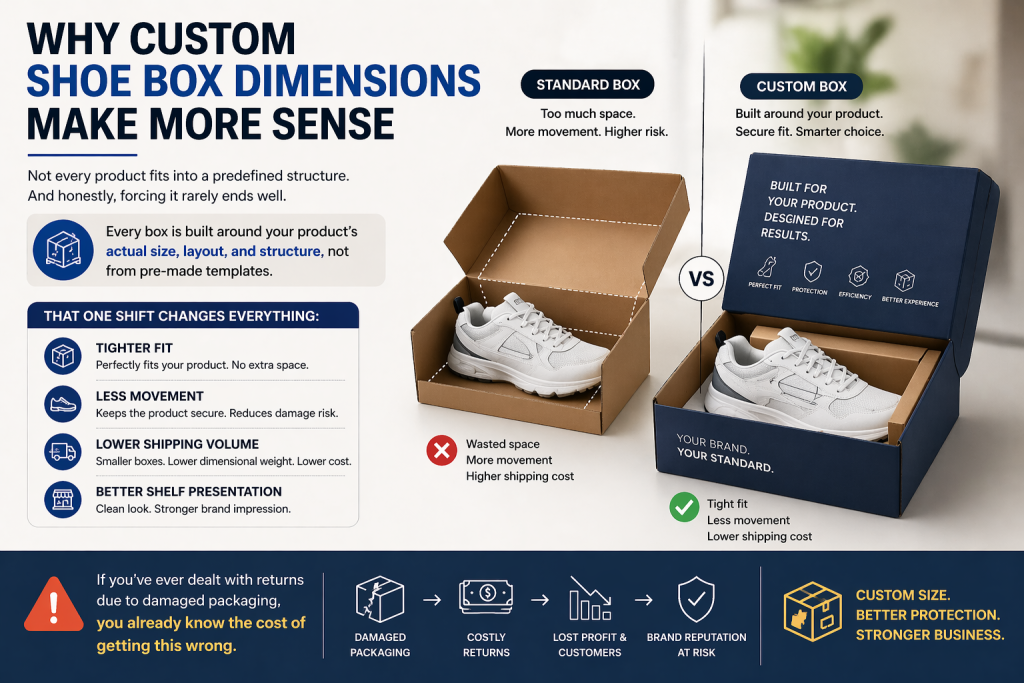
Not every product fits into a predefined structure.
And honestly, forcing it rarely ends well.
Every box is built around your product’s actual size, layout, and structure, not from pre-made templates.
That one shift changes everything:
- tighter fit
- less movement
- lower shipping volume
- better shelf presentation
If you’ve ever dealt with returns due to damaged packaging, you already know the cost of getting this wrong.
Materials and Structure — Not Just Size
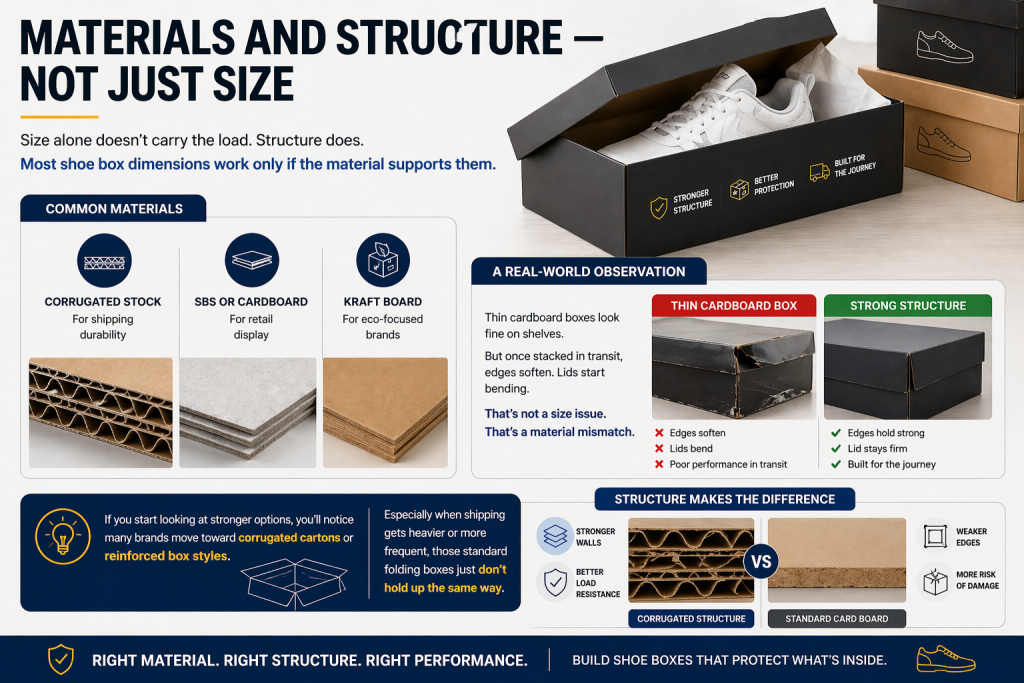
Size alone doesn’t carry the load. Structure does.
Most shoe box dimensions work only if the material supports them.
Common materials:
- Corrugated stock for shipping durability
- SBS or cardboard for retail display
- Kraft board for eco-focused brands
Here’s a real-world observation:
Thin cardboard boxes look fine on shelves. But once stacked in transit, edges soften. Lids start bending. That’s not a size issue. That’s a material mismatch.
If you start looking at stronger options, you’ll notice many brands move toward corrugated cartons or reinforced box styles. Especially when shipping gets heavier or more frequent, those standard folding boxes just don’t hold up the same way.
Small Differences That Affect Big Costs
This is where things get technical.
Even slight changes in shoe box measurements affect:
- shipping weight tiers
- carton configuration
- pallet efficiency
Example:
Increase box height by 1 cm → fewer units per carton → higher shipping cost per unit
It doesn’t look like much on paper. But at scale, it adds up fast.
Common Mistakes Businesses Still Make
Not theory. Real issues we see repeatedly:
- Designing for aesthetics first, fit later
- Ignoring how boxes behave under stacking pressure
- Choosing finishes that scuff during transit
- Using one box size for multiple shoe types
And the biggest one:
Assuming all standard shoe box size options work the same across brands
They don’t.
When to Stick With Standard vs Go Custom
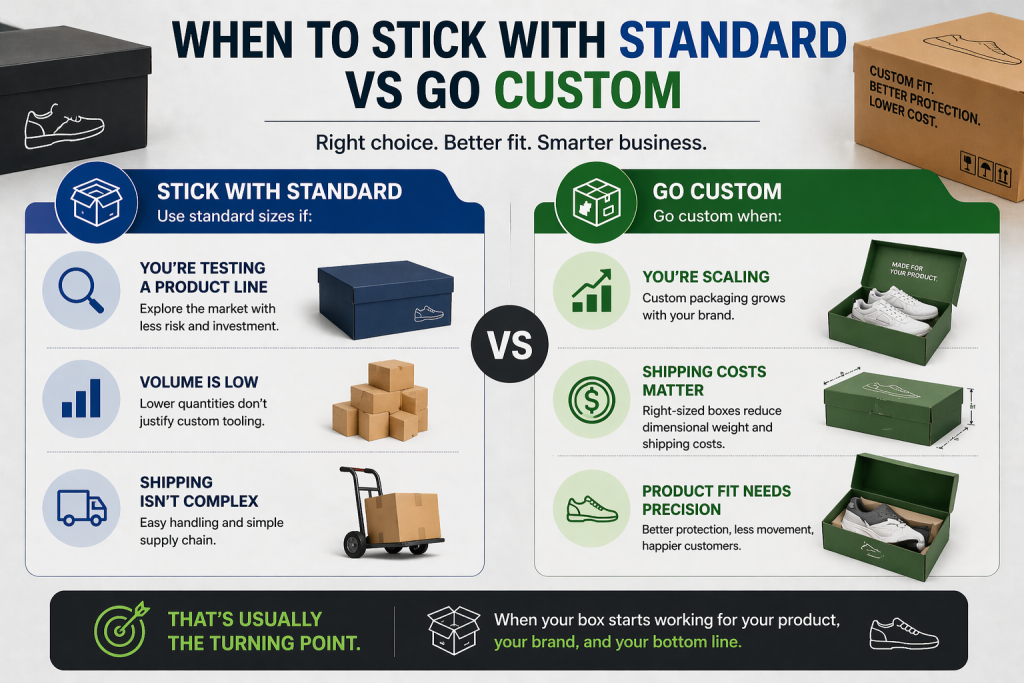
Use standard sizes if:
- You’re testing a product line
- Volume is low
- Shipping isn’t complex
Go custom when:
- You’re scaling
- Shipping costs matter
- Product fit needs precision
That’s usually the turning point.
A Quick Note on Branding and Finish
Size handles protection.
Finish handles perception.
Matte vs gloss, foil stamping, embossing… they all behave differently depending on handling conditions. If you’ve ever compared matte vs gloss finishes what actually works for packaging, you’ll know that some finishes look great but don’t hold up well during transit.
So size, structure, and finish should always be decided together. Not separately.
Frequently Asked Questions
You’ll see 33 x 19 x 11.5 cm mentioned a lot. It works as a general reference. But it’s not exact. Shoe type, shape, even the brand — all of that shifts the box slightly, so sizes tend to vary more than people expect.
Not exactly. Nike boxes are usually slightly larger, while Adidas keeps things more compact for stacking efficiency.
Because even small size differences affect how many boxes fit into a shipping carton. That impacts cost and protection.