
HELLO CUSTOM BOXES · PACKAGING GUIDE
Finishes & Add-ons
Choose the surface and the details.
A finish changes how a box looks or feels. An add-on changes how it displays, holds, or organizes the product. Start with the job your packaging must do, then select a surface treatment and structure together. These are options to discuss during specification; availability and compatibility need confirmation for each project.
THE SHORT ANSWER
Choose matte for restrained reflection, gloss for shine, or soft touch for a velvety feel. Use spot UV or foil to emphasize selected artwork, embossing or debossing for relief, and windows or internal components for presentation and fit. Check the complete construction before making recycling or food-contact claims.
Compare the Look and Construction
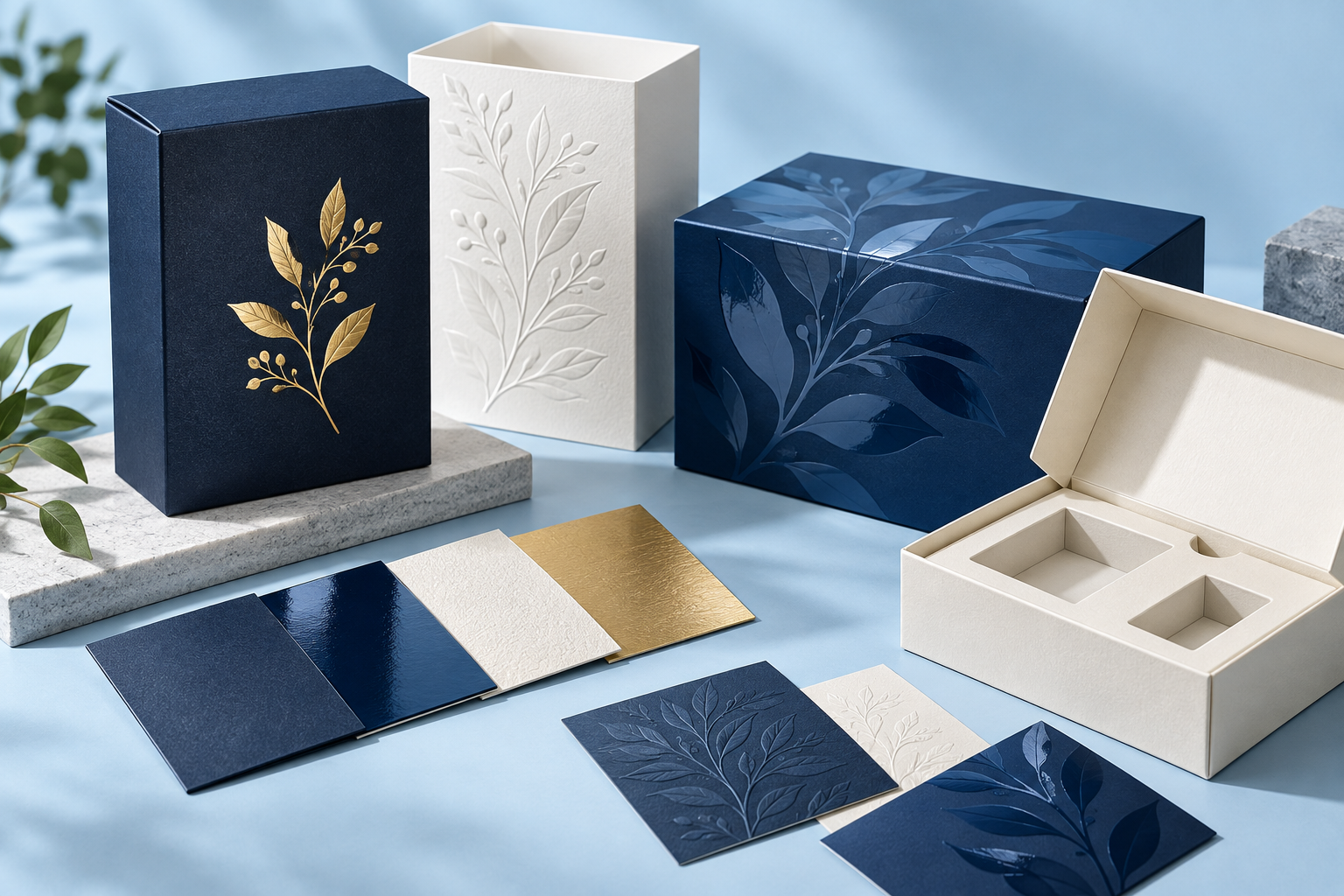
Illustrative samples help describe an effect. Use physical samples to approve the specified finish.
Lamination and coatings are different constructions
Lamination bonds a separate film to paperboard. A coating or varnish is applied to the surface and dried or cured. Similar appearance does not mean identical performance.
Matte and gloss
Matte lamination gives a low-shine surface; gloss lamination reflects more light. Both use film. Matte and gloss coatings can create related effects without that separate laminated film. Compare samples on the intended board and artwork, especially where reflections affect small text.
Soft touch
Soft-touch films create a smooth, tactile surface, but soft-touch coatings also exist. Specify the construction alongside the feel. Ask about scuffing, fingerprints, and compatibility with later foil, varnish, and gluing rather than treating every soft-touch finish as interchangeable.
Coating choices
Water-based dispersion coatings dry; UV coatings cure under ultraviolet light. Formulation, surface preparation, and ink compatibility matter. A decorative coating is not evidence that a package is waterproof or suitable for direct food contact.
Reference: Holmen: Film and foil lamination for paperboard · Taghleef: Transparent Gloss & Matte Laminating Films · Derprosa: DL Soft Touch Original · Holmen: Varnishing techniques · HEIDELBERG: Shiny Application 75 Poster · FDA: Determining the Regulatory Status of Components of a Food Contact Material
Spot UV: contrast in selected areas
Spot UV applies UV-cured varnish to chosen elements instead of covering the whole surface.
Plan the highlight
A glossy logo or pattern can contrast with a matte background. Raised digital effects build polymer above the surface; they are different from physically embossing the board. Confirm the intended height, finish adhesion, and alignment with print. Ask the producer how to supply separate finish artwork and keep critical text readable without the effect.
Reference: Holmen: Varnishing techniques · Scodix: Technology · Holmen: Embossing and debossing paperboard
Foil stamping versus metallic stock
A metallic accent and a metallic printing surface solve different design problems.
Localized foil
Hot foil stamping uses heat, pressure, and tooling to transfer decoration to selected areas. The carrier is removed. Consider it for a logo, border, or short line of text; discuss fine-detail limits before approving artwork.
A metallic base
Metallic stock starts with a reflective surface, which may use metallized film laminated to board. Ask for its exact construction. For broad metallic artwork, compare that approach with localized foil, and request a printed sample showing how opaque white and color will behave on the reflective background.
Reference: Holmen: Film and foil lamination for paperboard · KURZ: Hot Stamping · Taghleef: Opaque & Metallized Laminating Films
Embossing raises; debossing recesses
These processes shape paperboard into permanent relief rather than adding a raised varnish layer.
Let the board guide the design
Relief can stand alone or combine with print or foil. Board construction and surface strength limit achievable depth and detail. Request a physical sample to assess cracking, definition, and the reverse-side impression. Have the producer review placement around folds and glue areas instead of assuming a screen mockup proves feasibility.
Reference: Holmen: Embossing and debossing paperboard · Holmen: Gluing
Windows: visibility with structural consequences
A cutout exposes the product; a patched window adds transparent material behind the opening.
Review the opening and patch together
Confirm window material, adhesive, and bond performance. Check the assembled box with its actual contents so the opening shows the intended detail. Ask whether the remaining board supports handling and stacking. An open cutout does not provide the coverage of a patched window.
Reference: Holmen: Gluing
Sleeves, inserts, and partitions
Choose these components for the way the product is packed and removed, as well as how it looks.
Sleeves
A sleeve wraps around a product or container and provides space for graphics and information. Check fit, retention, and assembly. For a promotional version, consider whether a separate sleeve is useful enough to justify another component.
Inserts and partitions
An insert locates a product within the box; partitions separate multiple items into cells. Paperboard and corrugated constructions serve different needs. Test with actual product dimensions and weight, including loading and removal. A neat presentation alone does not establish protection during shipping.
Reference: Smurfit Westrock: Carton sleeve packaging · Smurfit Westrock: Packaging Inserts · Smurfit Westrock: Box Partitions
Choose one priority, then proof the combination
Begin with visibility, touch, product retention, or surface protection. Add effects only when they serve that priority.
Compare complete specifications
Request alternatives using the same board, quantity, and artwork. Ask how tooling, coverage, additional operations, and assembly affect price and timing. A matte surface with one accent is a useful comparison against a more elaborate combination. Review a finished sample for color, adhesion, creasing, rubbing, and fit; a digital proof cannot demonstrate tactile performance.
Reference: Holmen: Film and foil lamination for paperboard · Derprosa: DL Soft Touch Original · Holmen: Embossing and debossing paperboard · Holmen: Gluing
Assess recyclability by grade and construction
A paper-based box is not automatically recyclable in every program.
Evaluate the whole package
Review board grade, films, coatings, adhesives, windows, and removable components together. Some transfer decorations have manufacturer recycling evidence; that evidence does not validate every finished box. Ask for evidence covering the specified construction and follow local collection rules. Do not substitute a recycled-content or compostability claim for a recyclability assessment.
Reference: AF&PA: Design Guidance for Recyclability · AF&PA: What Types of Paper Can Be Recycled? · KURZ: Recyclability of the Finished End Product
Food-contact suitability needs separate evidence
Neither appearance nor a finish name establishes suitability for food packaging.
Describe the intended use
Tell the supplier what food is packed, whether a liner or primary pack separates it from the box, and the contact time and temperature. Request documentation for the relevant materials and conditions. The finish name alone does not establish suitability for that use.
Reference: FDA: Determining the Regulatory Status of Components of a Food Contact Material · FDA: Food Types & Conditions of Use for Food Contact Substances
Before You Send the Specification
Use these checks to prepare your handoff.
Finishes & Add-ons FAQs
Is matte coating the same as matte lamination?
No. Coating is applied and dried or cured; lamination bonds a separate film. Compare the specified materials.
Can soft touch be combined with spot UV or foil?
Some film grades support these combinations. Confirm the exact grade and test the finished combination.
Does foil make every box unrecyclable?
No universal answer applies. Transfer decoration differs from laminated metallic film; evaluate the complete package and collection route.
PLAN YOUR PACKAGING
Discuss the finish before you approve the box.
Share your product, box size and the details you need help with.