You notice it before you touch the box
A customer picks up your product. Same shelf, same price range, similar design. But one box catches light differently. The logo reflects, feels slightly raised, almost tactile. That’s usually where the decision happens.
Now flip the situation. Your packaging looks clean, printed well, but flat. No depth. No second glance.
That gap might look small, but it shows up quickly once the box is in someone’s hands. This is usually where foil stamping comes in. Not to decorate everything, just to give one part of the design a bit more presence so it doesn’t get lost.
TL;DR – Quick Answer
- • Foil stamping packaging uses heat and pressure to apply metallic or pigmented foil onto boxes
- • Commonly used for logos, brand names, and highlight elements
- • Works best on rigid, cardboard, and kraft packaging
- • Adds visual depth and shelf impact without increasing print complexity
- • Ideal for luxury, retail, and premium eCommerce packaging
- • Frequently combined with embossing or matte finishes for contrast
What Is Foil Stamping Packaging?
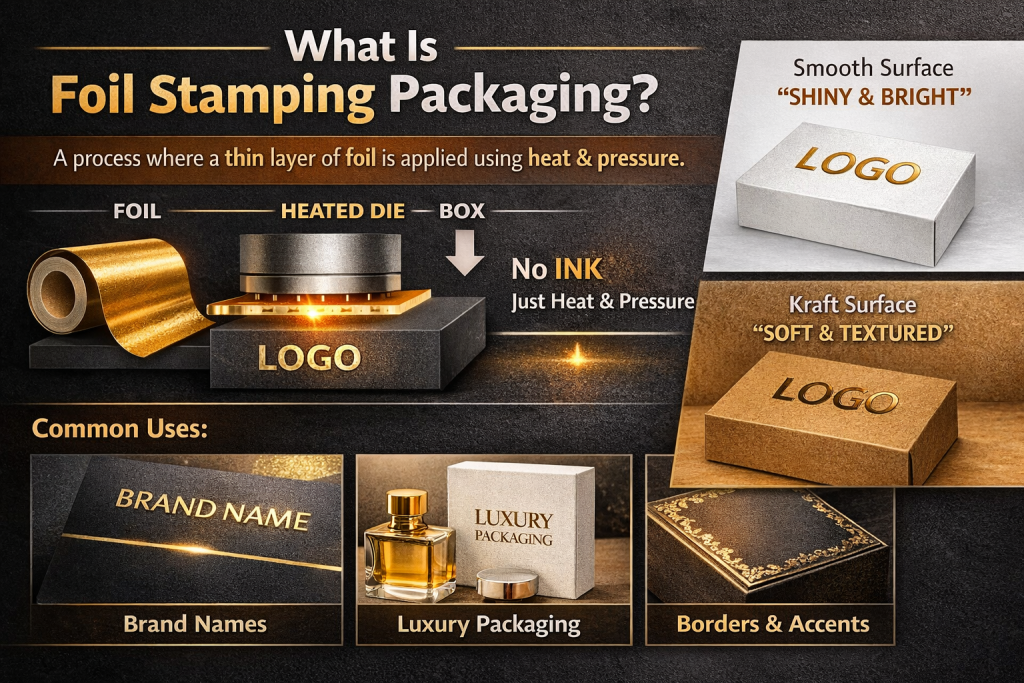
Foil stamping packaging is a printing process where a thin layer of foil, usually metallic, is transferred onto a box using heat and pressure. No ink involved.
In simple terms, instead of printing color, you’re pressing a reflective layer directly onto the surface.
You’ll see it mostly on:
- Logos
- Brand names
- Borders or accents
And here’s something people don’t always realize: foil behaves differently depending on the surface. On smooth SBS board, it looks sharp and mirror-like. On kraft, it softens slightly, almost muted, which some brands actually prefer.
If you’ve ever seen gold foil stamping on perfume or cosmetic boxes, that’s the standard reference point.
Why Foil Stamping Packaging Matters for U.S. Businesses
In retail, especially in the U.S., shelf competition is brutal. Online, it’s even worse because packaging also shows up in unboxing videos and product photos.
Foil stamping helps in ways that aren’t obvious at first:
- Shelf visibility: reflective surfaces catch light faster than printed ink
- Perceived value: customers associate metallic finishes with premium quality
- Brand recall: embossed or foil logos tend to stick visually
There’s also a practical angle. In eCommerce, packaging gets handled, stacked, sometimes slightly compressed. A well-applied foil area usually holds up better than heavy ink coverage, which can scuff.
I’ve seen brands switch from full-color heavy prints to minimal design plus foil, and surprisingly, returns didn’t change, but perceived quality did.
Types of Foil Stamping Used on Boxes
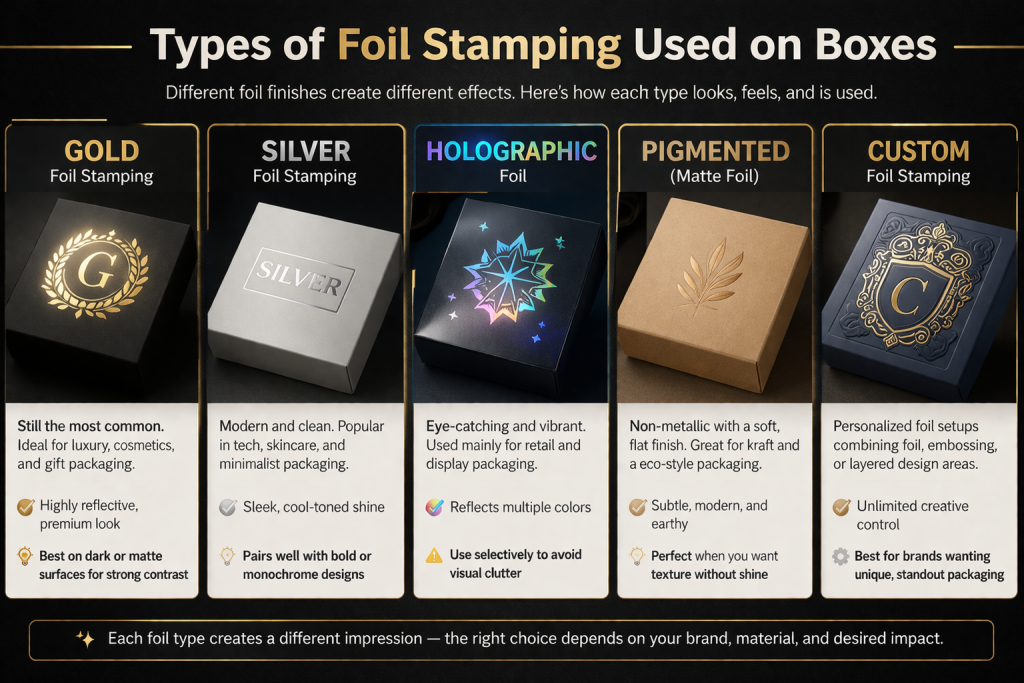
Gold Foil Stamping
Still the most common. Works best for luxury branding, cosmetics, and gift packaging. It reflects light strongly, so placement matters.
Silver Foil
It leans more clean and modern. You’ll see it a lot in tech or minimalist packaging, where silver foil detailing on boxes adds just a bit of reflection without making things look too glossy.
Holographic Foil
Used more in retail display packaging. Eye-catching but can be overwhelming if overused.
Pigmented (Matte Foil)
Non-metallic. Used when you want texture without shine. Works well on kraft boxes.
Custom Foil Stamping
This is where brands experiment, combining foil with embossing or layering it over specific print areas. More control, but requires precise setup.
Materials & Printing Options
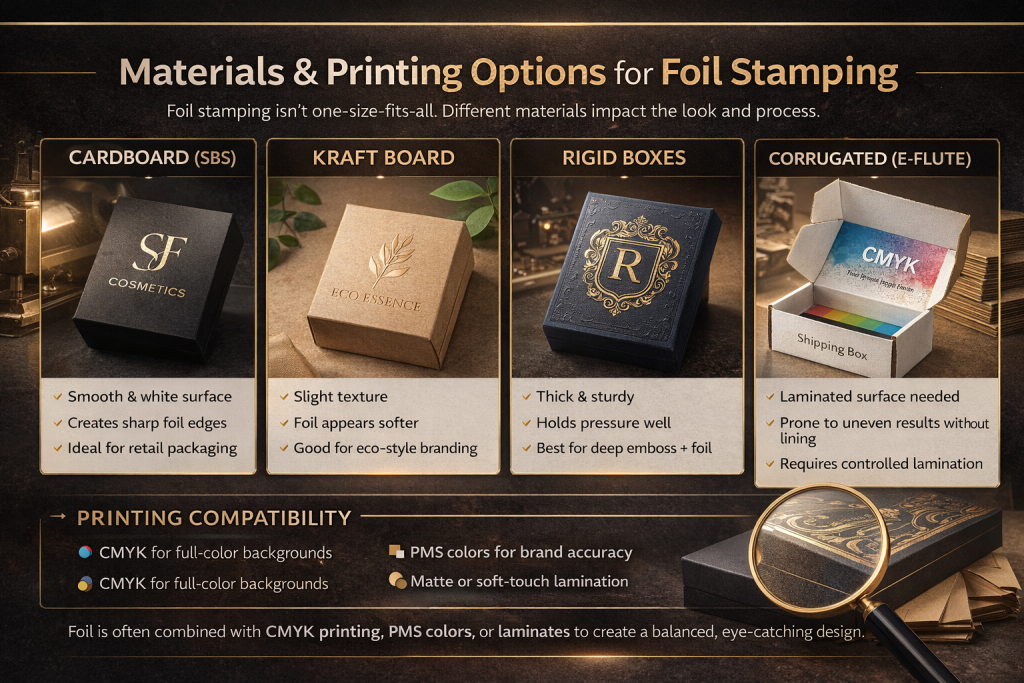
Foil stamping doesn’t work the same across all materials.
Cardboard (SBS)
- Smooth surface
- Best for sharp foil edges
- Common in retail packaging
Kraft Board
- Slight texture
- Foil appears softer
- Good for eco-style branding
Rigid Boxes
- Thick structure
- Holds pressure well
- Ideal for deep emboss + foil combinations
Corrugated (E-flute)
- Limited use for foil
- Requires lamination for proper results
Printing Compatibility
Foil is often combined with:
- CMYK printing for full-color backgrounds
- PMS colors for brand accuracy
- Matte or soft-touch lamination to create contrast
Most of the time, foil isn’t added on its own. It’s worked in alongside CMYK or PMS printing, depending on how the colors are set up and how the metallic parts need to sit on top.
In real production, foil stamping also overlaps with metalized packaging finishes, since both are used to create a reflective effect on the surface rather than relying only on printed color. The difference usually comes down to how controlled the application needs to be and which areas of the design are being highlighted.
Where things usually go wrong with foil stamping
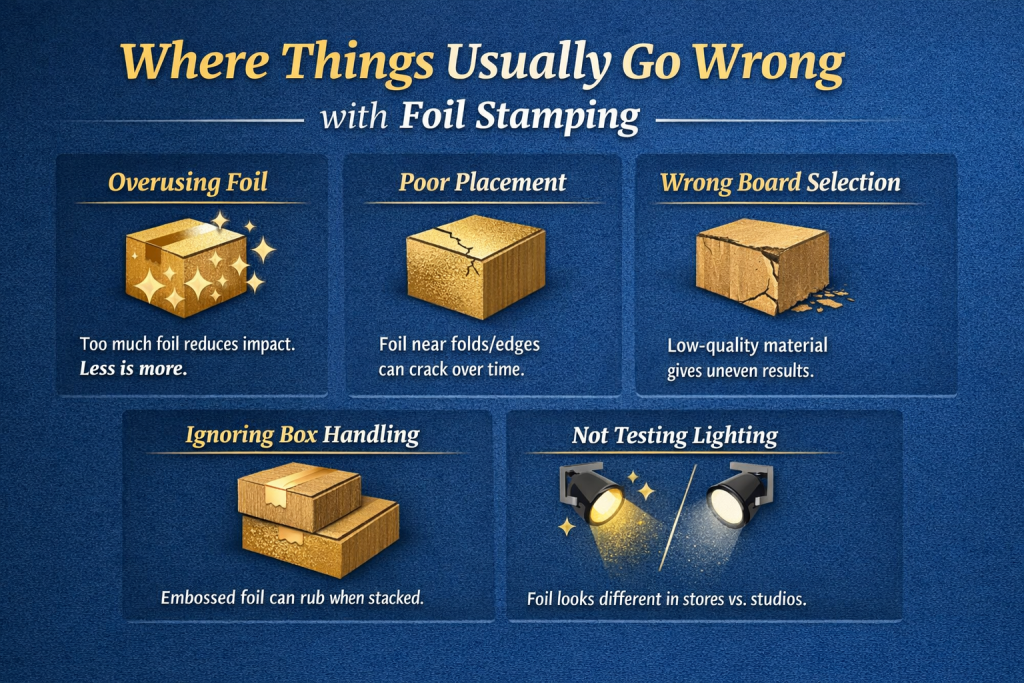
part gets overlooked, but it matters.
1. Overusing foil
Too many foil elements reduce impact. One strong highlight works better than five small ones.
2. Poor placement
Foil near folds or edges can crack over time, especially on tuck-end boxes.
3. Wrong board selection
Trying foil on rough or low-quality material leads to uneven results.
4. Ignoring box handling
If your boxes are stacked tightly, raised foil (with embossing) can rub against each other.
5. Not testing lighting conditions
Foil looks different under retail lighting vs studio lighting. This affects how it appears in stores.
How Hello Custom Boxes Solves This
At Hello Custom Boxes, foil stamping isn’t treated as an add-on. It’s planned alongside structure, material, and printing from the start.
Every box is built around your product’s actual size, layout, and structure, not from pre-made templates.
That changes things. Placement becomes intentional. Pressure settings are adjusted based on board type. Even how the box opens gets considered, so foil areas don’t crack or fade over time.
Real Use Cases Across Industries
eCommerce Brands
Use foil for logos to improve unboxing experience and brand recall.
Retail Packaging
Especially cosmetics and supplements, where shelf visibility matters.
Food Packaging
It’s still not used everywhere, but it’s picking up, especially with dry goods or bakery items where presentation tends to matter more than moisture exposure.
Gift & Promotional Boxes
Foil works well when presentation is part of the product value.
Expert Tips (From Packaging Floor Reality)
- Keep foil areas slightly away from fold lines
- Use matte lamination under foil for better contrast
- Test small runs before full production
- Combine foil with embossing only where needed
- Avoid placing foil on areas that get frequent handling
Thinking About Using Foil Stamping?
If your packaging already looks decent but lacks that final layer of depth, foil stamping is usually the next step.
Not always necessary. But when used correctly, it changes how your product is perceived before it’s even opened.
Conclusion
Foil stamping packaging isn’t just about shine. It’s about control, where attention goes, how branding feels, and how your product stands in a crowded space.
Used carefully, it does its job quietly. But effectively.