A small business preparing 200 holiday gift sets doesn’t want 1,000 unused boxes taking up storage space in January. But ordering too few creates a different problem: customers are ready to buy, and there isn’t enough packaging to fulfill their orders.
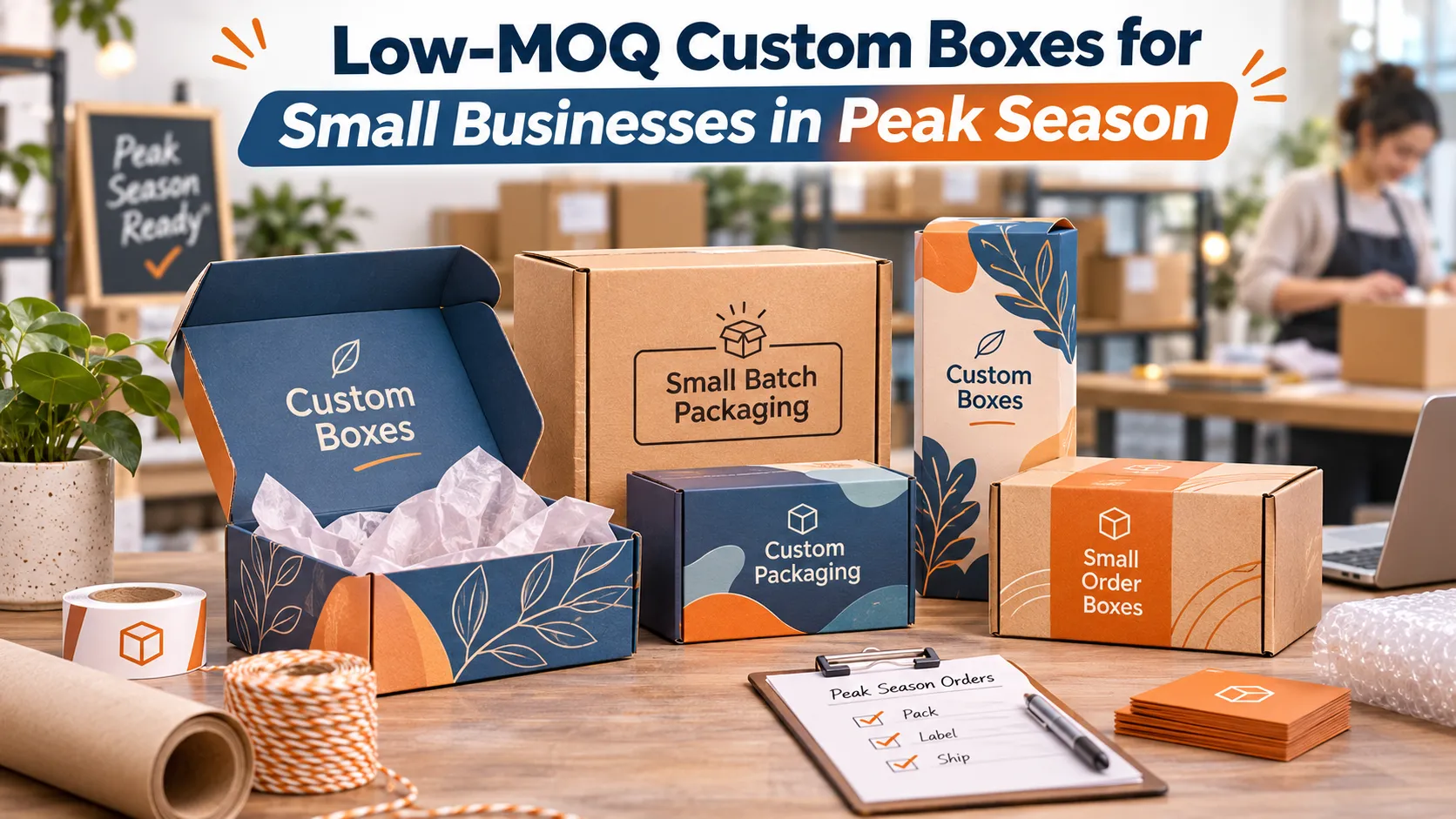
Low MOQ custom boxes can help businesses manage that balance. MOQ stands for minimum order quantity, meaning the smallest number of boxes a supplier will produce in one order. Smaller production runs allow brands to test packaging, prepare limited-edition collections, and manage upfront spending.
The challenge is knowing how many boxes to order, which style to choose, and when to begin production before seasonal demand increases.
What Does Low MOQ Mean for Custom Packaging Boxes?
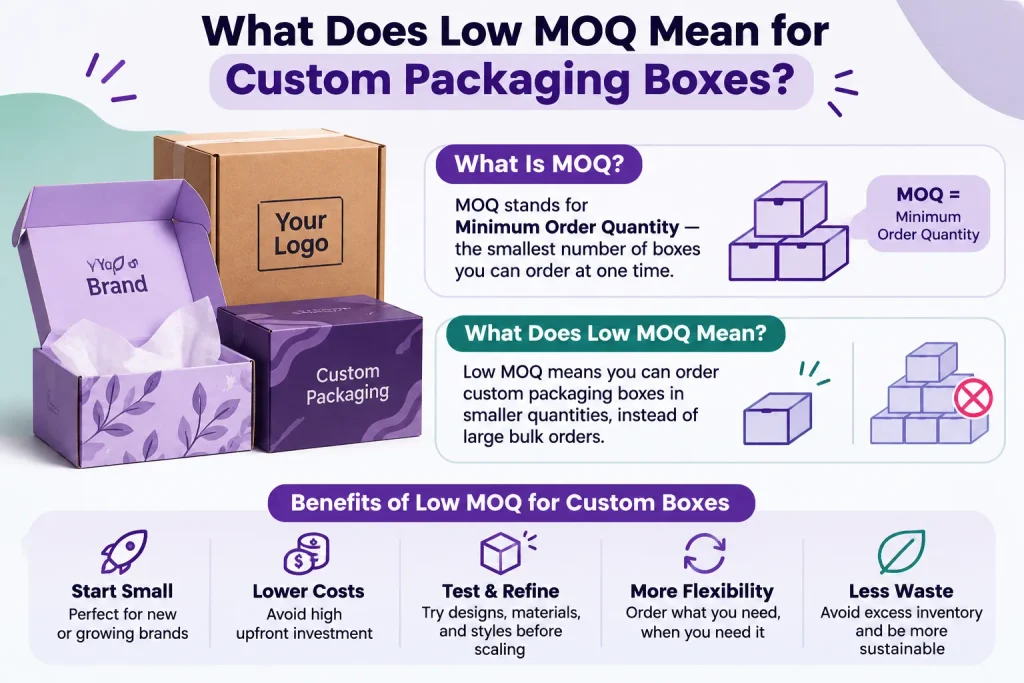
Low MOQ means a packaging supplier accepts relatively small production quantities. There’s no universal number that defines a low minimum; requirements depend on the box structure, materials, printing process, and production setup.
At Hello Custom Boxes USA, standard orders generally start at 100 boxes, although minimums vary by style. Certain specialty or sample runs may have different requirements.
Before placing an order, clarify:
- Minimum per size: Different box dimensions may require separate production runs.
- Minimum per design: Multiple artwork variations aren’t always combined into one order.
- Material requirements: Rigid boxes and folding cartons may have different minimums.
- Printing and finishes: Additional processes can affect production requirements.
A supplier offering 100 custom boxes doesn’t necessarily allow five different designs in quantities of 20 each. Confirm how the minimum applies to your specifications.
Why Small-Batch Packaging Helps During Peak Season
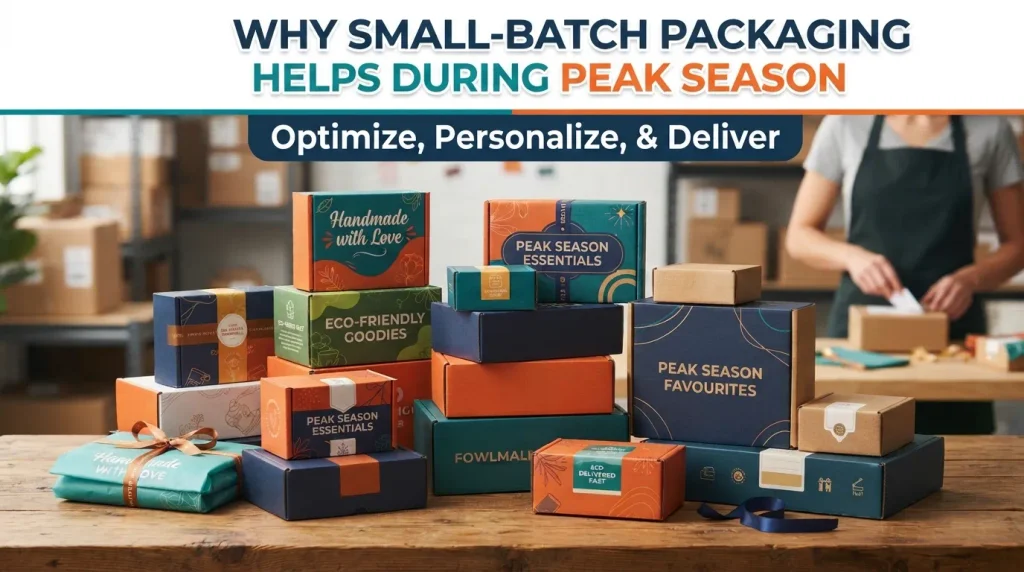
Holiday demand isn’t always predictable, especially for newer brands without previous sales data.
Small batch custom packaging offers flexibility when businesses need branded boxes without committing to excessive inventory.
Its main advantages include:
- Lower upfront spending: Purchase fewer boxes while reserving funds for products, shipping, and marketing.
- Reduced storage needs: Smaller quantities are easier to manage in limited stockroom space.
- Seasonal flexibility: Test holiday artwork without committing to a large production run.
- Product experimentation: Launch new scents, gift sets, or accessories with manageable packaging quantities.
- Lower leftover-inventory risk: Avoid holding excessive event-specific cartons after the promotion ends.
There are trade-offs. Smaller runs often carry higher per-unit costs, and reordering may involve another production cycle.
For products with stable year-round demand, larger quantities may eventually offer better value.
Choose the Right Custom Box for Your Small Business
A low minimum doesn’t make a box suitable for every product. Construction, size, and protection should come before decorative finishes.
Folding Cartons for Retail Products
Folding cartons work well for lightweight products such as soap, cosmetics, small accessories, and promotional merchandise.
They can be supplied flat for convenient storage and assembled as needed. Straight tuck-end and reverse tuck-end structures are common options when a simple retail presentation is required.
Businesses developing product packaging can compare custom box styles for retail merchandise based on their product dimensions and display requirements.
Corrugated Mailer Boxes for Online Orders
Corrugated mailer boxes are useful for subscription kits, small gift sets, and many direct-to-consumer orders.
Their construction can provide additional support during handling, but board strength and protective inserts must match the product.
An oversized mailer may require unnecessary packing material and increase shipping costs. A properly sized design helps keep products more secure.
Gift Boxes for Seasonal Collections
Holiday collections often need packaging that looks distinctive without becoming difficult to assemble or store.
Depending on the product, folding gift cartons, two-piece boxes, or rigid structures may be suitable.
For limited-edition collections, printed holiday packaging options can be planned around product dimensions, seasonal artwork, and expected order quantities.
How Many Custom Boxes Should You Order?
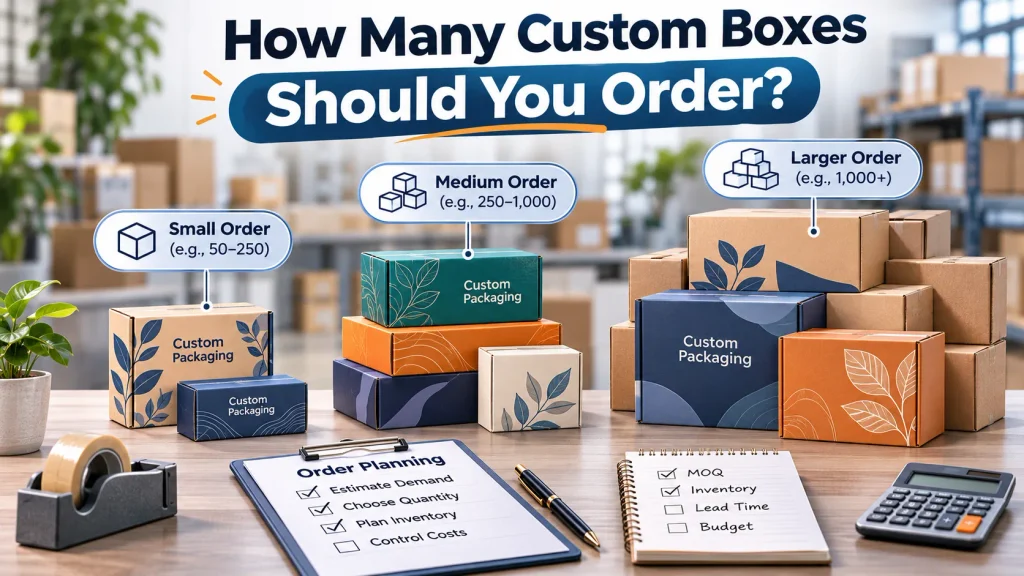
The right quantity depends on expected sales, packaging variations, and how quickly additional stock could arrive.
Begin with actual business information rather than choosing the supplier’s lowest unit-price tier.
Estimate Demand Using Sales and Preorders
Review previous seasonal orders where available. Consider upcoming promotions, confirmed preorders, and changes to your product range.
For example, suppose a gift business expects 180 orders during a seasonal promotion.
Adding a hypothetical 10% allowance for packing mistakes and unexpected demand gives:
180 expected orders + 18 extra boxes = 198 boxes
The business could compare quotes for 200 and 250 boxes rather than immediately ordering 500.
This is an illustrative calculation, not a recommended allowance for every business.
Allow for Damaged Boxes and Reorders
Some additional cartons may be useful, but the allowance should reflect the actual packing process.
Ask yourself:
- How many boxes are used per customer order?
- Do different products need different sizes?
- Can leftover cartons be used after the season?
- How long would another production run take?
- Is the extra inventory worth the additional expense?
For uncertain seasonal demand, a smaller initial order may be preferable. For consistent year-round products, ordering more at once could reduce repeated purchasing costs.
Small-Batch vs. Bulk Custom Box Costs
Larger orders frequently reduce the price per box because production expenses are distributed across more units.
However, lower unit pricing doesn’t always mean lower overall spending.
Consider this hypothetical comparison:
Illustrative numbers only; these are not Hello Custom Boxes quotations.
The 500-box order has the lowest unit cost, but requires $385 more upfront than the 100-box order.
If only 200 seasonal products are sold, the remaining cartons could tie up money and storage space.
Compare the total delivered cost, including printing, setup charges where applicable, inserts, finishes, shipping, and potential leftover inventory.
The best quantity is the one that supports realistic demand at an acceptable total cost—not automatically the largest available discount tier.
Reduce Seasonal Packaging Costs Without Sacrificing Quality
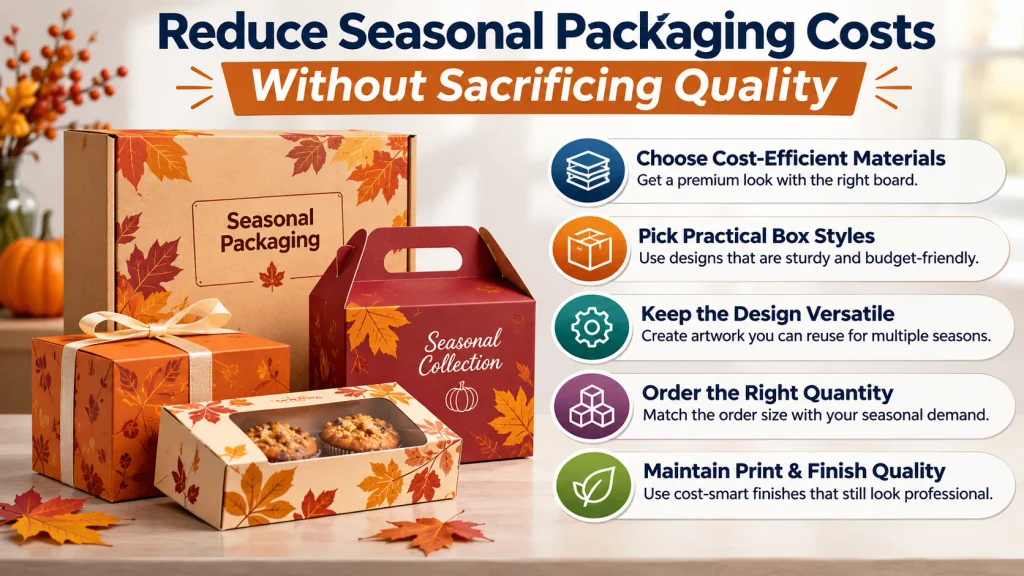
Affordable packaging doesn’t necessarily mean using thinner material or removing essential protective features.
Small businesses can control costs through simpler specifications and better planning.
Consider these approaches:
- Choose accurate dimensions: Avoid oversized boxes and unnecessary void fill.
- Limit artwork variations: Use one coordinated design where products can safely share the same box.
- Keep printing straightforward: Simple graphics may be more suitable than multiple premium finishing processes.
- Use removable seasonal labels: A year-round branded carton can support several promotions.
- Compare material options: Choose sufficient strength without specifying heavier construction than needed.
For example, a candle company could use the same properly fitted carton throughout the year and add a removable holiday sleeve for seasonal collections.
This reduces dependence on dated artwork while preserving a consistent branded presentation.
Quality shouldn’t be compromised where packaging protects fragile products or supports safe transportation.
Plan Custom Box Production Before Peak Season
Custom packaging involves more than printing. Dimensions, materials, artwork, and proof approval must be completed before production begins.
During busy periods, late design changes can affect the order schedule.
A practical preparation sequence is:
- Confirm product dimensions: Include inserts, accessories, and protective materials.
- Select the box style: Check construction, material, and closure requirements.
- Prepare artwork: Provide logos, print files, colors, and required product information.
- Review the proof: Check spelling, panel placement, dimensions, and folding areas.
- Approve production: Confirm the final design and order specifications.
- Plan delivery: Allow time for manufacturing, shipping, and receiving the cartons.
Start planning backward from the date your products need to be packed—not merely the date the holiday begins.
Also confirm whether a quoted turnaround refers to production, dispatch, or delivery. These are different milestones.
What to Check Before Choosing a Low-MOQ Supplier
Low minimum custom boxes can be useful, but the supplier’s order conditions deserve attention.
Before accepting a quote, check:
- Whether the MOQ applies to each design or box size.
- What materials and printing options are available.
- Whether digital proofs or physical samples can be requested.
- Which additional charges apply to inserts or finishes.
- Whether shipping is included in the quotation.
- How production and delivery schedules are confirmed.
Be specific about your business requirements. A quote request should ideally include product measurements, preferred materials, printing details, quantity, and delivery destination.
You can review minimum order and production information before discussing your packaging specifications.