Recyclable Wrapping Paper
Wrapping paper is generally recyclable as long as it’s mostly clean paper fibers and doesn’t have coatings, laminations, glitter, heavy foil, or finishes that stop it from breaking down in a pulper. Local programs make the decision, so the same paper can be accepted in one town and rejected in the next. Always check the rules where it will actually end up.
Looking like paper doesn’t mean much on its own. The base stock, surface treatments, amount of ink, decorative layers, leftover tape or bows, and what the local system can handle all matter. We deal with these questions every day while working with brands on custom boxes and wraps. This guide is for brand owners, ecommerce teams, packaging buyers, retailers, and anyone ordering custom wrapping paper. The point is practical information so you can choose materials that protect the product and still give the paper a real chance of being recovered as fiber.
Is Wrapping Paper Recyclable?
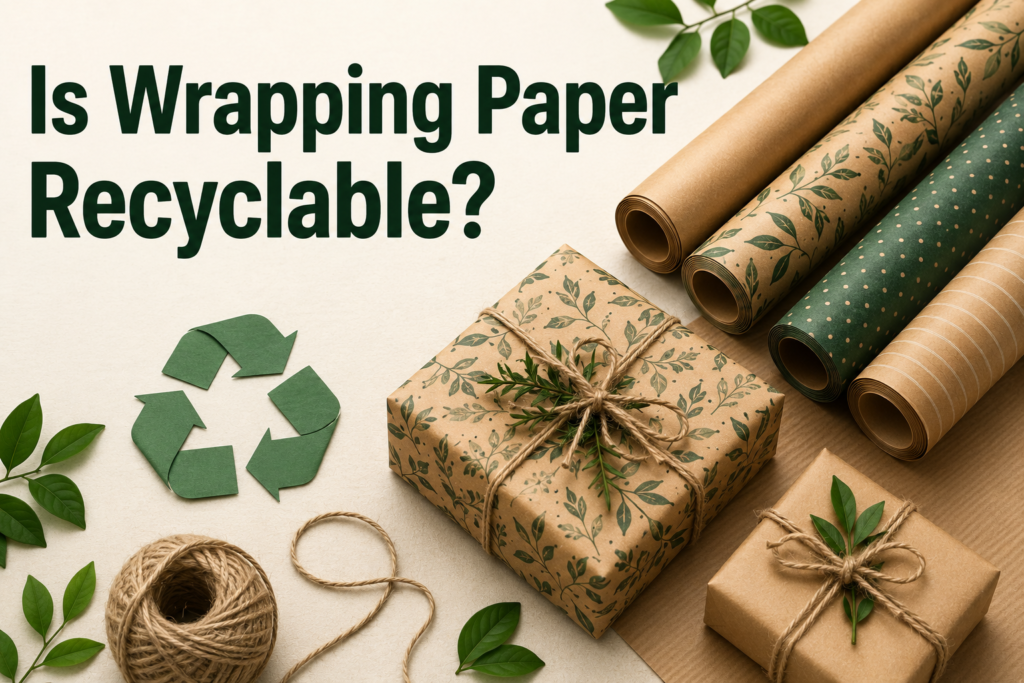
A lot of wrapping paper can go into paper recycling if it’s primarily recoverable fiber and free of heavy coatings, lamination, glitter, or large foil areas. Clean uncoated or lightly printed sheets usually separate during pulping and move back into the paper stream. Acceptance is never automatic. Local collection systems differ, and contamination or mixed finishes often change the outcome.
Looking like paper doesn’t prove much. A glossy or metallic sheet can hide a film or a coating that won’t break down. Technical recyclability means the fibers can be recovered under normal mill conditions. Local acceptance means the municipal program or private hauler actually takes the material and can process it without too much trouble. Those two things don’t always match.
In a typical paper recycling process the material gets sorted, mixed with water and agitated so the fibers come apart, screened to pull out larger debris, and de-inked when needed. Usable fiber is cleaned and turned into new paper. Sheets that stay bonded, heavily coated, or loaded with non-paper particles can clog screens or get sorted out as residual waste. Equipment and end markets vary by region, so the same grade might move through one system and get rejected by another. Check current guidance from the local program before putting wrapping paper in the bin.
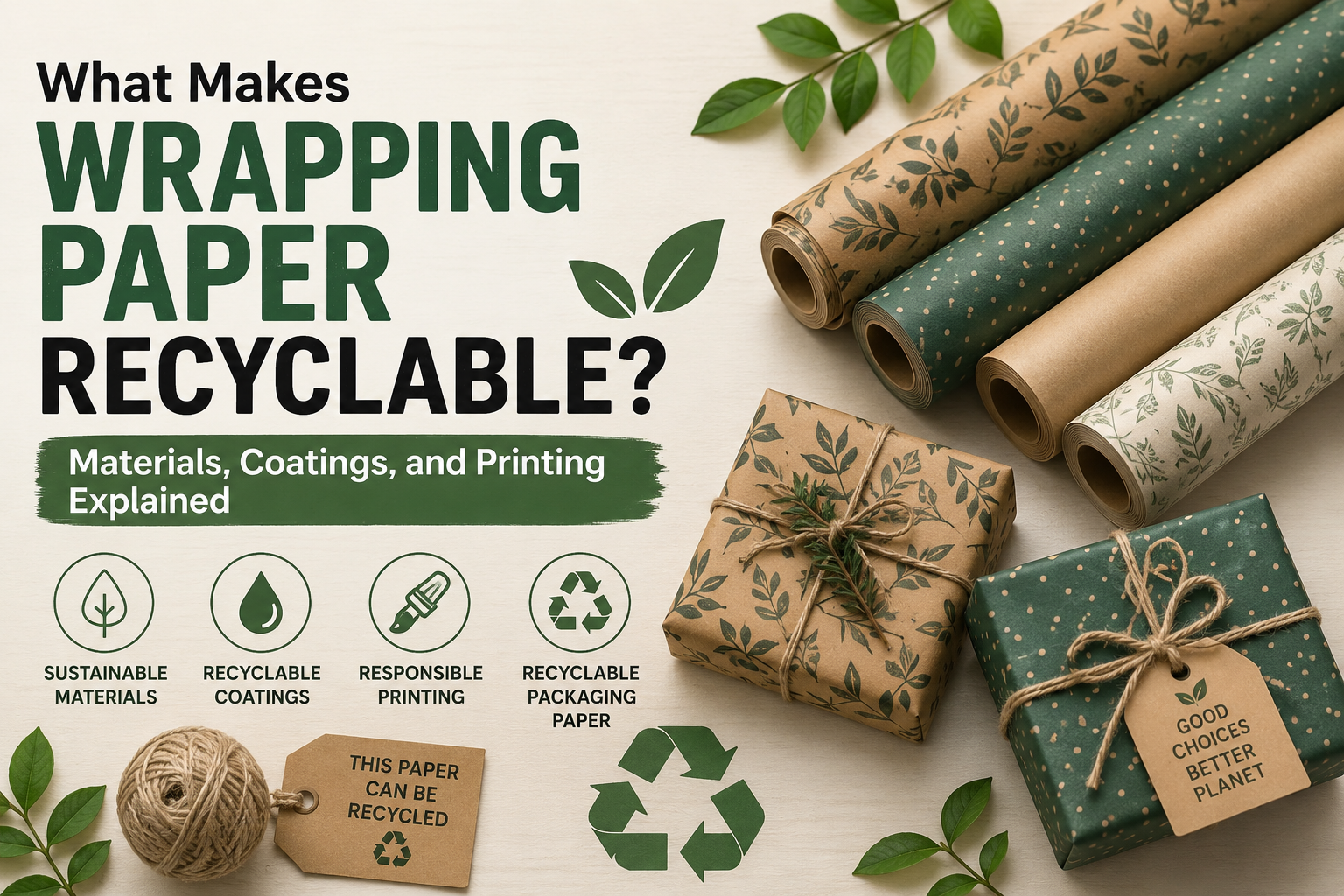
What Makes Wrapping Paper Recyclable?

A few practical conditions decide whether the paper has a realistic shot at being recovered.
Paper Fiber Content: The sheet needs to be mostly paper fiber that can be recovered. Longer fibers usually make stronger recycled pulp, but shorter fibers from many commercial grades still work. Both virgin and recycled fiber (post-consumer or pre-consumer) can be recyclable. Recycled content tells you where the fiber came from. Recyclability tells you what happens at the end of this use. A recycled-content sheet can still fail if heavy coatings or finishes get added later. Heavily filled or heavily processed sheets sometimes behave differently in the pulper, yet most standard wrapping grades stay workable when they’re kept relatively clean.
Ability to Break Down During Pulping: Collected paper is mixed with water and agitated so the individual fibers separate. Screens take out non-paper materials, metals, and bigger contaminants. De-inking systems lift many inks off the fiber surface. The recovered slurry gets cleaned further and formed into new paper. Wrapping paper has to release its fibers instead of staying locked behind a continuous film or thick barrier. If the surface treatment keeps water from reaching the fiber network, the sheet often travels through as a contaminant rather than usable pulp.
Cleanliness and Contamination: Grease, food residue, heavy adhesive, tape, bows, ribbons, and tags all lower the odds. Even good paper can get rejected once mixed with non-paper items. For commercial packaging that means designing the unboxing experience so non-paper pieces are easy to pull off, and giving customers clear instructions when it makes sense.
Local Recycling Acceptance: Programs and mills set their own criteria based on equipment, contamination tolerance, and what the end markets want. National statements don’t hold up. The same paper grade can be welcomed in one area and excluded in another. Confirm with the local program. Brands should word disposal guidance to match the actual material instead of broad claims.
Which Wrapping Paper Materials Are Most Recyclable?
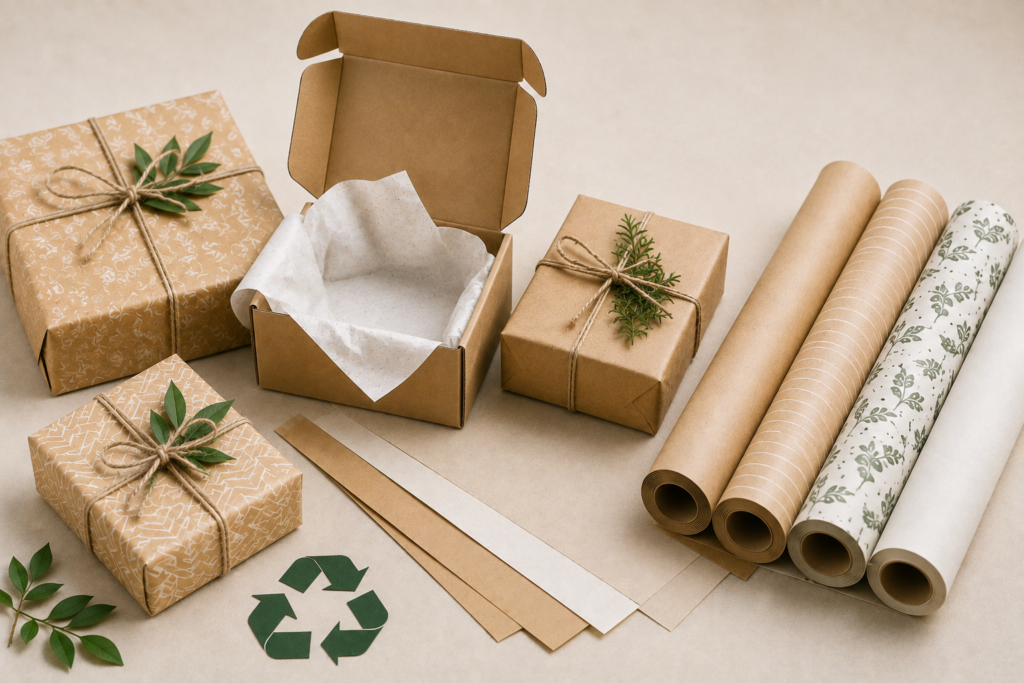
Uncoated, paper-based wrapping materials are usually the easiest to recycle. They present the fewest barriers to fiber recovery and get accepted more often where paper recycling is available.
Uncoated Paper: Without a surface barrier, water reaches the fibers quickly. Separation is straightforward and de-inking stays manageable with moderate ink coverage. Uncoated stock works for a lot of commercial uses when a matte or natural surface is fine. You can still print on it with water-based or conventional systems, though color density and rub resistance should be checked on samples. The natural surface can become part of the brand look instead of something that has to be covered up.
Kraft Wrapping Paper: Natural kraft and white kraft give solid strength and tear resistance. Ecommerce, food, handmade, and natural-product brands reach for them a lot because the surface takes simple branding and feels consistent with those categories. Kraft is generally recyclable when left uncoated and free of heavy non-paper finishes. Colors print less saturated than on coated stock. That difference can be used on purpose. Kraft isn’t automatically the most sustainable choice every time—fiber source, recycled content, and final finishes still matter.
Recycled Wrapping Paper: Sheets with post-consumer or pre-consumer recycled fiber can be fully recyclable. Recycled content is about origin. Recyclability is about end-of-life performance. A recycled-content sheet becomes hard to recycle if it’s laminated, heavily glittered, or given a non-repulpable barrier. Color, texture, and print consistency can shift a bit between batches, so samples are worth looking at before big runs.
FSC-Certified Paper: FSC certification covers responsible fiber sourcing and chain of custody. It doesn’t mean the finished printed and finished sheet is recyclable. A certified base paper can still get coatings, laminations, or decorations that interfere with pulping. Keep the two attributes separate.
Tissue Paper Used for Wrapping: Some tissue grades get accepted when they’re clean and free of heavy ink, glitter, or coatings. Very thin fibers can be harder for certain systems to recover efficiently, and local rules differ. Heavy decoration or contamination often changes the outcome. Check local guidance rather than assuming it will be taken.
Custom-Printed Paper Wrapping: Custom wrapping paper stays recyclable when the base paper, ink system, coating, and decorative finish are chosen carefully. Brands use it for retail products, subscription boxes, apparel, cosmetics, gift packaging, ecommerce orders, and seasonal campaigns. The key is treating paper grade, printing, and finishing as one system instead of adding effects one at a time.
Which Wrapping Paper Materials or Finishes Are Harder to Recycle?
A sheet that looks like paper can still carry surface treatments that limit fiber recovery.
Laminated Wrapping Paper: Laminated wrapping paper is often difficult or unsuitable for standard paper recycling. The bonded surface layer frequently fails to separate cleanly during pulping, so mills may reject the material even when a paper layer is visible. Local rules vary, but many programs treat laminated sheets as residual waste. If moisture or scuff resistance is truly needed, ask for technical data on repulpability rather than assuming a thin lamination will pass.
Glittered Wrapping Paper: Loose or bonded glitter introduces particles that contaminate the stream and can interfere with sorting and fiber processing. Most programs prefer that glittered paper stay out of the paper bin. The visual effect rarely justifies the recycling complication for commercial quantities.
Heavily Foiled Wrapping Paper: Small, limited foil details may be tolerated by some systems depending on how they’re attached and what the local system can handle. Large foil coverage or fully metallic-looking sheets more often get rejected. Acceptance isn’t automatic. Confirm with the printer and the relevant recycling guidance.
Metallic and Pearlescent Finishes: The look can come from specialty inks, coatings, films, or particles. Appearance alone doesn’t tell you the chemistry or the impact on pulping. Ask for the exact material and finish specification rather than relying on how the sheet looks under store lighting.
Waxed or Barrier-Coated Paper: Water-resistant or grease-resistant treatments can reduce repulpability by limiting water penetration. Some water-based or specially engineered coatings perform better than traditional wax, but that has to be confirmed through supplier documentation or testing. Don’t assume a barrier coating is recyclable just because it’s described as water-based or “eco.”
Heavily Coated Paper: Ordinary print coatings at moderate weights are often still recyclable, depending on the mill. Thick decorative or barrier coatings change the picture. Distinguish light functional coating from heavy surface treatment and ask for coating weight and chemistry details.
Paper With Excessive Adhesive, Tape, or Attached Decorations: Ribbons, bows, labels, adhesive strips, and decorative attachments should be removed before recycling whenever practical. Residual adhesive can cause problems in the pulper and screening stages.
Comparison Table: Recyclable and Difficult-to-Recycle Wrapping Paper
How Do Coatings Affect Wrapping Paper Recyclability?
Coatings change how easily water reaches the fibers and how cleanly the sheet breaks down in the pulper. An uncoated surface is usually the simplest option for recycling because nothing extra stands between water and fiber.
Some clay coatings used on printing papers remain recyclable when applied at moderate levels and accepted by the local mill. Not every clay-coated sheet gets rejected. Water-based coatings are often considered when brands need light protection, yet “water-based” doesn’t automatically mean the finished sheet is recyclable. Coating weight, chemistry, and total coverage still decide performance. Aqueous coatings follow the same logic: recyclability depends on the specific formula, not just the application method.
Barrier coatings meant for moisture, grease, or scuff resistance can reduce repulpability. Ask for repulpability information, any available testing, technical data sheets, and notes on mill compatibility. Lamination is generally harder for conventional paper recycling because the bonded layer resists separation. When a coating is truly required for product protection, confirm the end-of-life behavior of the complete construction rather than relying on the coating description alone.
How Does Printing Affect the Recyclability of Wrapping Paper?
Printing by itself doesn’t automatically stop recycling. Ink chemistry, coverage, curing method, and any extra finishes influence de-inking and fiber recovery.
Water-based inks are common and often compatible with standard de-inking systems, though they aren’t free of all trade-offs. Soy-based and vegetable-based inks can reduce reliance on certain conventional components, but the full formulation—pigments, additives, drying systems—still matters. These inks don’t turn an otherwise unsuitable paper into a recyclable one. Conventional inks appear on many successfully recycled paper products. Heavy coverage and certain formulations simply increase the work at the de-inking stage.
Coverage has a practical effect. Light patterns, one- or two-color printing, and designs that leave substantial unprinted area usually create fewer challenges than dark flood coats or dense full-color work on both sides. Large solid areas can affect the look of recycled pulp and raise de-inking demand, yet they don’t automatically make the sheet non-recyclable. Metallic inks introduce fine particles or specialty pigments. Confirm recyclability with the printer and paper supplier. UV-cured and other specialty systems may behave differently during de-inking, so technical confirmation is useful when those effects are required.
Eco-Friendly Printing and Branding Tips for Businesses
Pick the base paper grade first, then decide on finishes. The fewest finishes needed for the product and brand usually give the most straightforward recyclability outcome. Design around the natural surface—kraft texture, recycled flecks, or the matte quality of uncoated stock—so the paper itself contributes to the visual identity instead of needing heavy coverage.
Keep ink coverage moderate where you can. Smaller repeat patterns, strategic logo placement, one- or two-color artwork, and deliberate unprinted space all help. Treat inks and coatings as a single system. A recyclable base sheet can become less suitable if the finishing specification isn’t considered together. Ask for samples that show color accuracy, ink rub resistance, fold behavior, tear strength, surface feel, print consistency, and any available recyclability information.
Questions Worth Asking a Packaging Supplier or Printer:
- What is the base paper grade and basis weight?
- Does it contain recycled fiber, and at what percentage?
- Is the paper FSC-certified?
- Is the final printed and finished sheet considered repulpable?
- What coating, if any, will be applied, and is it actually required?
- What ink system will be used?
- Is third-party recyclability or repulpability testing available?
- Will the planned ink coverage create de-inking concerns?
- Can the same design be produced without lamination, heavy foil, or glitter?
How to Tell If Wrapping Paper Is Recyclable
No single home test gives complete proof, but several practical checks help.
Check the Label or Product Specification: Look for paper composition, recycling instructions, coating details, certification marks, recycled-content claims, and disposal guidance. A recycling symbol by itself doesn’t guarantee curbside acceptance.
Perform the Scrunch Test: Scrunch a small piece tightly in your hand. If it stays compressed, the sheet is more likely to be primarily paper. If it springs back strongly, a coating or bonded layer may be present. The test is only a quick indication, not a technical evaluation.
Check the Surface: Look for glossy bonded layers, glitter, metallic films, wax-like coatings, heavy texture, or attached decorations.
Tear the Paper: A fibrous, paper-like tear edge often suggests a paper-based sheet, but it doesn’t confirm that every coating is recyclable.
Remove Non-Paper Attachments: Remove tape, bows, ribbons, tags, labels, decorative cords, and adhesive strips where practical before placing the paper in recycling.
Check Local Recycling Guidance: Municipal or waste-hauler rules take priority over general advice. When in doubt, follow the local program.
Recyclable Wrapping Paper for Businesses
Wrapping paper is used for presentation, surface protection, unboxing experience, seasonal branding, gift packaging, and product separation inside boxes. Order volume affects printing method and unit cost. Short-run digital printing suits smaller quantities and frequent design changes. Larger offset or flexographic runs can become more economical at higher volumes, with attention to color consistency and setup. Exact thresholds vary by printer and design complexity.
Paper weight and strength need to balance foldability, tear resistance, opacity, print quality, shipping performance, and material usage. The heaviest available sheet isn’t automatically the best or most sustainable choice. Brand positioning can be supported by recyclable gift wrap without excessive decoration—for example natural kraft with one-color printing for handmade products, white uncoated paper with a subtle repeat pattern for cosmetics, recycled paper with simple branding for ecommerce apparel, or tissue combined with outer wrapping for subscription boxes.
When communicating disposal, print clear and accurate guidance only when it matches the material specification. Avoid vague claims such as “100% eco-friendly,” “completely sustainable,” or “planet-safe.” Specific statements are more trustworthy: made with a stated percentage of recycled content, printed with a specified ink system, recyclable where local paper programs accept it, or produced on FSC-certified paper from responsibly managed sources.
Common Mistakes Businesses Make
Assuming all paper is recyclable ignores surface treatments and composite construction. Choosing the finish before the paper often locks in decorative decisions that later conflict with recycling goals. Using sustainability terms without evidence weakens trust. Adding lamination purely for appearance introduces an unnecessary barrier. Heavy ink coverage without testing can create rub, drying, color, or de-inking issues. Ignoring local recycling differences produces disposal instructions that don’t match reality for a national brand. Relying only on the scrunch test underestimates the value of supplier documentation. Confusing recycled content with recyclability, assuming certification guarantees end-of-life performance, and failing to review the complete specification (paper + ink + coating + adhesive + finish) are common sources of disappointment.
Packaging Insight: Uncoated kraft absorbs ink differently from coated stock. Colors look less saturated and the surface texture stays visible. That difference can become a deliberate design feature rather than a limitation.
Buyer Tip: Request samples of the exact printed and finished construction, not just the base paper. Fold, tear, and rub tests on the finished sheet reveal more than the unprinted roll.
Print Consideration: Dark solid areas and high ink coverage increase de-inking demand. Designs that leave breathing room for the paper surface usually create fewer processing questions.
Conclusion
The most recyclable wrapping paper is usually a straightforward paper-based sheet with recoverable fibers, restrained printing, and no unnecessary decorative barriers. Review the complete specification—base paper, recycled content if any, ink system, coating, decorative finishes, adhesives, and local recycling acceptance—before committing to production. When those elements work together, brands can achieve clear presentation, adequate protection, and a realistic path into the paper recycling stream.
For help selecting custom wrapping paper that balances print quality, brand presentation, product requirements, and recyclability, contact the team at Hello Custom Boxes. As specialists in custom packaging boxes and related materials, we can review paper grades, printing options, and finishing choices against your specific needs.
Frequently Asked Questions
Many wrapping papers can be recycled when they’re mostly clean paper fiber without heavy coatings, lamination, glitter, or large foil areas. Local programs decide acceptance, so check municipal guidance. Contamination from tape, bows, or food residue often changes the outcome.
Uncoated kraft, white uncoated paper, many recycled-content grades, and carefully specified custom-printed uncoated sheets are among the most commonly accepted. Simple paper construction without non-repulpable barriers gives the best chance of successful fiber recovery.
Yes, kraft wrapping paper is generally recyclable when left uncoated and free of heavy non-paper finishes. Natural and white kraft grades are widely used for this reason. Confirm local acceptance and avoid adding lamination or glitter if recycling is a priority.
Laminated wrapping paper is frequently unsuitable for standard paper recycling because the bonded layer resists separation during pulping. Many programs reject it. Request technical confirmation if a thin barrier is considered necessary.
Gloss can come from coatings, films, or inks. Light functional coatings may still be accepted; heavy coatings or lamination often are not. Appearance alone is not decisive—ask for the coating specification and local program rules.
Printing alone rarely prevents recycling. Heavy coverage, certain specialty inks, or metallic effects can increase de-inking work or introduce particles, but many printed papers are successfully recycled. The full system of paper, ink, and finish determines the result.
Some clean tissue grades are accepted, while very thin fibers or heavy decoration can cause rejection. Local guidance is essential. Remove any non-paper elements before disposal.
Remove as much tape, adhesive, and non-paper decoration as practical. Residual adhesive and mixed materials reduce the chance of acceptance. Clean paper stands a better chance than contaminated sheets.
No. Recycled content describes the fiber source. The finished sheet can still become difficult to recycle if laminated, heavily coated, or glittered. Evaluate the complete construction.