Choose Party Food Boxes by Portion Size
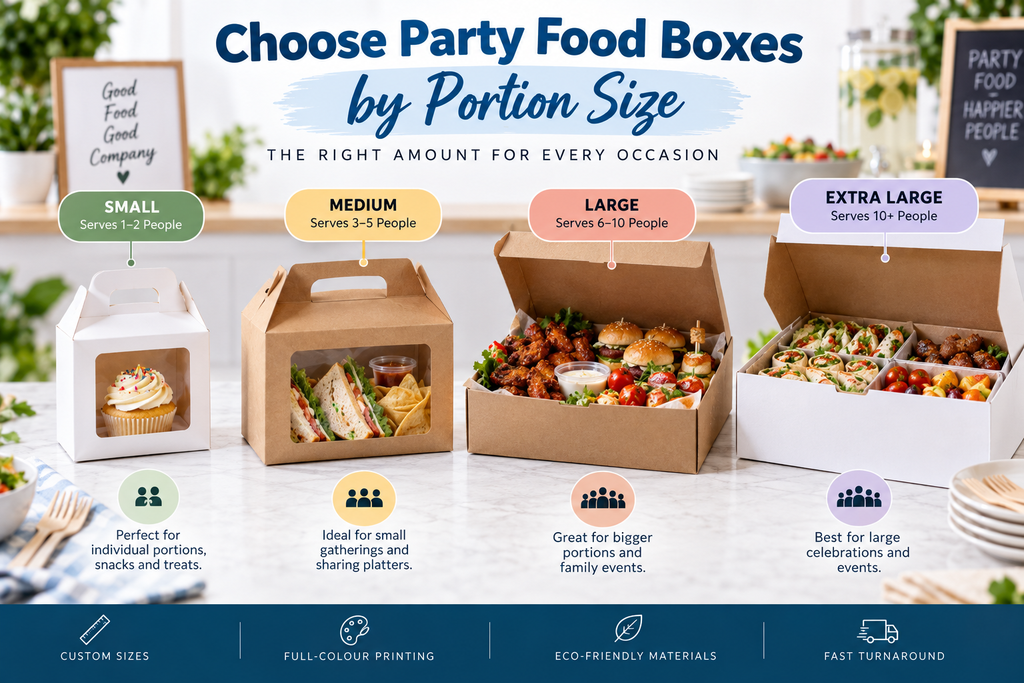
Start with the portion before deciding on the box style.
A package that works for one sandwich and a side will not perform the same way for a tray of appetizers or a larger group serving. Portion size affects the footprint, depth, strength, closure, and internal layout of the box.
Individual Portions
Individual food boxes for parties are useful when each guest receives a complete serving.
They work well for boxed lunches, sandwiches, finger foods, snacks, desserts, and other meals that need to be handed out quickly.
The food should have enough room to sit comfortably without being pressed against the lid or sides. At the same time, an oversized box can allow smaller items to slide during carrying or delivery.
Individual portions are especially practical for birthday parties, corporate lunches, conferences, school events, and other occasions where food is distributed guest by guest.
For snack-based menus, custom snack boxes for individual portions can also help keep several smaller items organised within one package.
Sharing Portions
Sharing boxes are better suited to food intended for several people.
They may hold sliders, pastries, appetizers, cookies, finger foods, or mixed snack selections. Because multiple items sit inside one box, usable surface area often matters more than simply adding depth.
If foods need to remain separate, dividers can help maintain the arrangement and reduce movement.
It is also worth thinking about how guests will serve themselves. A wide box that opens fully can be more practical for a shared table than a deep carton designed mainly for transport.
Family-Size Portions
Family-size or group portions normally add more weight to the package.
That makes base strength, closure security, carrying, and stacking more important. A box may technically fit the food but still be unsuitable if the base flexes once it is fully loaded.
For catering and larger group orders, also consider how multiple boxes will sit together during transport. Stable shapes and consistent dimensions make loading, stacking, and unloading easier.
Match the Box to the Food Inside
Portion size tells you how much room is needed. The food itself tells you what the packaging must handle.
Dry finger foods are usually straightforward, while fried foods, warm meals, decorated desserts, and mixed assortments create different packaging demands.
Greasy or oily foods need packaging with a suitable grease-resistant food-contact surface. The material should be selected according to the food and expected holding conditions, not appearance alone.
Warm foods can release steam after packing. Where trapped moisture could affect texture or packaging performance, ventilation may help.
Decorated desserts need enough clearance above and around the product. Frosting, toppings, and other delicate details can be damaged even when the outside of the box remains intact.
For items such as cupcakes, cupcake boxes with protective inserts are a good example of where internal support can matter just as much as the outer structure.
Mixed assortments need one more check: should all the foods actually touch? Moist, dry, sweet, savory, delicate, and heavier items may need separation even when they fit comfortably in the same package.
These food-specific conditions should guide the choice of food packaging boxes, rather than choosing a box first and then trying to make the food fit.
Choose Packaging Around the Event
The same food may need different packaging depending on how and where it will be served.
A sandwich prepared for a wedding reception does not have exactly the same packaging needs as one being handed out during a corporate lunch.
For corporate meals, individual packaging can make portion control and distribution easier. Sandwich boxes for boxed lunches, for example, can be sized around the actual sandwich format instead of leaving unnecessary space inside the package.
At weddings and receptions, presentation may carry more weight because food is often displayed before guests take it.
Outdoor events introduce another factor: movement. Boxes may be carried farther, moved between tables, or transported in less controlled conditions. In those cases, closure security and internal stability become more important.
When Extra Packaging Features Matter
Not every party food box needs every available feature.
Add structural details only when they solve a real packaging problem.
Dividers are useful when several foods share one package but need to stay separated.
Fitted inserts help keep delicate products in place and reduce unwanted movement.
Ventilation may be useful for certain warm foods when trapped moisture could affect texture.
Grease-resistant barriers are important for fried, oily, buttery, or sauce-heavy foods. The food-contact surface should be suitable for the intended use.
Secure closures become more important for takeout, catering deliveries, and outdoor events.
Stack strength matters when several filled boxes will be transported together.
The goal is not to add more features. It is to use the features that the food, portion, serving method, and transport conditions actually require.
Individual vs. Shared Boxes: Which Works Better?
Neither option is always better.
Choose individual party food boxes when portion control, fast distribution, dietary identification, or grab-and-go convenience matters. Each guest receives a defined serving, and the food does not need to be handled again before eating.
Choose shared boxes when several guests will select from one assortment or when food will be placed in the centre of a table. They work well for appetizers, pastries, desserts, and finger foods intended for group serving.
The serving method is often the deciding factor.
For example, six sandwiches may fit inside one shared box, but six individual boxes could still be the better option for an office lunch where meals need to be distributed quickly.
Check the Fit Before Ordering in Bulk
Box dimensions alone do not tell you how the packaging will perform once it is filled.
Before placing a larger order, test the proposed party food box size using the actual food whenever possible.
Check:
- clearance around and above the food;
- movement inside the box;
- lid and closure performance;
- base strength when fully loaded;
- grease or moisture after the expected holding time;
- stability when boxes are stacked;
- presentation after the box is carried and reopened.
Avoid Overpacking and Underpacking
A box should not be judged only by whether everything fits inside.
Overpacking can crush food, disturb toppings, or make items difficult to remove. Underpacking leaves too much room for movement and may result in a package that is larger than necessary.
For larger event orders, test one complete portion before packing the full run. Carry it the way it will normally be handled, stack it if stacking is part of delivery, and then open it again.
Need Party Food Boxes for Your Event?
If standard boxes do not match your portions, food layout, or serving needs, Hello Custom Boxes can create custom party food boxes around your requirements.
Share your food size, portion quantity, serving method, and event needs to get packaging designed for a better fit, easier handling, and cleaner presentation.
Request a custom quote for your party food packaging.
Frequently Asked Questions
Choose the size according to the actual food dimensions, portion quantity, required headroom, and whether dividers or inserts are needed. The food should fit securely without being compressed or leaving excessive empty space.
Yes, provided the packaging material and food-contact surface are suitable for the intended food and holding conditions. Some warm foods may also benefit from ventilation where trapped moisture could affect texture.
Not always. Dividers are most useful when several foods need to stay separated or when movement could affect presentation. Stable single-item portions usually do not need them.