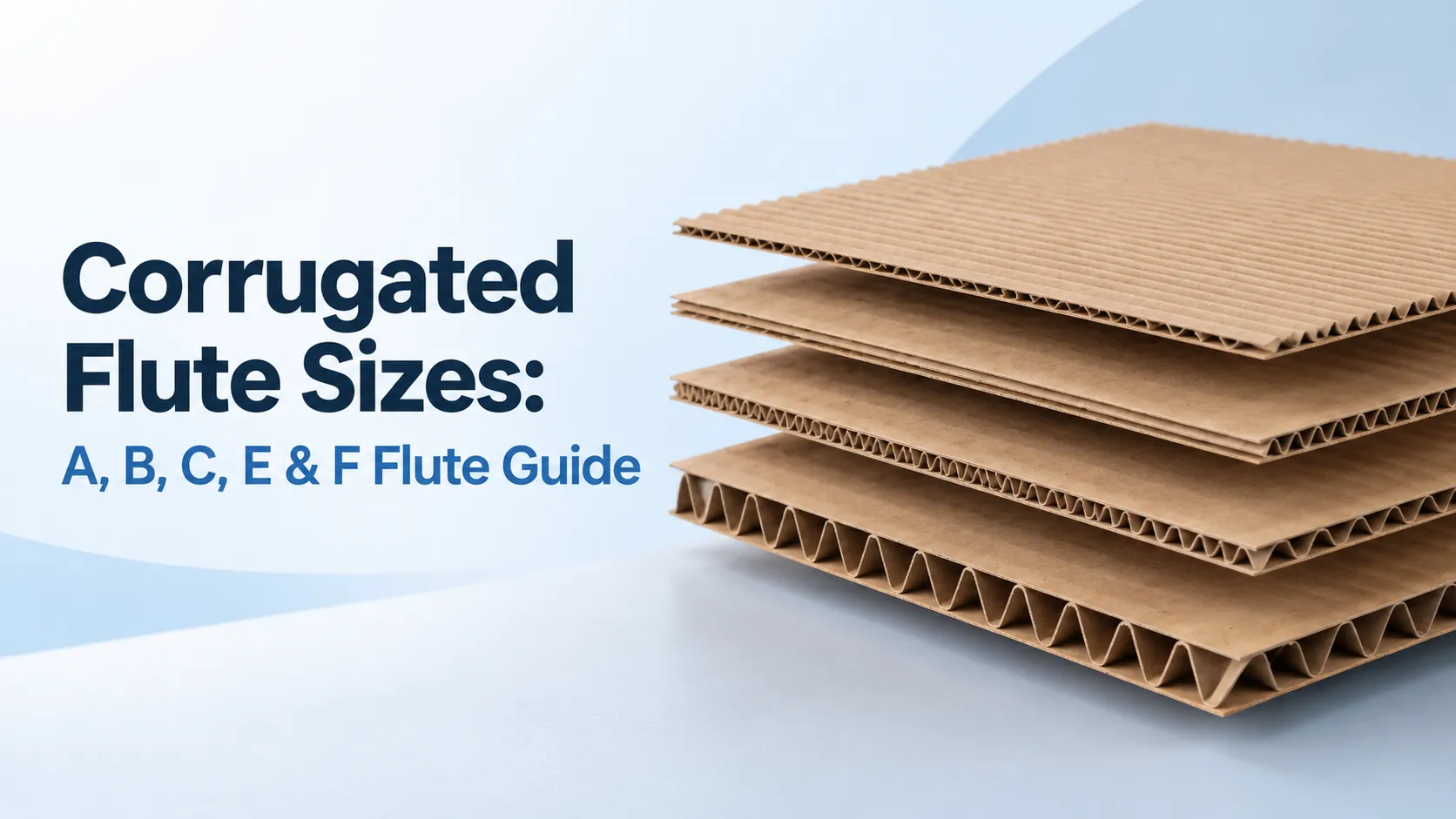
Corrugated board is not all built the same way. Cut through the edge and you will see the difference: the paper between the two liners rises and falls in a wave. That wave is the flute.
Its profile changes the character of the board. Some flutes leave more room for cushioning. Others keep a box thinner, resist crushing well, or give printed graphics a finer surface to sit on. So when comparing corrugated flute sizes, thickness is useful, but it should not be the only thing you look at.
There is also a naming quirk worth knowing. A, B, C, E, and F are not arranged by thickness. Of these five, the approximate order from thickest to thinnest is A, C, B, E, then F.
What Does Corrugated Flute Size Actually Mean?
A corrugated sheet normally combines flat linerboard with a shaped corrugated medium. The height of those waves and how closely they sit together create the flute profile.
Large flutes have fewer waves over a given distance and more space between the liners. Fine flutes are shallower and occur more frequently.
That difference influences several things at once: board caliper, cushioning, crush resistance, space usage, and print surface. It is why selecting a flute is really a packaging decision, not simply a measurement decision.
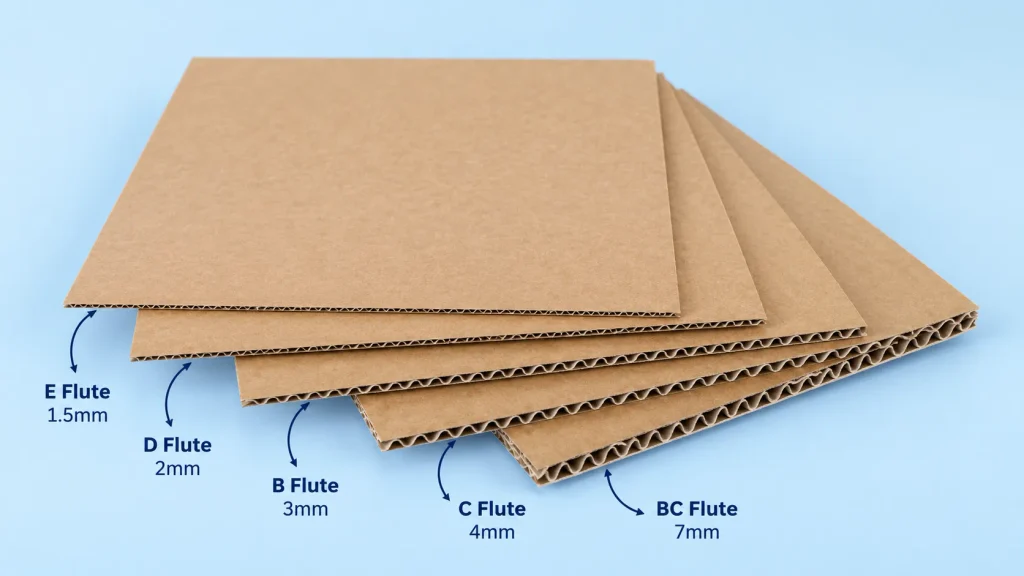
Corrugated Flute Size and Thickness Chart
These measurements are useful working references. Actual flute profiles can vary somewhat with paper grades, manufacturing equipment, and production specifications.
The order may look unusual at first. C flute is thicker than B flute. The letters are flute designations, not a numbered progression from thick to thin.
A Flute Gives Fragile Products More Cushioning Space
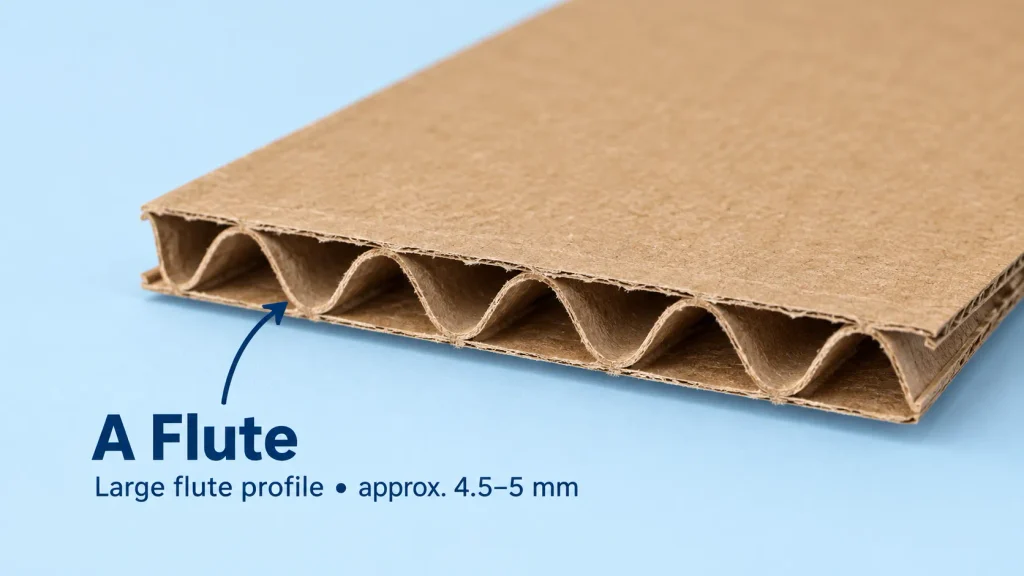
With a profile of roughly 4.5, 4.8 mm, A is the deepest flute covered here. There are only about 33 flutes per foot, so each arch is comparatively large.
The extra depth gives the board room to absorb impact, which can be useful around fragile goods. That benefit comes with additional bulk. A-flute packaging occupies more space and its surface is not as fine as a microflute board.
For that reason, choosing A flute makes most sense when the cushioning has a job to do not simply because a thicker board feels more substantial.
B Flute Keeps the Board More Compact
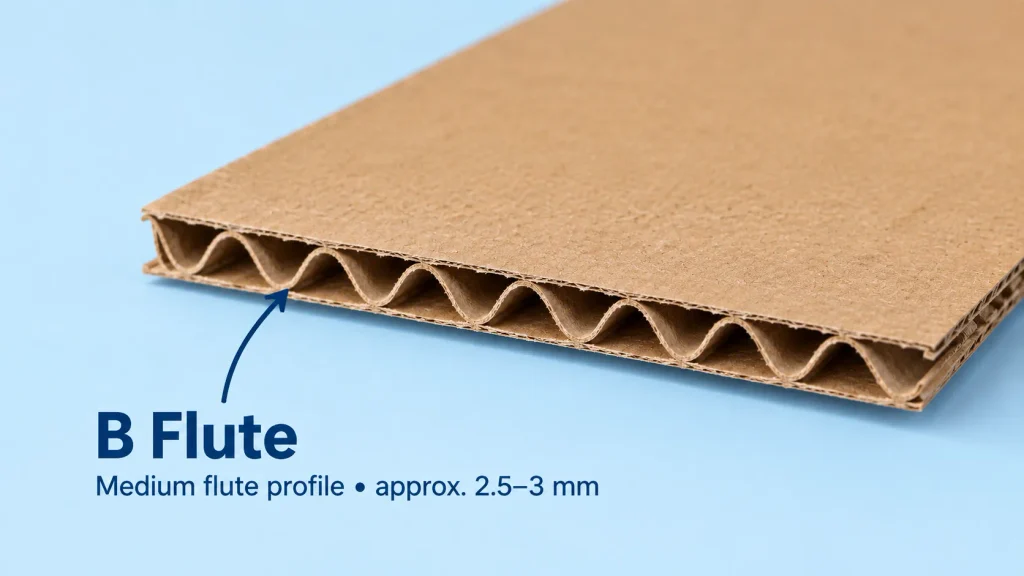
B flute takes a different approach. Its profile is around 2.5–3.2 mm, with roughly 47 flutes per foot.
The tighter structure is known for good crush resistance while keeping the board relatively compact. You’ll often encounter it in die-cut packaging, displays, dividers, and corrugated mailer boxes.
It also sits in a useful middle ground for branded packaging: enough structure for many protective applications without the depth of C or A flute.
C Flute Fits Many Everyday Shipping Applications
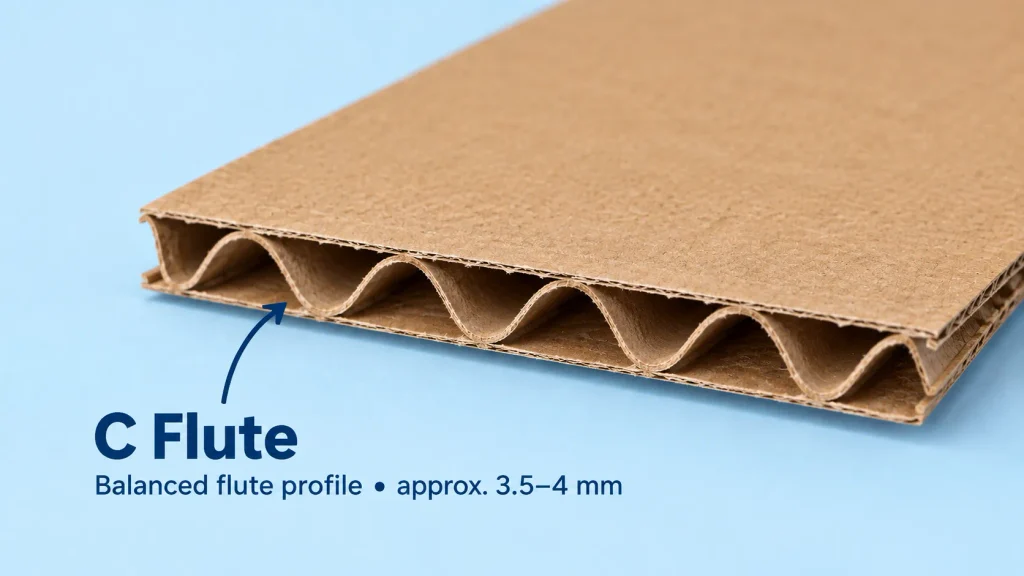
At approximately 3.5–4.0 mm, C flute is thicker than B but not as deep as A. It has around 39 flutes per foot.
That middle position works well for many conventional shipping cartons because it combines cushioning with useful structural properties. Larger products, ecommerce shipments, and cartons that will be stacked during distribution are typical situations where C flute may be considered.
A small, lightweight shipment may not need that much board, though. Using more material only makes sense when the packed product and distribution conditions call for it.
E and F Flutes Prioritize a Finer Profile
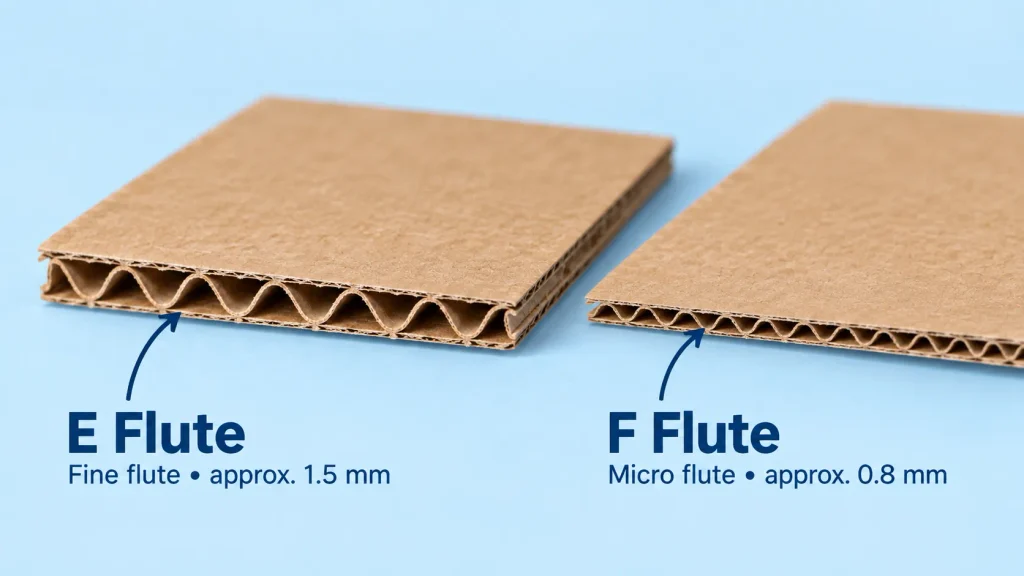
E and F deserve to be considered together because both move corrugated board into much thinner territory.
E flute is typically around 1.2-1.6 mm, with roughly 90 flutes per foot. It retains a corrugated structure without the bulk of B or C, making it useful for branded mailers, electronics, cosmetics, and other retail packs.
F flute is finer still. At roughly 0.7–0.8 mm and around 125 flutes per foot, it can suit small consumer products where a thick corrugated wall would feel excessive.
Their finer construction also creates a relatively smooth surface for graphics. The trade-off is straightforward: neither offers the same cushioning depth as the larger flute profiles.
Which Flute Makes Sense for Which Job?
At a Glance: Think of A and C when cushioning is a priority, B when you need a compact balance of structure and protection, and E or F when low bulk and printed presentation matter more.
Those are starting points, not fixed rules.
A fragile product may lead you toward A or C. General shipping cartons commonly use B or C depending on the load. For an ecommerce mailer, B may provide the structure required for one product while a lighter item can work well with E.
Retail packs with detailed branding often benefit from the finer profiles of E and F.
Does the Flute Change How a Box Prints?

It can.
The waves beneath the liner are more pronounced with larger flute profiles. As the profile becomes finer, the outer surface generally becomes smoother. This is one reason E and F flute appear in packaging where detailed graphics and a cleaner presentation are important.
That doesn’t mean B flute cannot be printed well. Nor does selecting E automatically guarantee better graphics. Liner quality and the printing process have a major influence too.
Flexographic, digital, and litho-laminated printing each approach corrugated surfaces differently. If print quality is important, consider the board alongside the method being used for printing custom cardboard boxes.
When One Flute Layer Is Not Enough
So far, these examples describe single-wall corrugated board. Some packaging needs more.
Double-wall board contains two fluted layers separated by additional linerboard. That’s why specifications such as BC and EB exist. BC combines B and C flutes; EB combines E and B.
Using two flute profiles can provide a different level of structural performance for products that exceed what a suitable single-wall board can handle. But double wall is not automatically necessary for every heavy item. The full load and shipping environment still need to be evaluated.
A Thicker Flute Does Not Automatically Mean a Stronger Box
This is probably the most important distinction in the guide.
Flute profile tells you something about the board, but it does not give you the complete strength specification.
A box also depends on its liner and medium grades, dimensions, wall construction, product weight, stacking load, moisture exposure, and handling conditions. Edge Crush Test (ECT) and burst strength specifications can provide additional information when structural performance matters.
So asking “Which flute is strongest?” can lead to the wrong decision. A more useful question is: what loads and conditions does this particular box need to handle?
Frequently Asked Questions
Of the five profiles discussed here, A flute is the thickest at roughly 4.5–4.8 mm. Its deep profile provides more room for cushioning.
C is thicker and offers a deeper cushioning profile. B is more compact and provides good crush resistance, which makes it useful for applications such as mailers, displays, and die-cut boxes.
Yes, when the product and board specification allow it. E flute can work for lightweight ecommerce and mailer applications, but heavier or fragile goods may require a different construction.
E and F have fine profiles that generally provide smoother printing surfaces. The final print quality also depends on liner quality, artwork, and printing method.
Not by itself. Flute profile is one factor alongside paper grades, wall construction, box dimensions, ECT or burst specifications, load, stacking, and environmental conditions.