A candle shop preparing Christmas gift sets has different packaging needs from a bakery selling decorated cookies. Glass jars need secure support, while bakery boxes may need windows, grease-resistant liners, and space for delicate decorations.
For small businesses, holiday packaging must do more than look festive. It should protect products, fit the budget, and remain practical when seasonal orders increase.
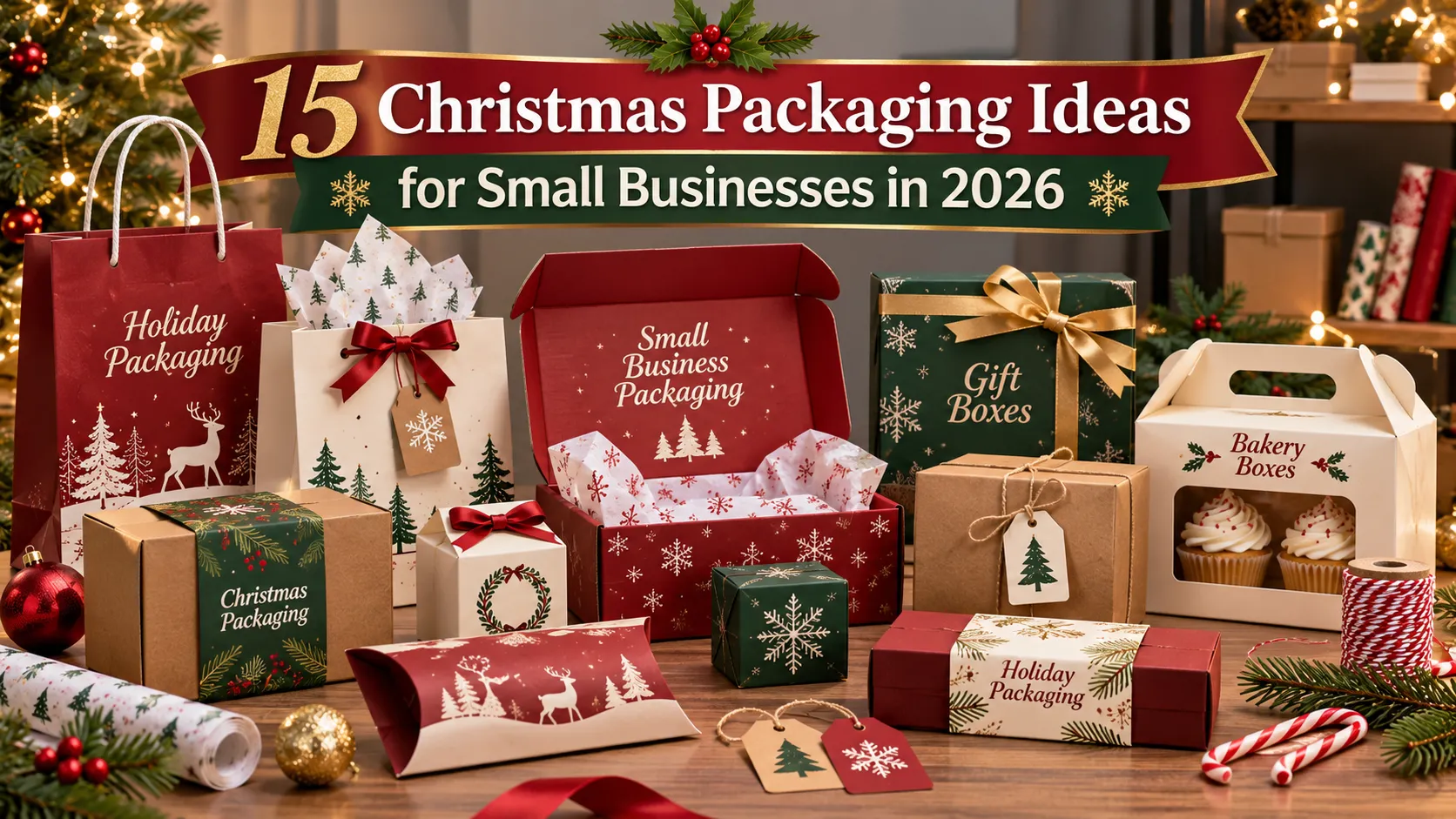
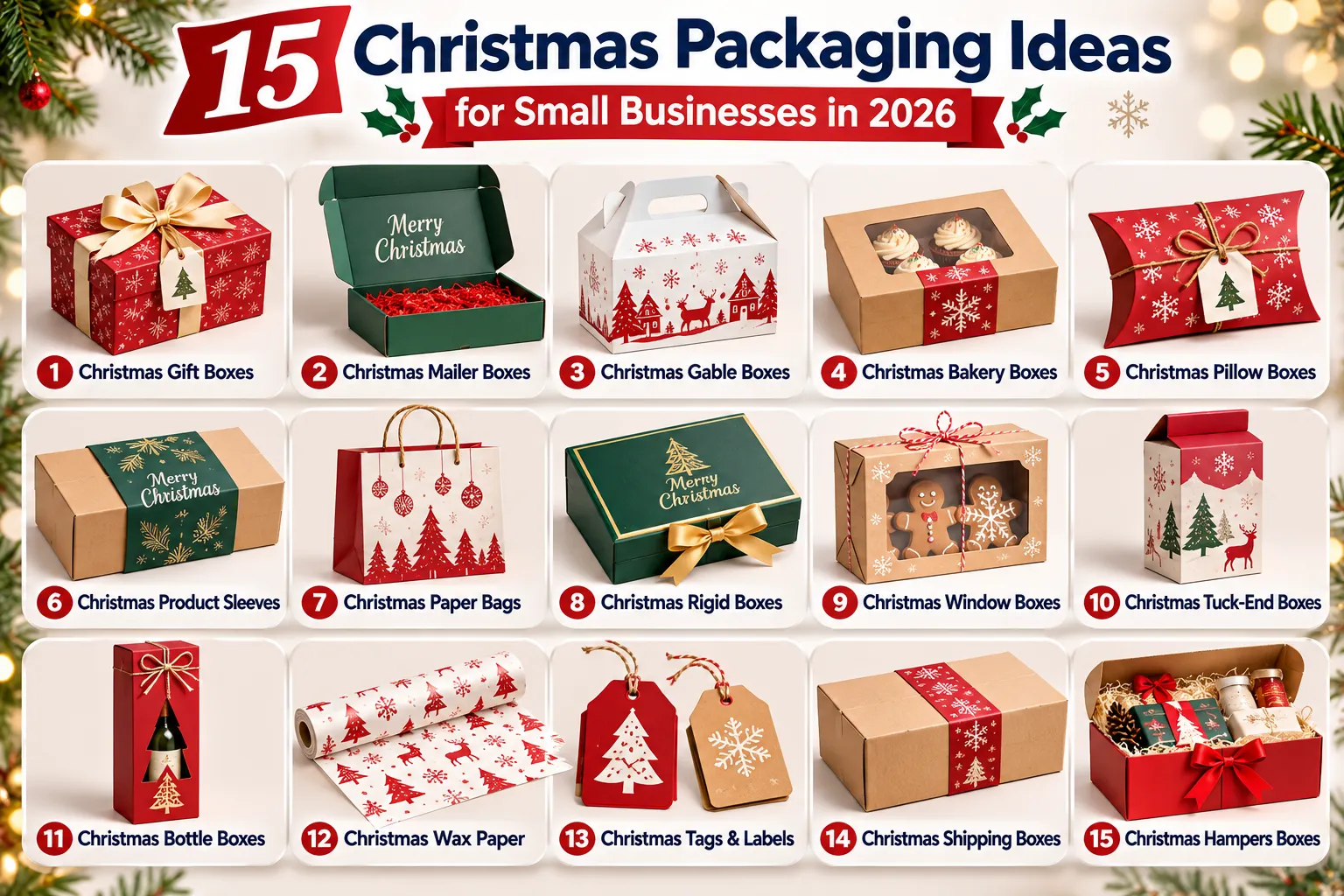
These 15 Christmas packaging ideas for small businesses in 2026 cover affordable ways to update existing boxes, protective options for online orders, and premium packaging for holiday gift collections.
Which Christmas Packaging Should You Choose?
For smaller budgets, consider seasonal stickers, printed sleeves, or branded tissue paper. Corrugated mailers work well for many online orders, while window cartons help display bakery treats. Rigid and drawer-style boxes suit selected premium gifts. Choose packaging based on product protection, storage space, and fulfillment requirements before adding Christmas artwork.
15 Practical Christmas Packaging Ideas for Small Businesses
Christmas packaging doesn’t need complicated artwork or expensive finishes. The best choice depends on what you’re selling, how customers receive their orders, and how much you can reasonably spend per package.
1. Custom Christmas Mailer Boxes for Online Orders
Corrugated mailer boxes are useful for clothing brands, subscription businesses, and online gift retailers. They combine product protection with space for seasonal branding.
A simple design could feature the company logo outside and a Christmas greeting inside the lid.
Before ordering:
- Measure products with their protective inserts.
- Select corrugated construction suitable for the packed weight.
- Check closure strength and shipping requirements.
- Avoid oversized boxes that need excessive filling material.
Measuring only the product and forgetting the cushioning. Measure the complete packed arrangement instead.
Explore corrugated mailer boxes for online orders when comparing structures and printing options.
2. Christmas Window Boxes for Bakery Treats
Decorated cookies, cupcakes, and pastries can become part of the presentation when displayed through a window.
A shallow carton with a clear panel works well for Christmas cookie assortments. Customers can see the decorations without opening the package.
However, window placement affects both appearance and structure.
Check that the box provides:
- Enough clearance above frosting and toppings.
- A stable base for the finished assortment.
- Suitable materials for the intended food-contact conditions.
Avoid unnecessarily large windows that reduce supporting board around the lid.
Window films, coatings, and liners also require separate consideration. A decorated bakery box should not automatically be assumed suitable for direct food contact.
3. Kraft Christmas Boxes With Minimal Artwork
Natural kraft paperboard suits handmade accessories, soap products, and lightweight retail gifts.
Its brown surface works with simple Christmas artwork, such as dark-green pine illustrations, burgundy lettering, or a small printed logo.
For brands with restrained packaging designs, limited-color printing may provide enough seasonal character.
Buying consideration: Colors printed on kraft may appear different from those printed on white paperboard. Fine details and light-colored graphics may require special attention.
Request an appropriate artwork proof before approving production.
Kraft’s appearance alone does not establish recyclability, biodegradability, or food-contact suitability.
4. Christmas Gable Boxes With Carry Handles
Gable boxes combine a folding carton with an integrated handle. They’re suitable for lightweight gifts, packaged treats, holiday favors, and promotional collections.
A cream-colored box with evergreen illustrations can create a festive presentation without additional wrapping.
Their main advantage is convenient carrying.
However, the handle does not automatically make the box suitable for heavy products. Check the bottom closure, handle construction, and stability of the filled carton.
For products with considerable weight, another box structure may provide better support.
5. Christmas Pillow Boxes for Small Gifts
Pillow boxes offer a compact alternative to rectangular cartons.
Their curved construction works for gift cards, lightweight accessories, and individually packaged favors. A small snowflake illustration or branded label may be enough for a Christmas design.
The shape also creates limitations.
Pillow boxes have less usable internal space and don’t provide the stable, flat base of a conventional carton.
Choosing pillow packaging for heavy or fragile accessories simply because the structure looks attractive.
Products requiring fitted inserts or stronger support may be better suited to folding cartons or rigid boxes.
6. Printed Christmas Sleeves Around Existing Boxes
Printed sleeves are useful when a business already has packaging that fits its products correctly.
For example, a soap brand could keep its standard white retail carton and add a removable Christmas sleeve.
This avoids redesigning the complete outer box and may make leftover cartons easier to reuse.
Sleeves work particularly well for:
- Soap and cosmetic packaging.
- Candle gift sets.
- Small retail accessories.
- Limited-edition product collections.
Measure the finished carton carefully. A sleeve that’s too tight may damage the box during assembly, while a loose sleeve can slide off during handling.
7. Branded Christmas Tissue Paper
Tissue paper introduces seasonal branding without requiring a new printed carton.
A clothing boutique could wrap garments in tissue featuring a repeating Christmas pattern. A jewelry retailer might use branded tissue inside a presentation box.
For businesses with multiple products, one tissue design can complement different packaging styles.
Keep the artwork simple enough that it doesn’t overpower the product.
Tissue paper mainly provides presentation and light separation. Fragile merchandise still needs appropriate protective inserts or cushioning.
8. Christmas Stickers and Packaging Seals
Seasonal stickers are a practical option for businesses with existing packaging inventory.
They can update plain boxes, paper bags, and tissue wrapping without changing the underlying structure.
Useful options include:
- Christmas logo stickers.
- Holiday-edition labels.
- Individual scent or flavor stickers.
- Small gift-message seals.
The advantage is flexibility. A business can update seasonal branding without ordering a completely different printed carton.
However, stickers must adhere properly to the selected surface and should never cover essential product information.
9. Christmas Gift Set Boxes With Inserts
Holiday gift sets allow businesses to combine related products in one package.
A skincare company might arrange lotion, soap, and lip balm together. A candle business could offer several small jars in a fitted box.
Inserts help keep individual items separated and properly positioned.
Before selecting the structure, consider:
- Combined product weight.
- Individual dimensions, including caps and accessories.
- Movement during transportation.
- Insert assembly time.
- Space for labels and instructions.
Designing inserts around empty product containers rather than the finished retail items.
Test the complete arrangement before approving the dieline.
10. Premium Rigid Christmas Gift Boxes
Rigid packaging suits selected jewelry, fragrance, cosmetics, and corporate gift collections.
A two-piece rigid box with a deep-green exterior and restrained metallic artwork can provide a gift-ready presentation.
Compared with folding cartons, assembled rigid structures often require more storage space and greater packaging investment.
Choose rigid packaging when the additional presentation value makes sense for the product and selling price.
Businesses can compare rigid packaging styles for premium gifts before selecting a structure.
A rigid presentation box may still require a separate protective shipping carton for parcel delivery.
11. Drawer-Style Christmas Boxes
Drawer boxes use an inner tray that slides out of an outer sleeve.
They’re suitable for jewelry, small accessories, and carefully arranged holiday gifts.
A ribbon pull or thumb notch can make opening easier, depending on the construction.
Before ordering, test the sliding mechanism with the actual product inside.
A tight tray may be difficult to remove, while a loose tray can move unexpectedly during handling.
Drawer boxes also involve multiple components, so consider storage space, assembly requirements, and production cost.
12. Foil-Accented Christmas Packaging
Foil stamping can highlight a logo, snowflake illustration, product name, or decorative border.
Gold, silver, and copper accents work with several Christmas color palettes.
A burgundy box with a small gold-foil logo, for example, may provide enough visual interest without complicated artwork.
Use foil selectively rather than covering large areas unnecessarily.
Foil stamping introduces additional production requirements and may increase costs. Compare it with conventional printing before finalizing the design.
13. Christmas Messages Inside the Box Lid
Inside-lid printing adds a holiday message without changing the entire exterior design.
This approach works particularly well for e-commerce mailers, subscription boxes, and gift sets.
A short thank-you note or seasonal greeting can appear when customers open the package.
Check the text orientation on the flat dieline. Artwork that looks correct on screen can appear upside down after folding if panel placement is incorrect.
Keep essential product instructions separate and accessible.
14. Reusable Winter-Themed Packaging
Christmas packaging doesn’t always need the year printed on it.
A winter-themed carton without “Christmas 2026” may remain suitable for later seasonal promotions.
Small businesses can also use existing branded boxes with removable holiday details.
Options include:
- Neutral winter illustrations.
- Separate Christmas sleeves.
- Year-round branded cartons.
- Labels for limited-edition products.
This approach may reduce leftover seasonal inventory, provided the packaging remains suitable for future products.
15. Personalized Gift Tags and QR Cards
Gift tags make standard packaging more personal without requiring a different box for every recipient.
A bakery could attach flavor tags to cookie assortments, while an accessories brand might include short gift messages.
QR cards can link to product-care instructions, gift information, or a verified brand page.
Test QR codes on different devices before printing and make sure the destination works on mobile.
Essential safety or product information should remain available without requiring a scan.
How to Choose Christmas Packaging for Your Business
The right option depends on product size, weight, sales channel, and customer handling. Choose the box structure before deciding on decorative finishes.
Budget-Friendly vs. Premium Packaging
Packaging costs depend on construction, materials, printing, quantity, and additional features.
These are relative comparisons, not supplier quotations.
When comparing prices, include inserts, printing, finishing, shipping, and assembly. An inexpensive box may not offer the lowest total cost if it requires additional protection or packing labor.
Christmas Packaging Planning for the 2026 US Holiday Season
According to the National Retail Federation’s October 15, 2026 holiday forecast, November and December retail sales in the United States were projected to grow 4.2% compared with 2025, reaching approximately $1.013 trillion.
This industry-wide forecast does not predict demand for an individual small business or custom packaging supplier.
Seasonal packaging orders should therefore be planned around actual product requirements, expected sales, and confirmed production schedules.
Before Approving Christmas Packaging
- Measure finished products. Include accessories, inserts, and protective materials.
- Choose suitable construction. Consider product weight, storage, and shipping.
- Prepare artwork. Check logos, colors, text, and dieline placement.
- Review proof options. Ask whether digital or physical proofs are available.
- Confirm final approval. Establish when production scheduling begins.
- Check production and shipping separately. Manufacturing completion is not the delivery date.
- Allow packing time. Boxes must arrive before products can be assembled and shipped.
Because the 2026 holiday season is already underway, businesses ordering now should verify production capacity and delivery feasibility before making customer promises.
For Christmas 2027, review this section using updated forecasts and current supplier information.