Custom packaging is packaging developed around a product’s specific size, structure, protection, presentation, and branding requirements. Unlike a stock box chosen from predetermined dimensions, a custom box can be adjusted in size, material, construction, printing, inserts, and finishing to suit the product and the way it will be sold.
For a U.S. business, this might mean a compact paperboard carton sized around a cosmetic product, a corrugated mailer built for e-commerce shipping, or a rigid presentation box with a fitted insert.
The important point is that custom packaging is not simply a standard box with a logo added. Printing can be part of customization, but the box itself can also be engineered around what goes inside.
How Is Custom Packaging Different From a Stock Box?
The main difference is how the packaging specification is determined.
A stock box is already manufactured in predetermined dimensions and styles. A business chooses the closest available option and adapts the product to that package.
With custom packaging boxes, the process can work in the opposite direction: start with the product, then determine the box dimensions, structure, material, and artwork around it.
Stock packaging is not automatically a poor choice. It can work when an existing size and construction already suit the product.
Customization becomes more useful when fit, presentation, protection, retail requirements, or branding cannot be handled well by an off-the-shelf box.
What Can Be Customized on a Packaging Box?
Customization can happen at several levels. A business does not necessarily need every available option.
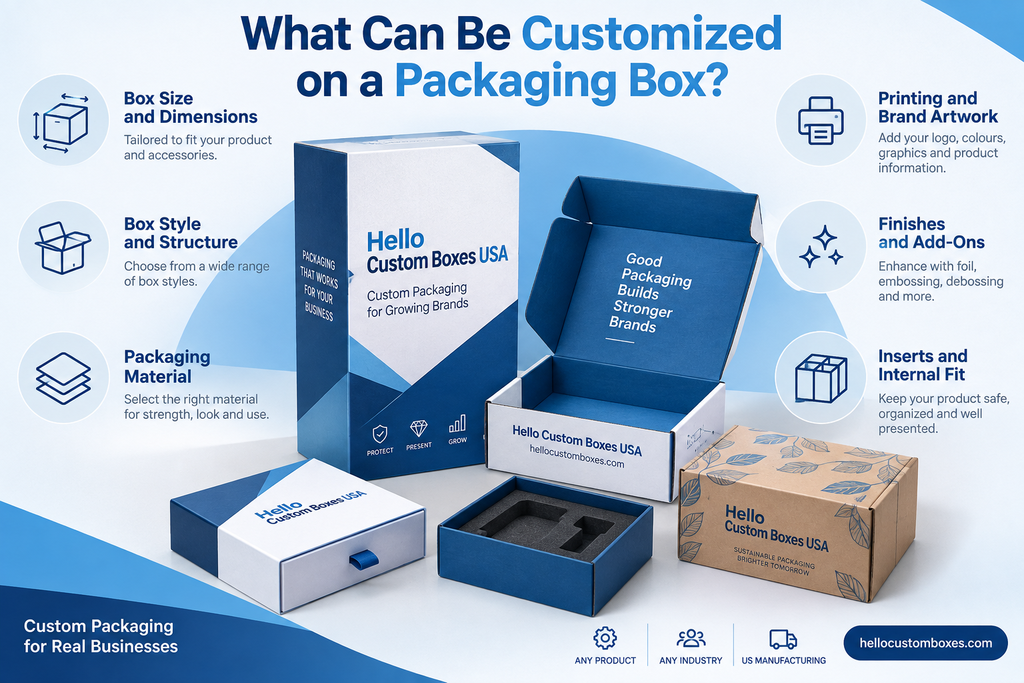
Box Size and Dimensions
The dimensions are usually one of the first decisions.
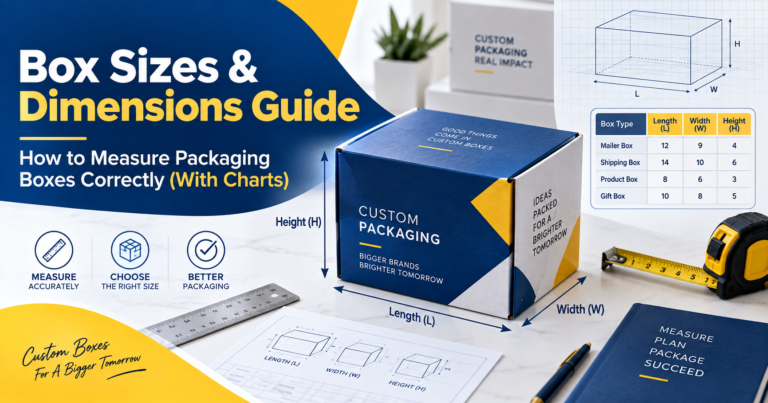
A well-sized custom packaging boxes should accommodate the finished product and any necessary inner components without creating excessive empty space.
Measurements should account for more than the product itself. Depending on the application, that may include an inner pouch, bottle cap, protective wrap, instruction booklet, accessory, or insert.
Designing around the complete packed product gives a more reliable fit than using nominal product dimensions alone.
Box Style and Structure
The structure determines how the box is assembled, opened, closed, displayed, and handled.
Depending on the product, businesses may consider folding cartons, mailer-style boxes, tuck-end structures, sleeves, two-piece boxes, corrugated shipping formats, or rigid presentation boxes.
The best style is not necessarily the most elaborate one. It is the structure that performs the required job without adding unnecessary complexity.
Packaging Material
Material selection affects rigidity, print appearance, weight, construction, and handling.
A lightweight retail product may have very different requirements from a heavy product being shipped through a parcel network.
This is why custom packaging materials should be selected after considering the product and distribution environment rather than based on appearance alone.
Printing and Brand Artwork
Printing turns the structural package into branded packaging.
A custom printed box can carry a logo, product name, colors, instructions, graphics, barcodes, and other required information.
Good artwork also establishes hierarchy. A customer should be able to identify the brand and product without having to sort through competing visual elements.
Finishes and Add-Ons
Finishes can be used to emphasize selected parts of the design or create a particular tactile or visual effect.
Options may include treatments such as foil, embossing, debossing, or selective surface effects, depending on the box material and production specification.
More finishing does not automatically make packaging more premium. One carefully chosen detail can have greater impact than several effects competing on the same panel.
Inserts and Internal Fit
An insert can hold a product in position, separate multiple items, organize accessories, or improve presentation when the box is opened.
It should have a functional reason for being included.
If the structure already holds the product securely, adding another component simply because “premium packaging needs an insert” may increase material and cost without solving a packaging problem.
What Materials Are Used for Custom Packaging Boxes?
There is no single material that is best for every custom box packaging project.
Paperboard
Paperboard is widely suited to folding retail cartons where a relatively lightweight structure, printable surface, and compact format are important.
It can work for products across cosmetics, food, personal care, electronics accessories, and other retail categories when the grade and construction suit the application.
Kraft Board
Kraft board is useful when its natural paper appearance complements the brand and the board specification provides the required performance.
Its visual character can become part of the design itself, reducing the need to cover every panel with heavy graphics.
Businesses interested in this direction can compare kraft packaging options based on the product and required structure.
Corrugated Board
Corrugated material uses fluting between liner layers to provide greater rigidity and cushioning than a typical lightweight folding carton.
It is commonly considered for mailers, larger boxes, heavier products, grouped items, and shipping applications.
The required board construction depends on factors such as product weight, box dimensions, stacking, and distribution conditions.
Rigid Board
Rigid boxes use substantially thicker board and are generally selected when presentation and structural feel are major parts of the packaging experience.
They can suit premium products, gift sets, and presentation-led packaging, particularly when paired with a fitted internal arrangement.
The higher-end appearance should still have a commercial reason. A rigid structure is unnecessary when a simpler carton already meets the product’s needs.
How Are Custom Packaging Boxes Made?
A useful custom packaging process starts before artwork.
The general sequence is:
1. Define the product.
Confirm its dimensions, weight, quantity per pack, fragile areas, accessories, and any inner packaging.
2. Establish the packaging role.
Determine whether the box is primarily for retail presentation, e-commerce, shipping, gifting, product organization, or a combination of functions.
3. Choose the structure and material.
Match the construction to the product and handling requirements.
4. Determine the internal fit.
Establish the box dimensions and decide whether an insert, divider, or other internal component is actually required.
5. Create the dieline and artwork.
The dieline defines the panels, cuts, folds, and print area. Artwork can then be positioned around the actual structure.
6. Select printing and finishes.
Choose options that suit the artwork, material, production quantity, and intended presentation.
7. Test before full production.
A physical sample or prototype can reveal fit, loading, closure, artwork, and handling issues that are difficult to judge from a flat design.
This order matters. Finalizing attractive artwork before the structure is settled can lead to unnecessary redesign when dimensions or panels change.
Why Do Businesses Use Custom Packaging?
The practical advantages depend on the product.
For one business, the biggest benefit may be eliminating excess room around a small retail item. For another, it may be creating enough internal organization for a product and several accessories.
Common reasons include:
- better product fit;
- clearer branding;
- more suitable retail presentation;
- improved organization of multiple components;
- dimensions suited to the actual product;
- consistent presentation across a product range;
- packaging designed around specific distribution requirements.
Brand recognition matters, but it should not replace packaging fundamentals.
A visually distinctive box that fits poorly or is difficult to load is still a poorly specified package.
How Does Custom Packaging Protect a Product?
Protection starts with understanding how the product can be damaged.
A fragile item may need movement control. A heavier product may require greater structural strength. Several components packed together may need separation.
Custom sizing can help by reducing uncontrolled empty space, while inserts or dividers can provide additional organization where necessary.
However, custom product packaging should not be assumed to provide every type of protection simply because it is made to order. Structural performance still depends on the material, construction, internal fit, product weight, and handling environment.
A box should be designed for the risks the product will realistically encounter.
Custom Packaging for Retail vs E-Commerce
Where the package will be used can change its specification.
Retail packaging has to work within a physical selling environment. Shelf dimensions, hanging requirements, product information, barcode placement, brand visibility, and customer handling can all matter.
Brands developing packaging designed for retail shelves should establish those requirements before finalizing the box structure.
E-commerce introduces different priorities. The branded product box may travel inside a separate shipping carton or mailer, where movement, compression, empty space, and parcel handling become relevant.
This creates an important distinction:
product packaging and shipping packaging do not always need to be the same box.
Trying to make one package perform every possible role can sometimes create a larger or more complicated structure than the product needs.
Does Custom Packaging Have to Be Expensive?
Not necessarily.
Cost is influenced by more than whether a box is “custom.” Dimensions, material, construction, print coverage, finishes, inserts, order quantity, and production complexity all affect the final specification.
A relatively simple custom-sized carton with clean printing may be more appropriate than a stock box filled with additional material to compensate for poor fit.
Likewise, adding several premium finishes and a complicated insert can increase cost without creating equivalent value.
A better question is:
Which custom features does this product actually need?
That keeps the packaging specification focused on useful decisions rather than customization for its own sake.
How to Choose the Right Custom Packaging
Start with the product rather than a box style you have seen elsewhere.
Confirm:
- finished product dimensions;
- packed weight;
- quantity per box;
- accessories or secondary components;
- protection requirements;
- retail or e-commerce use;
- desired opening method;
- printing requirements;
- required product information;
- realistic production budget.
Then determine the structure and material.
This approach also makes conversations with a packaging manufacturer more productive because decisions are based on measurable requirements rather than broad requests such as “make it look premium.”
Custom Packaging Checklist Before You Order
The more accurately these points are defined before production, the less guesswork is required later.
Start With the Product, Then Customize the Box
So, what is custom packaging? At its most useful, it is a packaging specification developed around a real product rather than forcing that product into the nearest available box.
Customization can involve dimensions, structure, material, internal fit, printing, and finishing. That does not mean every project needs every option. Good custom packaging uses only the features that help the product fit, function, travel, or present itself more effectively.
For U.S. businesses, Hello Custom Boxes develops custom packaging boxes around product requirements, branding, structure, materials, and printing.
The best place to begin is not with foil, colors, or a box style. Measure the product, define what the package needs to do, and build the specification from there.