You only notice it when something feels off
You open a shipment and the boxes look fine at first. Colors are sharp, branding is clear. Then you stack a few, move them around, and suddenly you see it, small scratches, dull patches, fingerprints that won’t go away.
That’s usually where coatings come into the conversation. Not during design, but after something goes wrong.
UV coating on packaging boxes isn’t about making things shiny for the sake of it. It’s more about how the surface holds up once the boxes leave the printer and start getting handled, stored, shipped, and opened.
TL;DR – Quick Answer
- • UV coating on packaging boxes is a liquid coating cured under UV light to create a hardened surface
- • Adds gloss, protection, and resistance to scratches and fingerprints
- • Commonly used on retail and cosmetic packaging
- • Works best on smooth cardboard surfaces, less effective on rough materials
- • Can be applied as full UV or spot UV for specific design areas
- • Often used when brands want both durability and visual sharpness
What is UV Coating on Packaging Boxes?
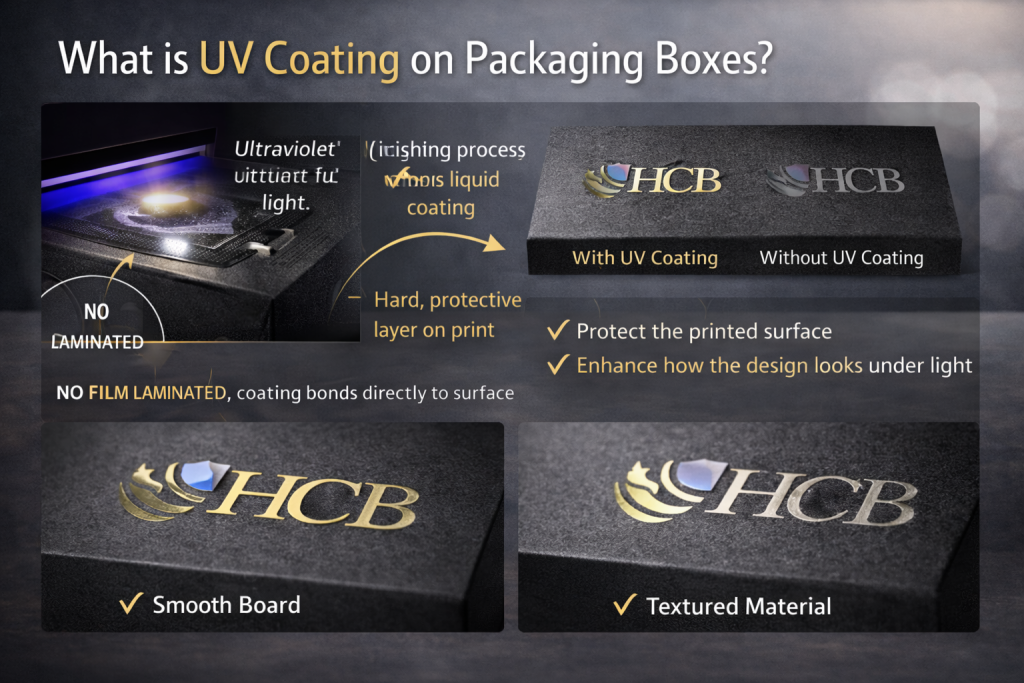
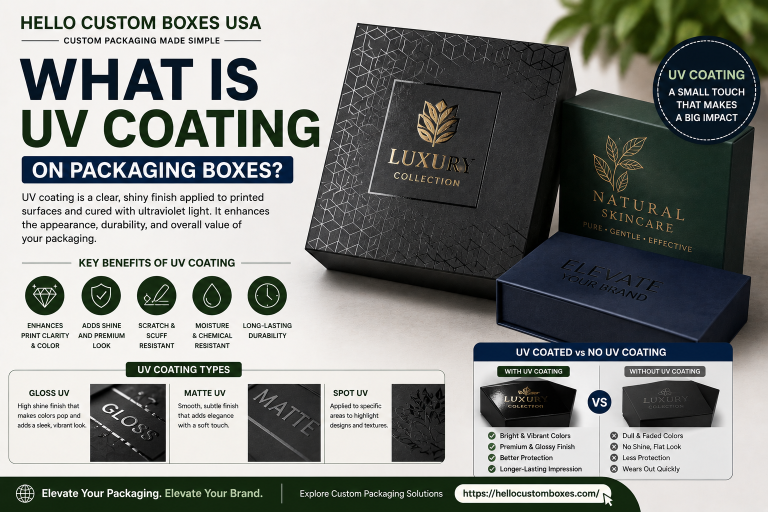
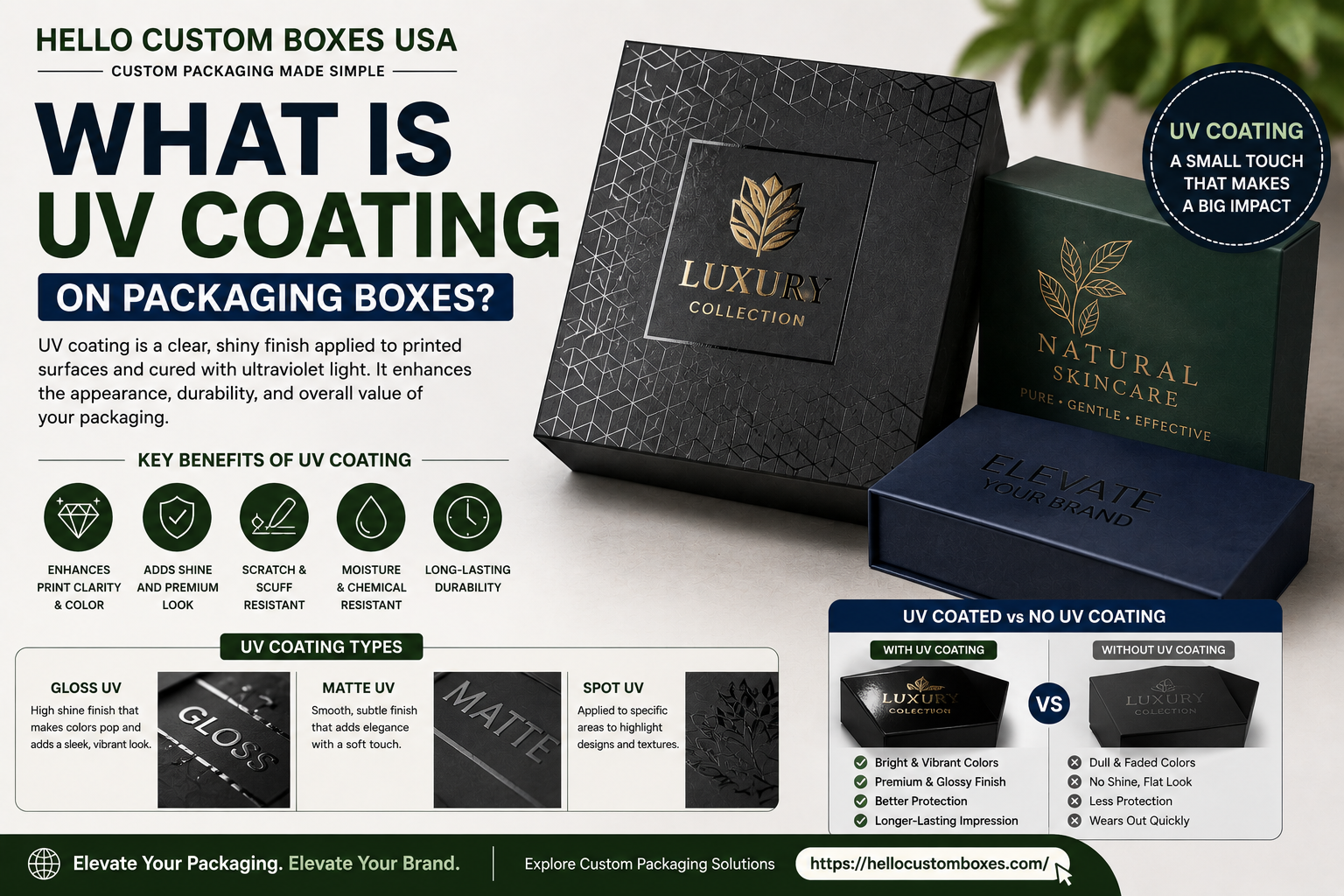
UV coating is a finishing process where a liquid coating is applied to printed packaging and then cured instantly using ultraviolet light. Once cured, it forms a hardened layer on top of the print.
It’s different from lamination. There’s no film being added. Instead, the coating bonds directly to the surface.
In UV coating printing, the goal is usually one of two things:
- Protect the printed surface
- Enhance how the design looks under light
You’ll often see it used on logos, images, or entire box panels depending on how the design is set up.
One thing worth noting, UV coating reacts differently depending on the material. On smooth boards, it looks sharp and reflective. On textured stock, it can lose some of that clarity.
Why UV Coating Matters for Packaging Boxes in the U.S.
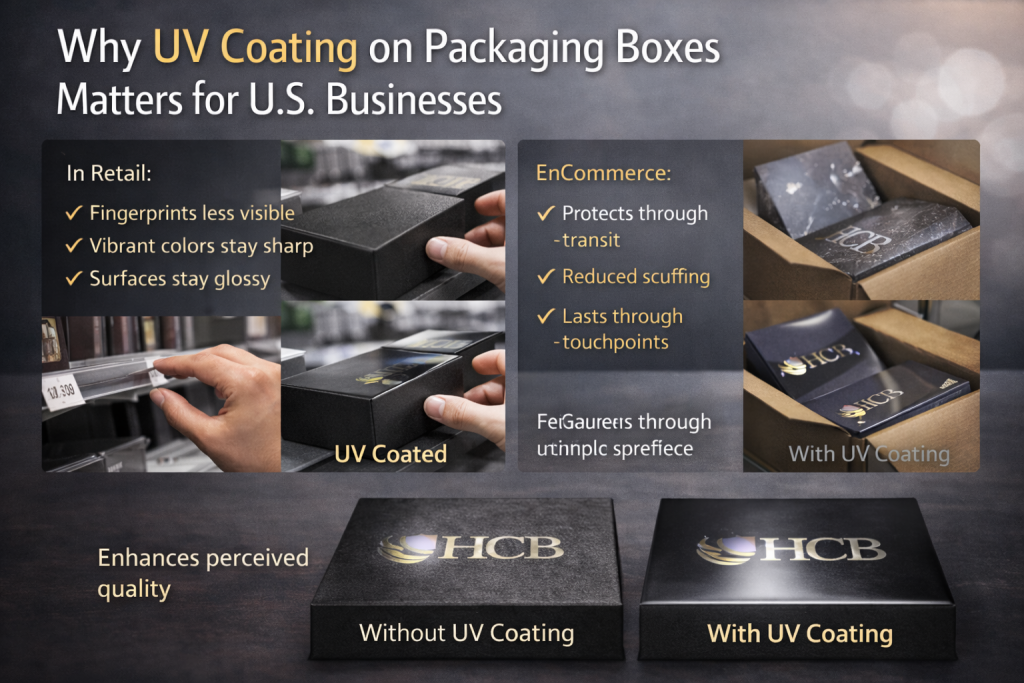
In real use, packaging doesn’t stay untouched. Boxes get stacked, slid across surfaces, packed tightly into cartons. That’s where finishes start to matter.
In retail, this usually shows up over time. Boxes stay looking cleaner on shelves. Fingerprints don’t stand out as much, and the colors don’t fade or dull as quickly.
For eCommerce, it’s more practical than visual. Packages go through multiple touchpoints. Without some kind of surface protection, printed areas can scuff before they even reach the customer.
There’s also perception. A box with a slight gloss finish often feels more refined, even if the structure hasn’t changed.
I’ve seen cases where brands didn’t change their design at all, just added UV coating, and the packaging suddenly looked more “finished.”
Types of UV Coating used on Boxes
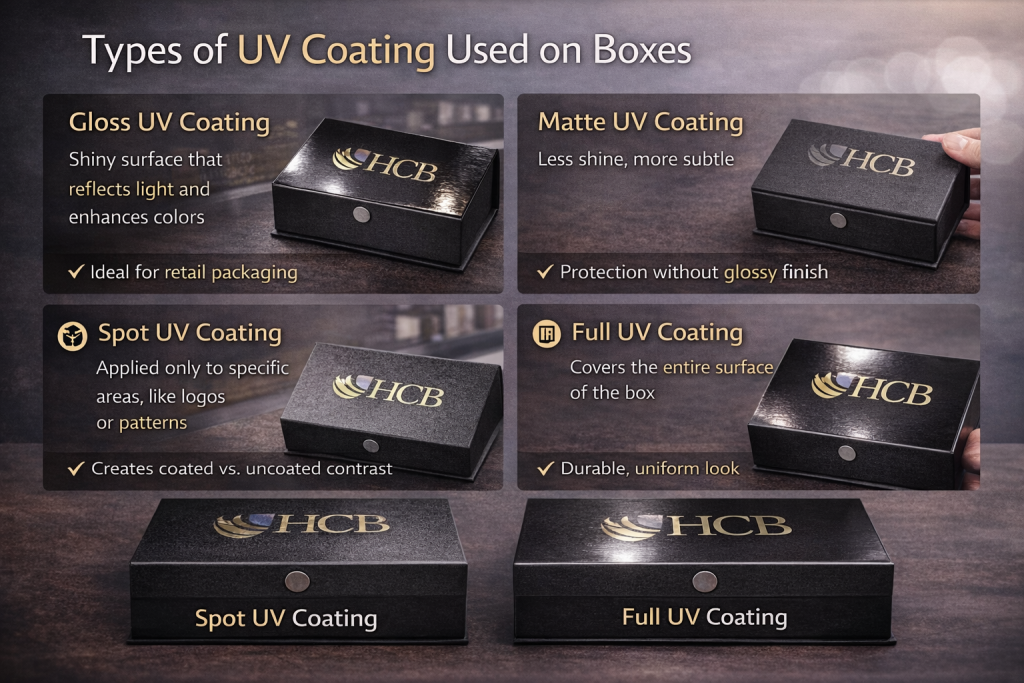
Gloss UV coating
This is the one you’ll see most often. It gives the surface a noticeable shine, so colors look a bit stronger. Usually used in retail packaging where the box needs to catch light on the shelf.
Matte UV coating
Less shine, more subtle. Used when brands want protection without a glossy finish.
Spot UV coating
Applied only to specific areas, like logos or patterns. This creates contrast between coated and uncoated surfaces.
Full UV coating
Covers the entire surface of the box. More uniform look, often used when durability is the priority.
Materials and Printing, What Actually Changes The Result
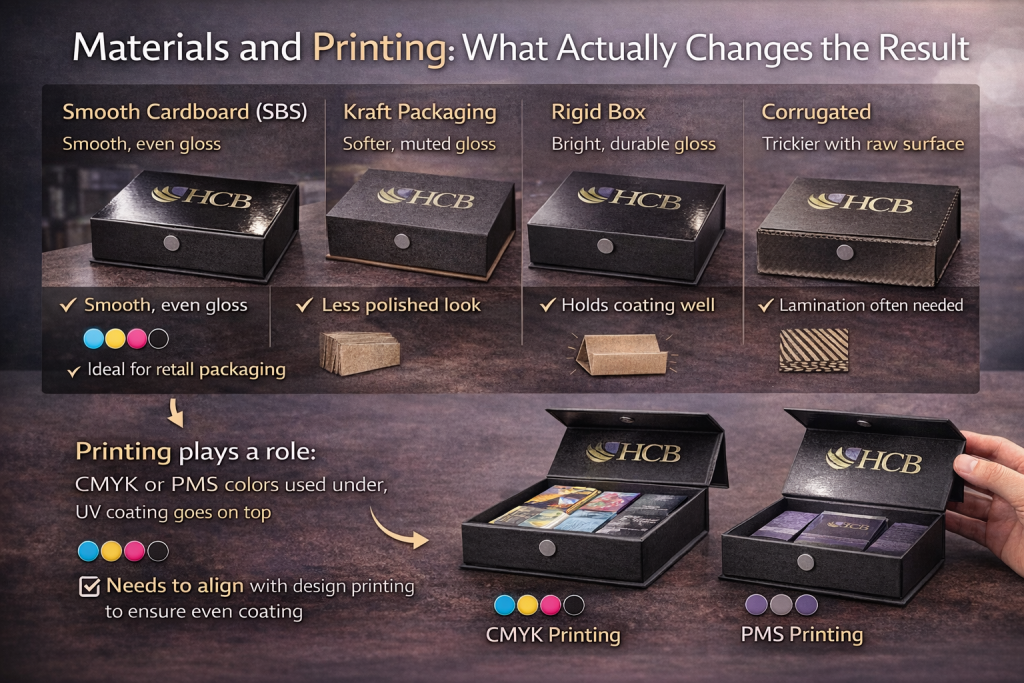
UV coating doesn’t behave the same across all materials.
On cardboard (SBS), the coating sits evenly. You get a smooth finish, and the gloss effect looks consistent across the surface.
With kraft packaging, things shift. The texture absorbs some of the coating, so the finish looks softer. Not as reflective. Some brands prefer that because it feels less polished.
On rigid structures, UV coating works well because the surface stays stable. No bending, no flexing, which helps the coating stay intact.
Corrugated material is trickier. Direct UV coating doesn’t always give clean results unless the surface is laminated first.
Printing plays a role too. Most packaging already uses CMYK or PMS colors, and UV coating is layered on top of that.
It’s not something added at the end without planning. It needs to align with how the design is printed, otherwise certain areas can look uneven once the coating is applied.
And in practice, this often overlaps with how UV coating for packaging is used alongside other finishes. The goal isn’t just shine, it’s making sure the surface behaves properly once the box is in use.
Where Things Tend to go Wrong with UV Coating
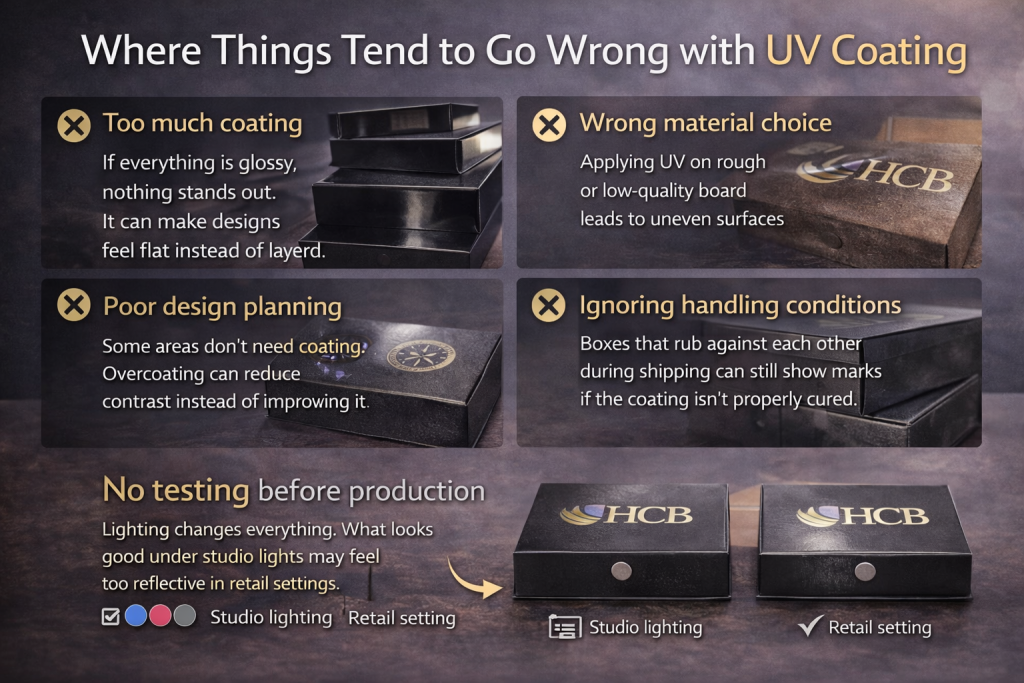
This part doesn’t get discussed much, but it shows up quickly in production.
Too much coating
If everything is glossy, nothing stands out. It can make designs feel flat instead of layered.
Wrong material choice
Applying UV on rough or low-quality board leads to uneven surfaces.
Poor design planning
Some areas don’t need coating. Overcoating can reduce contrast instead of improving it.
Ignoring handling conditions
Boxes that rub against each other during shipping can still show marks if the coating isn’t properly cured.
No testing before production
Lighting changes everything. What looks good under studio lights may feel too reflective in retail settings.
How Hello Custom Boxes Approaches This
At Hello Custom Boxes, UV coating isn’t treated as a last-minute add-on. It’s considered early, when structure, material, and print are being planned together.
Every box is built around your product’s actual size, layout, and structure, not from pre-made templates.
That makes a difference. Coating placement becomes intentional. Materials are chosen based on how they react to finishing, not just cost or availability.
Where UV coating is actually used
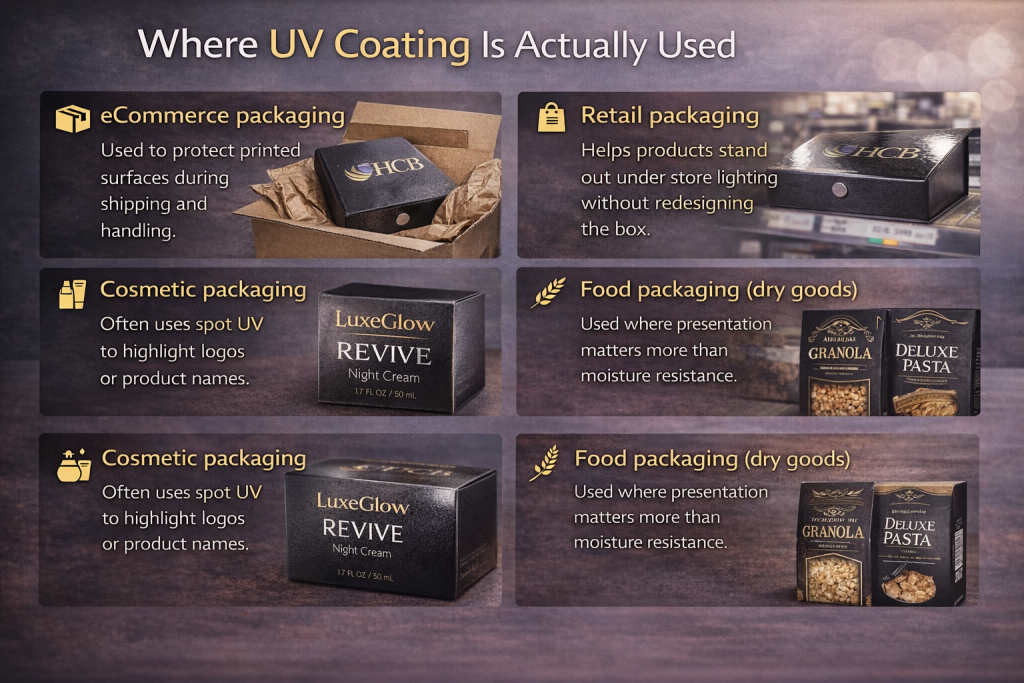
eCommerce packaging
Used to protect printed surfaces during shipping and handling.
Retail packaging
Helps products stand out under store lighting without redesigning the box.
Cosmetic packaging
Often uses spot UV to highlight logos or product names.
Food packaging (dry goods)
Used where presentation matters more than moisture resistance.
Practical tips from Real Packaging use
- Keep UV coating away from heavy fold lines
- Use spot UV instead of full coating for better contrast
- Test under real lighting, not just screens
- Don’t combine too many finishes in one design
- Check how the box behaves after stacking, not just printing
Thinking about using UV coating?
If your packaging looks fine but doesn’t hold up during handling, UV coating is usually worth considering.
Not always necessary. But in cases where print durability or surface finish matters, it solves a very specific problem.
Conclusion
UV coating on packaging boxes isn’t just about making things glossy. It’s about how the surface holds up, how the design looks over time, and how the packaging feels once it’s in use.
Used carefully, it adds both protection and presence without changing the structure.